



- when carrying out all work, maintain maximum cleanliness;
- before loosening any connections, it is necessary to thoroughly clean the surrounding surface;
- place all removed parts on a clean surface and cover if necessary;
- do not use lint-free cloths when working;
- remove new parts from packaging immediately before installation;
- use only original spare parts;
- do not pour the drained liquid back into the system.
To remove the steering control, you must perform the following operations:
- place the car in front on supports and turn the wheels away. It is important to ensure that the vehicle cannot jump off the supports. After removing the front wheels, you can place them behind and in front to support one of the rear wheels. Otherwise, place chocks under the rear wheels;
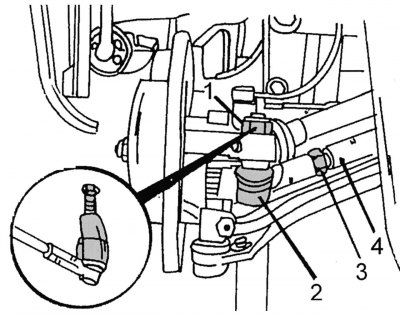
Figure 258. Connection of the steering rod to the steering knuckle arm: 1 - hex nut; 2 — steering rod end joint; 3 — lock nut; 4 - steering rod
- unscrew nut 1 (figure 258) and disconnect the hinge that secures the steering rod end to the steering knuckle using a special puller. The figure shows a suitable puller, which can be replaced with a universal one if necessary. Do the same on the other side. After loosening lock nut 3, unscrew the left end joint from rod 4. When unscrewing, count the number of revolutions (with an accuracy of half a turn). When installing, the joint should be screwed in by the same number of turns - this will maintain the wheel alignment angle setting;
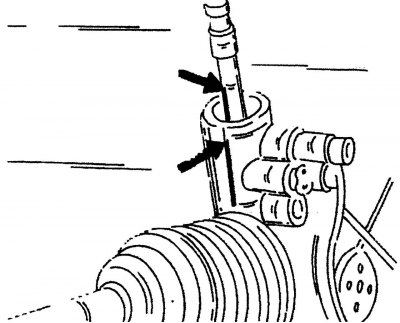
Figure 259. Marks indicating the central position of the steering wheels
- set the wheels straight. Securely fix the steering wheel in this position. Just in case, you should check that the marks on the steering gear and the steering gear housing match (figure 259);
- using a syringe, draw fluid from the power steering reservoir;
- disconnect both pipes from the steering gear: one of them is a hose (elastic) high pressure, the other is reverse. The installed sealing rings should be replaced. Pour the leaked liquid into a container or collect it with a rag. When assembling, tighten the high-pressure hose to a torque of 45–50 N·m, the return hose to a torque of 30–32 N·m;
- unscrew the bolt from the steering shaft cardan joint with a Torx head and remove the joint from the shaft;
- turn the steering gear away from the front axle. To do this, bend it forward and stretch it to the right.
Installation must be carried out in reverse order, taking into account the following:
- before installing the steering gear, turn its shaft all the way in one direction, then turn it all the way in the other direction, counting the number of revolutions. Now rotate the shaft again in the other direction by exactly half the number of revolutions obtained. When the center position is correct, the marks on the pinion and steering gear housing will coincide (see figure 259);
- insert the steering gear from the left side and turn it up;
- check again whether the steering gear is set to the middle position (the shaft gear could turn);
- install the steering gear into the mounting seats and tighten the bolts evenly crosswise with a torque of 55-60 N·m;
- install the cardan joint on the gear shaft so that the hole in the joint aligns with the round spline on the shaft. Screw in the fixing bolt and tighten it to 35 Nm. To do this, again use the special Torx head inserted into the torque wrench;
- screw the ends with joints onto the steering rods (to the previous position) and secure them to the steering knuckles. Tighten the nuts to a torque of 120-130 Nm;
- connect both pipes to the steering gear and tighten the high-pressure hose fasteners to a torque of 45–50 N·m, the return hose to a torque of 30–32 N·m;
- pour liquid into the system and bleed it (described below);
- lower the car and tighten the wheel bolts to 160-180 Nm;
- next, you should check that the wheels and steering wheel are straight. If this is not the case, unscrew the cardan joint again and move it to the required number of teeth in the desired direction. A shift of one tooth corresponds to 6° of steering wheel rotation;
- finally, check the system for leaks and the fluid level in the power steering reservoir.