



Intermediate shaft
In gearboxes for eight-cylinder engines up to number 544, a bearing with a flange on the outer ring was installed on the front end of the intermediate shaft. When removing the intermediate shaft, this bearing does not need to be removed from the shaft. Dismantling work is carried out in the following sequence:
Remove the intermediate shaft rear bearing with the groove on the outer ring.
Loosen the fastening nut on the rear end of the driven shaft.
Loosen the mounting nut on the drive shaft.
Remove the bearings from the drive and driven shafts.
Raise the drive and driven shafts and move the intermediate shaft back until the front bearing comes out of the hole in the gearbox housing.
Remove the drive shaft forward from the crankcase, taking into account the position of the fourth gear synchronizer ring and the needle bearing between the drive and driven shafts.
Place the third and fourth gear engagement clutch in the third gear engagement position.
Move the driven shaft to the right and remove it from the gearbox housing at an angle upwards (see fig. 187).
Similarly, remove the intermediate shaft together with the bearing from the gearbox housing. During repairs, the bearing with a flange on the outer ring can be replaced with a bearing with a groove on the outer ring, after which the drive shaft can be installed assembled with the bearing, as described above. The remaining assembly work is performed as described for gearboxes of later releases.
Synchronizer
On early gearboxes, cylindrical coil springs are installed in the synchronizers. The design of such a synchronizer is shown in Fig. 202. To disassemble, wrap the synchronizer sleeve in a rag and pull it out of the hub together with the leashes. Check the wear of all parts. When assembling, install the springs and leashes in the synchronizer hub and push the synchronizer sleeve on.
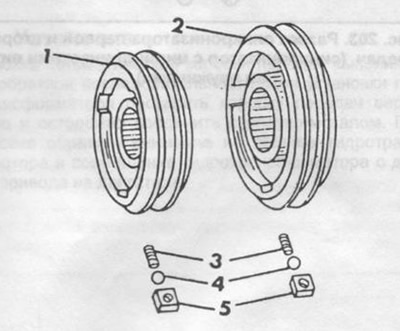
Fig. 202. Parts of a synchronizer with cylindrical coil springs.
1 - 3/4 gear synchronizer,
2 - 1/2 gear synchronizer,
3 - spring,
4 - ball,
5 - leash.
If you press the link (5) in Fig. 202 from the front, the ball will move and return to its original position. For distinction, the links of the 1/2 gear synchronizer are chamfered. When installing the links, the chamfer should be directed towards the second gear.
The 1/2 gear synchronizer must be assembled so that the narrow part of the hub and the flange on the synchronizer sleeve (arrows in Fig. 203) were turned to first gear.
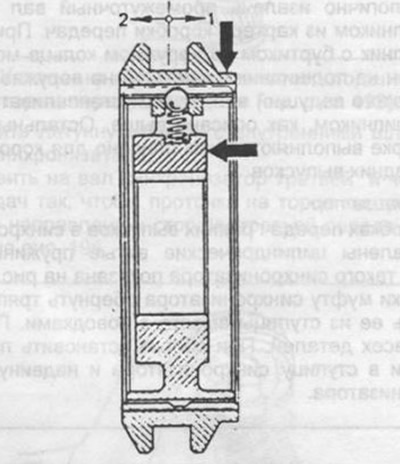
Fig. 203. Section of the synchronizer of the first and second gears, (synchronizer with cylindrical coil springs).
The 3/4 gear synchronizer must be assembled so that the wide part of the hub and the groove on the synchronizer sleeve (arrows in Fig. 204) were on the same side.
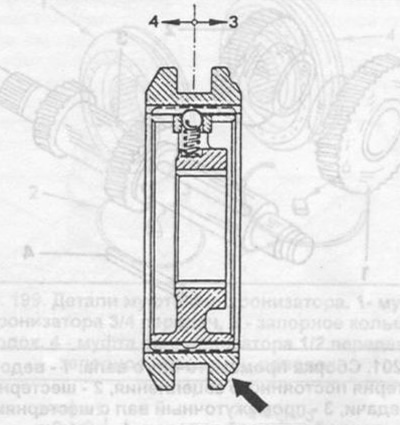
Fig. 204. Section of the synchronizer of the third and fourth gears (synchronizer with cylindrical coil springs).
Checking the level and changing the oil in a manual transmission
(Publication taken from an online resource MercedesMAN)
To check the oil level, unscrew the plug on the side of the gearbox and put your index finger in the hole. If the tip of your finger touches the surface of the oil, the level is normal.
The oil change is performed on a warm gearbox (but not hot). Unscrew the plug on the bottom of the gearbox, place a container underneath and drain the oil.