



| Type and designation of manual transmission | |
| Models 163.136 | (ML 230) 6-speed, 716.644 (SG-S370/6.1) |
| Models 163.113 | (ML 270 CDI) 5-speed, 717.461 (GL_7b/29_B_5) |
| Type and volume of transmission oil | See Specifications for Chapter Routine care and maintenance |
| Gear ratios | |
Manual transmission 716.644 | |
| 5.01 |
| 2.83 |
| 1.78 |
| 1.25 |
| 1.00 |
| 0.82 |
| 4.56 |
| Data not provided |
| Tightening force of threaded connections, Nm | |
| Manual transmission 716.644 | |
| Bolts for fastening the manual transmission to the engine | 40 |
| Drain plug of the oil pan of the manual transmission | 60 |
| Filler plug | 50 |
| Nuts/bolts for fastening the rear cross member of the power unit to the body | 40 |
| Nut/bolt for fastening the rear cushion of the powertrain suspension support to the transmission | 40 |
| Self-locking bolts securing the front camshaft to the transfer case output shaft | 40 |
| Manual transmission 717.461 | |
| Shift Rod Threaded Pin | 12 |
| Bolts for fastening the manual transmission to the engine | |
| Transmission to engine mounting bolts | |
M10x40 | |
| 55 |
| 40 |
| M10x90 | |
| 45 |
| 40 |
| Bolts for fastening the adapter housing to the gearbox housing | 20 |
Due to the energy released during combustion of the air-fuel mixture in the cylinders, the crankshaft of the engine develops torque, while its rotation speed is within a fairly narrow range. Most modern OHV engines develop their maximum torque at about 2500 rpm. As the engine speed increases to 4500 rpm, its torque value decreases so much that further increase in power is no longer possible. Overhead camshaft (OHC) engines are capable of developing significantly greater torque, but in a much narrower range of rotation speeds.
The use of such a component as a gearbox in the transmission line allows you to regulate the relationship between engine speed and the speed of rotation of the vehicle's drive wheels, ensuring a sufficiently high efficiency of the power unit in almost any vehicle operating conditions.
Smooth transmission of torque from the crankshaft to the primary shaft of the manual gearbox (MT) is ensured by the clutch assembly, the design and operating principle of which are discussed in Chapter Transmission line of this Manual. Sequential gear shifting during changes in vehicle speed is ensured by using a multi-stage gearbox in the gearbox. The gear ratios of each of the five/six stages of the manual transmission ensure maximum efficiency in transmitting the engine power to the vehicle's drive wheels at various speeds.
On two of the Mercedes-Benz M-Class all-wheel drive models covered in this Manual, in addition to automatic transmissions (see Chapter Automatic transmission) manual transmissions (RCPP) of one of two types can be used: 717.461 (ML 230) and 716.644 (ML 270 CDI). Both boxes are of the standard design used on most Mercedes cars with classic rear-wheel drive (series 717.4 and 716.6).
The torque developed by the engine, converted in the gearbox of the manual transmission, is removed from the rear end of the main shaft and transmitted to the input shaft of the transfer case, which then distributes it between the front and rear drive axles of the vehicle. Detailed information on the design and operating principle of the transfer case is given in Chapter Transmission line of this Guide.
Both gearboxes provide synchronisation of all five (717.4)/six (716.6) gear shift stages of all forward gears.
It makes sense to pay a little attention to the operating features of more modern six-speed manual transmissions.
The 716.6 series gearboxes belong to the class of fully synchronized 2-shaft 6-speed gearboxes with one reverse gear, which are widely used in both rear-wheel drive and all-wheel drive vehicles equipped with both gasoline and diesel engines.
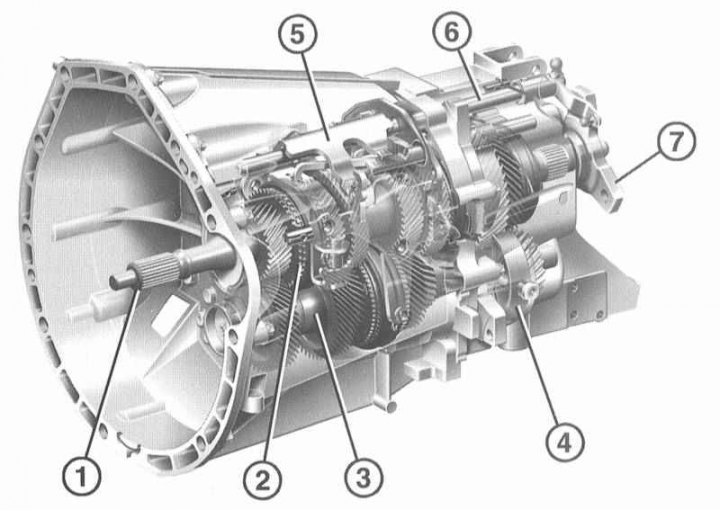
General view of the 716.6 manual transmission
1 - Primary shaft of the gearbox; 2 - Synchronizing ring 5/6 gears; 3 - Shaft; 4 - Reverse bearing shell; 5 - Shift cam; 6 - Switching axis; 7 - Flange connecting to the cardan shaft
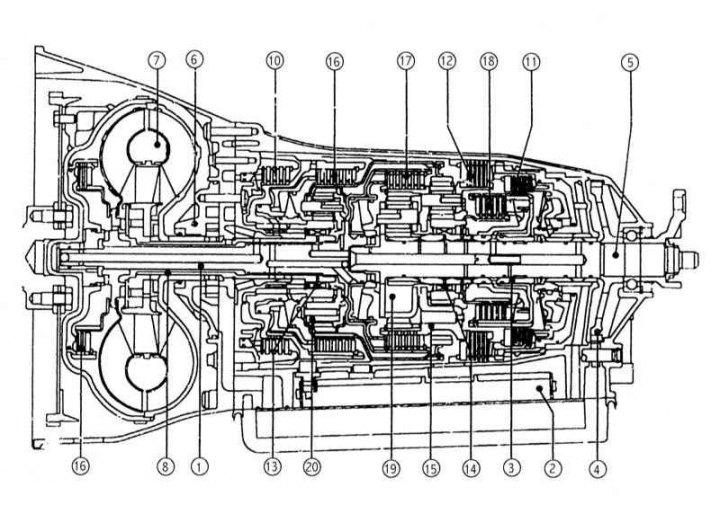
Design of manual transmission 7.6.6
1 - Input shaft; 2 - Main shaft; 3 - Intermediate shaft; 4 - Front crankcase; 5 - Rear crankcase; 6 - Clutch release device; 7 - Multi-cone synchronizer 1/2 shift; 8 - Multi-cone synchronizer 3/4 shift; 9 - 1st gear pinion; 10 - 2nd gear pinion; 11 - 3rd gear pinion; 12 - 4th gear pinion; 13 - 5th gear pinion; 14 - 6th gear pinion; 15 - Reverse gear; 16 - Central shift rod; 17 - Internal switching module; 18 - Reverse intermediate gear
Proper use of the 6th gear allows you to achieve significant savings in fuel consumption by reducing engine speed. Due to their design features, 6-speed transmissions carry more weight than 5-speed transmissions.
The gearbox receives torque from the engine via a conventional dry clutch equipped with an automatic wear compensator. The gearbox housing has a sealed design and is filled with transmission oil that does not require replacement.
The precision and ease of short-stroke shifting is achieved by the following design features:
- Use of a rod-cable shift drive with a central rod secured in needle bearings;
- Using multi-cone synchronizers for shifting 1st, 2nd, 3rd and 4th gears;
- Fully synchronized reverse gear.
The gearbox assemblies with shafts are placed between two bearing planes. The third bearing plane used in earlier 5-speed boxes is eliminated in this design.
The two-section split crankcase is made of light alloy and sealed with a special liquid compound.
The input shaft (1) is fixed in the flywheel by means of a guide bearing, and in the transmission housing by means of a ball bearing with a deep groove. The main (2) and input (1) shafts are connected to each other in the common plane of the transmission housing and are fixed by means of ball bearings with a deep groove (see ibid).
The intermediate shaft (3) has a lightweight hollow design and is secured in a roller clutch and a ball bearing with a deep groove.
Due to the minimal manufacturing tolerances of the half-crankcases and gears, as well as the use of roller clutches, there is no need to adjust the axial clearances of the shafts.
The movements of the gearshift lever are transmitted via rods to the gearbox. The manual transmission can be removed separately from the engine; removal is necessary when servicing the clutch, as well as in the event of the need to perform restoration repairs/replacement of the manual transmission itself.
Due to the complexity of the design of the manual transmission, the lack of commercially available replacement internal components and the need to use special equipment, the authors of this Guide do not recommend that car owners perform major repairs to the gearbox on their own. Repairing the gearbox in a car service workshop is a fairly expensive operation, so you should consider alternative options for replacing the failed unit with a new or refurbished one. Any useful information on repairing and replacing the transmission can be obtained at Mercedes-Benz service stations. Regardless of the chosen method of troubleshooting (repair or replacement), independent dismantling of the box from the car will significantly reduce material costs.
This Part of the Chapter offers the reader descriptions of the processes for performing such procedures, which are within the skill level of the average amateur mechanic, as general adjustment of the gear shift drive and removal/installation of the manual transmission assembly. Tips for controlling manual transmission shifting are presented in Chapter Controls and safe operating techniques.
Information on automatic transmissions (AT) is presented in Chapter Automatic transmission.