
Cars BMW Cars Volkswagen Cars Chevrolet Cars Land Rover Cars Lada Cars Honda Cars Peugeot
English Русский
Български
Беларускі
Український
Српски
Hrvatski
Română
Polski
Slovenský
Magyar
Bookmark News and articles Sitemap Feedback Site search
MercedesMan.ru


A-Class C-Class E-Class G-Class M-Class S-Class Others
W116 (1972-1980, petrol) W126 (1979-1991, petrol) W140 (1991-1998) W220 (1998-2005)
  • Main
  • S-Class
  • W116 (1972-1980)
  • Power unit
  • 6-cylinder I6 engine
  • Measuring cylinders, checking pistons and connecting rods

Measuring cylinders, checking pistons and connecting rods (Mercedes-Benz S-Class W116)

0
Contents: Checking pistons and connecting rods ↡ Measuring clearances in connecting…↡
All cylinder measurements for eight-cylinder engines apply equally to six-cylinder engines. The measurement diagram is shown in Fig. 28.

If deviations from the table data are noted in at least one cylinder, it is necessary to bore all cylinders. The permissible deviation from the nominal value is no more than 0.05 mm. Pistons of two larger sizes are available for sale (by 0.5 mm and 1 mm). To determine the cylinder size, it is necessary to determine the piston diameter, which is measured along the belt located 10 mm above the lower edge of the piston skirt, to this size it is necessary to add the value of 0.02... 0.03 mm of the gap between the cylinder and the piston. In addition, it is necessary to take into account an allowance of 0.05 mm for uneven processing along the height of the cylinder. Determine the gap between the piston and the cylinder based on the results of the above measurements. If the measurement result exceeds 0.08 mm, the cylinder must be bored, since its dimensions are at the limit of permissible wear.

Checking pistons and connecting rods


Inspect all parts; if there are nicks, scratches or wear, the parts must be replaced.

Use a feeler gauge to measure the gaps between the piston rings and the corresponding piston grooves, as shown in Fig. 66. Compare the results with the data in the tables. Increased gaps indicate wear of either the piston ring or the piston.
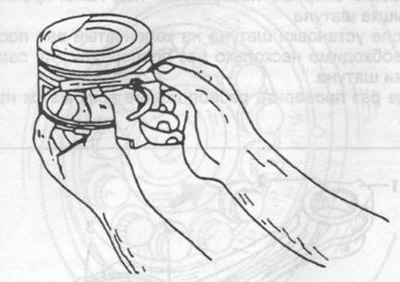


Fig. 66. Measuring the gap between the piston rings and the grooves in the piston. Clean the…

Fig. 66. Measuring the gap between the piston rings and the grooves in the piston. Clean the grooves thoroughly.


Install the ring in the lower cylinder belt at a distance of 20 mm from the lower edge and measure the gap in the piston ring lock with a feeler gauge ("A" Fig. 67). Compare the size with the data in the tables.
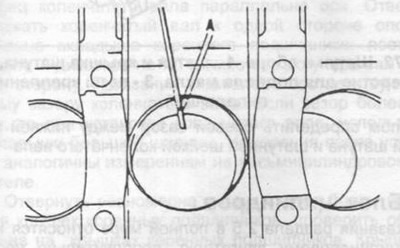
Fig. 67. Measuring the gap in the piston ring lock (A) in the lower belt of the cylinder.

Fig. 67. Measuring the gap in the piston ring lock (A) in the lower belt of the cylinder.


With a small gap (for example, when using new rings, which also need to be measured) it can be brought to the required size by filing the ends of the lock. To do this, clamp the file in a vice and move the ends of the lock along the surface of the file (see fig. 68). If the gap is increased, the ring must be replaced.
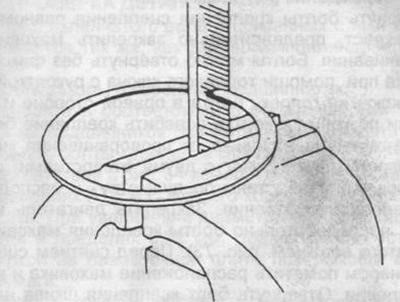


Fig. 68. Increasing the gap in the ring lock.

Fig. 68. Increasing the gap in the ring lock.


Check the piston pins and connecting rod top heads for wear and damage. If one of the connecting rods is defective, it can be replaced separately.

A connecting rod that has experienced head overheating (blue coating), is not suitable for further use. The bushing of the upper head of the new connecting rod is deployed. When reusing the connecting rod cap fastening bolts, it is necessary to measure the diameter of the bolt in the narrow part with a caliper (see fig. 29). If the dimension is less than 8.0 mm, the bolt must be replaced as described below. Before replacement, one more check must be performed. Place the connecting rod lower head cover on the mounting bolt and rotate it 180° relative to the connecting rod, as shown in Fig. 30. Place the connecting rod and cover horizontally. If the cover falls down under its own weight, the bolt must be replaced. To replace the bolts, do the following:

Press out the old bolts from the lower connecting rod head.

Place the connecting rod with the split surface on a steel plate with a hole larger than the diameter of the bolt and press in new mounting bolts one by one.


Using a device, check the connecting rod for twisting and bending.

Place the cover on the connecting rod and tighten the fastening nuts to a torque of 40...50 Nm. From this position, turn the nuts another quarter turn.

Place the connecting rod assembly in a vice and measure the diameter of the lower head with a bore gauge, as shown in Fig. 31. If the size exceeds 51.62 mm or the hole is found to be out of round, the surface of the connecting rod cap can be lapped on a marking plate; the layer of metal removed should not exceed 0.02 mm.

If the bushing in the upper connecting rod head is damaged or changes in size, it can be pressed out and a new bushing can be pressed in. The bushing is expanded to a size of 23.007...23.013 mm, which ensures the required clearance between the pin and the upper connecting rod head.

Measuring clearances in connecting rod bearings


These works are carried out together with the main bearings (section 3.6.2).
This article is available at: russian, bulgarian, belarusian, ukrainian, serbian, croatian, romanian, polish, slovak, hungarian
The article has been verified: Panova Maya Vladimirovna
Share with friends:
◀ Previous
S-Class W116 / 6-cylinder I6 engine
Next ▶

Pistons and connecting rods — removal
Cylinder head repair
Disassembling the cylinder head
Removal the cylinder head
Disassembly and assembly of the engine
Assembly of pistons and connecting rods
Installing pistons and connecting rods
Cylinder block
Removal the crankshaft
Crankshaft and flywheel: checking the parts
More similar articles for repairing other models

☛ Checking the engine oil level using a dipstick Mercedes W168 (1997-2004)
☛ Pistons and connecting rods — installation and checking clearance in… Mercedes 190 (W201) (1982-1993)
☛ Removal connecting rods and pistons Mercedes W123 (1976-1985)
☛ Checking compression pressure, assessing the condition of the… Mercedes W463 (1999-2019)
☛ Checking the compression pressure in the cylinders Mercedes W163 (1997-2005)
☛ Checking pistons and connecting rods Mercedes Sprinter (1995-2000, diesel)
Link in different formats to this article
Comments and feedback from visitors
No comments yet


How much will 38 + 22 ?


W220 (1998-2005) 
  • General information
  • Introduction to guide
  • User manual
  • Maintenance
  • Power unit
  • Engine repair
  • Cooling and heating systems
  • Power and exhaust systems
  • Ignition and control system
  • Charge and launch systems
  • Transmission
  • Automatic gearbox
  • Drive shafts
  • Chassis
  • Brake system
  • Front suspension
  • Rear suspension
  • Steering
  • Body
  • Body elements
  • Electrical equipment
  • Equipment and devices
  • Electrical circuits
W140 (1991-1998) 
  • User manual
  • Controls and instruments
  • Driving and operation
  • Maintenance
  • Power unit
  • Petrol engine V6
  • Petrol engine V8
  • Petrol engine V12
  • Diesel engine OM603
  • Diesel engine OM606
  • Cooling system
  • Power supply and injection system
  • Control system HFM-SFI
  • Control system LH-SFI
  • Control systems ME-SFI
  • Diesel control system
  • Ignition system
  • Charge and launch system
  • Transmission
  • Mechanical gearbox 717.438
  • Mechanical gearbox 717.454
  • Automatic gearbox 722.5
  • Automatic gearbox 722.6
  • Clutch and drive shafts
  • Differential
  • Chassis
  • Brake system
  • Steering
  • Front suspension
  • Rear suspension
  • Body
  • Exterior (external elements)
  • Interior (internal elements)
  • Electrical equipment
  • Equipment and devices
  • Electrical circuits
W126 (1979-1991, petrol) 
  • Power unit
  • Engine repair
  • Ignition system
  • Lubrication system
  • Cooling system
  • Fuel system
  • Fuel injection system
  • Transmission
  • Clutch and cardan
  • Mechanical gearbox
  • Automatic gearbox
  • Chassis
  • Front suspension
  • Rear suspension
  • Steering
  • Brake system
  • Electrical equipment
  • Power devices
  • Electrical circuits
W116 (1972-1980, petrol) 
  • General information
  • Introduction to guide
  • Power unit
  • 8-cylinder V8 engine
  • 6-cylinder I6 engine
  • Cooling and lubrication system
  • Power system (carburetor)
  • Fuel injection system
  • Ignition system
  • Transmission
  • Clutch and cardan
  • Car gearbox
  • Chassis
  • Front suspension
  • Rear suspension
  • Steering
  • Brake system
  • Electrical equipment
  • Power devices
  • Electrical circuits
 
MercedesMan.ru © 2017–2026 · Mobile version · Read about Mercedes · Sitemap: EN BG BY UA RS HR RO PL SK HU · Feedback · Site search · Bookmark A-Class (W168) · C-Class (W201) · C-Class (W202) · C-Class (W203) · E-Class (W123) · E-Class (W124) · E-Class (W210) · G-Class (W463) · M-Class (W163) · S-Class (W116, petrol) · S-Class (W126, petrol) · S-Class (W140) · S-Class (W220) · Sprinter · Vito 1 · Vito 2 · Vario 814D ·
 
We only use cookies without which some of the site's features may not be available.