



Attention! Each time a connecting flange is removed, the resistance to rotation of the corresponding axle assembly (without wheels) must be measured - the brakes must be released.
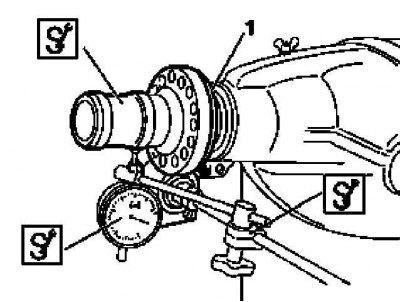
Checking the concentricity of the seat of the connecting flange (1) of the main gear drive pinion
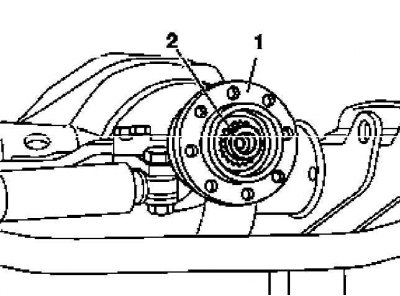
Mounting flange installation details
1 - Connecting flange
2 - Flanged nut
1. Disconnect the cardan shaft from the flange (1), move it to the side and tie it with wire to the car frame - the procedure is similar to that described in Section Disconnecting and connecting cardan shafts on the transfer case for transfer case connecting flanges.
2. The test is carried out using a dial gauge plunger type (DTI) and a special adapter flange (460 589 01 23 00).
3. Connect the adapter flange to the connecting flange (1).
4. Fasten the measuring frame to the axle housing so that its plunger is pressed against the measuring surface of the front journal of the adapter flange.
5. Zero the instrument and make the required measurement by turning the main gear one full revolution. Compare the measurement result with the requirements Specifications.
Front axle
If play is detected in the front axle final drive flange, replace the flange.
Attention! To avoid damaging the bearings, do not knock off the flange with a hammer under any circumstances - if necessary, use a special puller (460 589 02 33 00)! The flange nut must be replaced without fail!
Rear axle
1. If the rear axle flange play exceeds the maximum permissible value, unlock and loosen the flange nut (2) and remove the flange, after marking the position of the nut and flange relative to the pinion shank.
Attention! To avoid damaging the bearings, do not knock off the flange with a hammer under any circumstances - if necessary, use a special puller (460 589 02 33 00)!
2. Assess the condition of the flange and replace it if necessary.
3. If there is no need to replace due to damage, turn the flange 180° clockwise, install it in place, and repeat the check. Then, if necessary, the flange can be turned two more times (by 90° and again by 180°). If the required result cannot be achieved by turning the flange, replace it.
4. Make sure that the flange nut (in case of refusal to replace it) was tightened until the landing marks applied during dismantling were aligned.
Both bridges
1. Reconnect the driveshaft and secure it with NEW self-locking nuts, tightening them to the required torque.