



Contents: Valve springs ↡ Valve guide bushings ↡ Valve seats ↡ Valves ↡ Cylinder head ↡ Camshaft and camshaft housing ↡ Cylinder head assembly ↡
Check the wear of all cylinder head parts. Carefully clean the mating surfaces of the cylinder head from gasket residues.
Valve springs
All instructions for the eight-cylinder engine apply equally to the six-cylinder engine.
Valve guide bushings
Clean the guide bushings by pulling a rag soaked in gasoline through the hole. Clean the outer parts of the guide bushings with a wire brush clamped in the chuck of an electric drill.
Check the valve guide bushings for wear using a gauge. If the non-going side of the gauge enters the guide bushing hole, the valve guide bushing must be replaced.
The valve guide is pressed out using a mandrel. It is possible to install a valve guide of nominal size 1, which is pressed into the cylinder head using a mandrel until the installation ring stops against the end surface of the head. It is possible to install a valve guide of a repair size, the hole is then processed with a hand reamer. Before installation, it is recommended to cool the new guide in dry ice, it is advisable to perform this operation in a specialized workshop.
Before replacing the valve guide, check the general condition of the cylinder head. After pressing in the valve guide, the hole should be reamed to 9.000...9.015 mm for intake valves or 11.00...11.018 mm for exhaust valves. The intake valve guide is longer.
When replacing the valve guide, it is necessary to install a new valve and additionally process the valve seat.
After replacing the valve guide, the valve seat must be countersunk. If the valve seat can no longer be machined, do not replace the valve guide.
Valve seats
If the camshaft bearings are worn out, it is possible to install bushings of a repair size (the camshaft journals are ground) or installing a new cylinder head.
Check the valve seat working surfaces for wear or damage. Minor wear can be eliminated by countersinking at an angle of 45°. If such repair is no longer possible, the valve seat must be replaced.
The valve seats are pressed into the cylinder head and, to remove the old rings, they are drilled out using a special tool, without damaging the cylinder head. Then the size of the hole "D1" is checked (Fig. 62) and, if necessary, processed to the next repair size. The valve seat of the repair size should provide an interference fit of 0.074...0.1 mm.
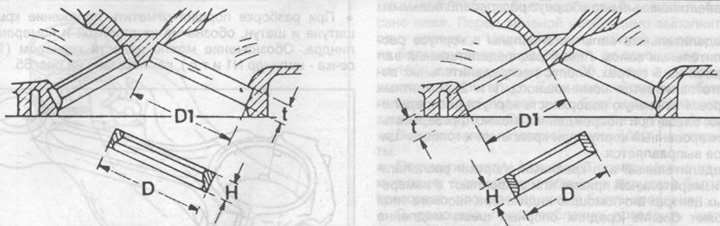
Fig. 62. Measuring the mounting hole for the seats of the intake and exhaust valves in the cylinder head. On the left for the intake valve, on the right for the exhaust valve.
Heat the cylinder head in a water bath to 90°C and cool the valve seat with dry ice, then use a mandrel to press the valve seat into the cylinder head.
Machine the valve seat using a drill or grinder. Install the valve and determine the dimension "A" shown in Fig. 63. Dimension "A" can be reduced after machining the mating surface of the cylinder head.
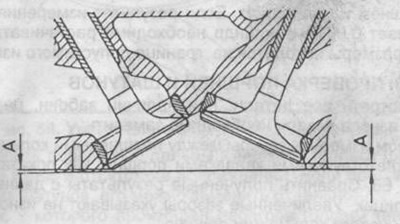
Fig. 63. Minimum distance between the valve plate and the split surface of the cylinder head.
After machining, measure the width of the working chamfer of the valve seat. If the size of the chamfer of the inlet valve seat does not correspond to the dimensions in the tables, it is necessary to bring it to the required values by countersinking from above with a countersink at an angle of 15° and from below with a countersink at an angle of 60°.
(Read more on the website MercedesMAN.ru)
Then it is necessary to grind the working chamfers of the valve seat and the valve using lapping paste. Apply the paste to the working chamfer of the valve seat and install the valve, using a suction cup, rotate the valve in two directions, pressing it against the surface of the seat.
After lapping, clean the parts from dirt and lapping paste residue and check the working chamfers of the valve seat and valve. On both parts, a continuous matte ring corresponding to the width of the working chamfer of the valve seat should be clearly visible. Apply a strip to the working chamfer of the valve with a lead rod, then carefully insert the valve into the guide sleeve and, pressing it against the valve seat, turn the valve 90°.
Remove the valve from the guide bushing and check the working chamfer of the valve seat. If the traces of the lead rod are evenly distributed over the entire surface of the working chamfer, this means that the lapping has been performed correctly and the cylinder head is suitable for further use. If there are any breaks, repeat the lapping or use a new cylinder head.
Valves
All information on the valves of the eight-cylinder engine given above applies equally to six-cylinder engines. The end of the valve stem is marked and valves with the same marking can be installed.
Check the valves for compliance with the data given in the tables of dimensions and adjustment data, and replace any valves that do not comply with these data.
When replacing exhaust valves, pay attention to safety precautions when disposing of valves.
When ordering, always indicate the year of manufacture and engine number.
Cylinder head
The instructions given for eight-cylinder engines also apply to six-cylinder engines. The mating surfaces of the cylinder head can be milled and then brought to dimension "A" (see fig. 63) to the required value.
Camshaft and camshaft housing
The camshafts are installed in the camshaft housing. The left camshaft rotates on 5 supports. The camshaft housing is manufactured in nominal, 1 and 2 repair sizes. The split surface of the camshaft housing can be milled if damaged. A deformed housing is straightened when fastened to the cylinder head.
The camshaft is placed with its outer supports on a measuring prism or secured in measuring centers and the runout of the middle bearing journals is checked using a dial indicator, slowly rotating the camshaft. If the runout exceeds 0.01 mm, the shaft is rejected and must be replaced.
Cylinder head assembly
The cylinder head assembly is performed in the reverse order of disassembly. Valves should be installed only in accordance with the markings on the cardboard tags. Oil-deflecting caps should be installed only using a special mandrel and their size should correspond to the diameter of the valve stem.
The installation of camshafts and camshaft housings is described in the relevant sections.