



Place the car hood in a vertical position as when removing the engine.
Disconnect the wires from the battery.
Drain the coolant from the cooling system (section 5.1).
Remove the air filter.
In cars with adjustable wheel suspension, unscrew the four bolts securing the hydraulic suspension pump, remove the pump together with the hoses and set it aside. Remove the pump drive parts.
In cars with air conditioning, remove the compressor and move it to the side along with the pipeline.
Remove the two covers on the front side of the camshaft housing.
Remove all parts, tubes, wires of the cooling system, fuel system, electrical equipment, etc. from the cylinder head and intake manifold.
Disconnect the fuel supply control rods.
Disconnect the oil line from the cylinder head.
Disconnect the oil level indicator tube in the automatic transmission and set it aside.
Remove the hose connecting the thermostat housing and the coolant pump and the bypass hose from the pump.
Disconnect the exhaust pipe from the manifold on the engine and disconnect the pipe mount on the gearbox. In cars with a carburetor, remove the heater housing.
Remove the rocker arms as described below.
Turn the engine crankshaft to TDC in the 1st cylinder and apply marks to the camshaft sprockets and the drive chain; these marks must be aligned during assembly. To turn the crankshaft, use a 27 mm socket wrench with a ratchet, which must be placed on the central pulley mounting bolt. It is not allowed to rotate the chain drive by the camshaft sprocket mounting bolts. Always turn the crankshaft in the direction of rotation (clockwise).
Unscrew the plug shown in Fig. 56, which closes access to the chain tensioner. Remove the spring and sealing ring.
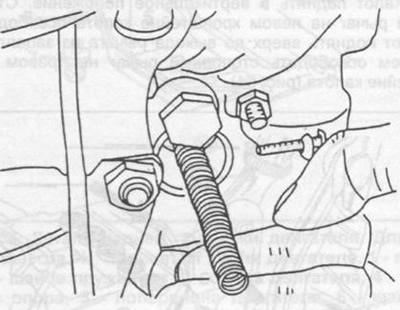
Fig. 56. Removing the chain tensioner
Loosen the camshaft sprocket mounting bolt, holding the shaft from turning with a wrench of the appropriate size, installed on the cam in the middle of the shaft, as shown in Fig. 57.
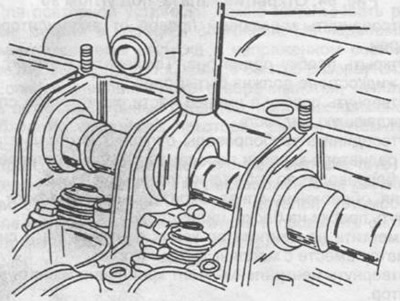
Fig. 57. Fixing the camshaft when loosening or tightening the sprocket mounting bolt.
Remove the chain guide from the camshaft housing (see below for relevant recommendations).
Move the camshaft back and remove the sprocket.
Loosen the cylinder head mounting bolts in the reverse order shown in Fig. 58. To loosen, use a socket wrench with an extension and a handle that provides the required force.
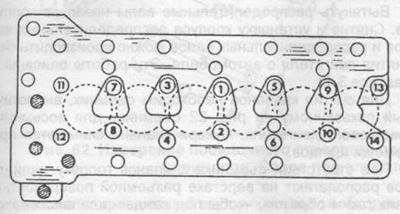
Fig. 58. Cylinder head bolt tightening sequence.
Unscrew the M8 bolts with a 6 mm Allen key. Use an extension to unscrew. Use a magnet to remove the bolts.
Pull the drive chain up and press the chain tensioner shoe toward the engine axle.
Remove the cylinder head. To make the work easier, you can hang the head by the lifting loops on a lifting device.
Thoroughly clean the mating surfaces of the cylinder head and block.
If necessary, repair the cylinder head as described in section 3.3.2. When installing the cylinder head, install a new gasket following the instructions below.
When installing the cylinder head, observe the following instructions:
Place a new gasket on the two mounting pins.
Place two wooden slats measuring 15x35x240 on the gasket. In the front side, place the slat on the narrow side, in the back on the wide side.
Hang the cylinder head by the lifting eyes on the lifting device. If there is no lifting device, the installation of the cylinder head is correspondingly more complicated.
Place the cylinder head on the racks and insert the drive chain and tensioner shoe into the opening of the head.
Raise the front side of the cylinder head, remove the rack towards the exhaust manifold and lower the head onto the mounting pin.
(Original material on the website www.MercedesMan.ru)
Raise the rear side of the cylinder head, remove the rack towards the exhaust manifold and lower the head onto the mounting pin.
Lubricate the cylinder head mounting bolts with engine oil.
Tighten the mounting bolts and tighten to a preliminary torque of 40 Nm in the sequence shown in Fig. 58.
New bolts are tightened in the same sequence, but with a torque of 90 Nm. Leave a pause of 10 minutes.
Install three Allen bolts and tighten to 25 Nm.
Perform final tightening of the cylinder head mounting bolts in the same sequence to a torque of 90 Nm.
Check the ease of rotation of the camshafts.
Place the top sprocket on the chain, lubricate the sprocket axle, insert the axle into the sprocket and use a hammer to press the axle into the cylinder head until it stops.
Place the sprocket together with the spacer ring on the intake camshaft. Lubricate the support sleeve and insert it into the bearing. Fig. 59 shows a section of the intake camshaft with the above parts.
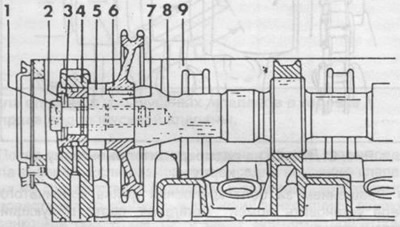
Fig. 59. Sectional view of the intake camshaft.
1 - mounting bolt,
2 - disc washers,
3 - support sleeve,
4 - bearing,
5 - distance ring,
6 - camshaft sprocket,
7 - key,
8 - camshaft,
9 - camshaft housing.
Place the sprocket with the drive chain on the exhaust camshaft. Lubricate the support bushing and insert it into the bearing. Fig. 60 shows a section of the exhaust camshaft with the above parts.
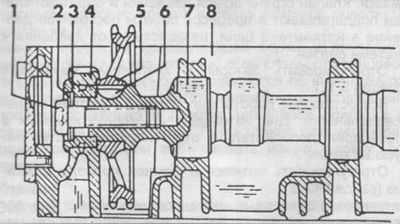
Fig. 60. Section of the exhaust camshaft.
1 - mounting bolt,
2 - disc washer,
3 - support sleeve,
4 - bearing,
5 - camshaft sprocket,
6 - key,
7 - camshaft,
8 - camshaft housing.
Tighten the sprocket mounting bolts together with the washers, but do not tighten.
Check the alignment of marks on the camshaft sprockets and drive chain.
Turn the crankshaft to the TDC of the piston of the first cylinder, check the alignment of the marks on the camshafts and their housing, as shown in Fig. 61, on the outer surface of the damper the designation "00" should be located under the TDC indicator pin.
Install the chain guide into the camshaft housing, preventing the chain from jumping off the sprocket teeth.
Screw in the chain tensioner and tighten the plug by hand.
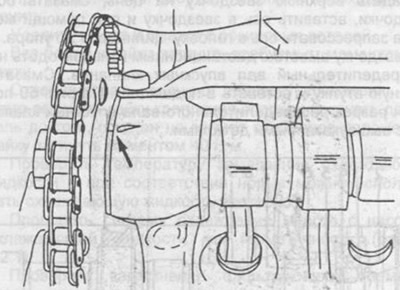
Fig. 61. Marks on the camshaft and housing.
By turning the crankshaft pulley mounting bolt, set the ignition timing to the value "00".
After repairing the cylinder head or camshaft housing, check the valve timing.
Tighten the camshaft sprocket mounting bolts to 80 Nm, holding the shafts from turning in the manner described above. Install the adjustable wheel suspension hydraulic system pump drive components and the pump.
Install the valve rocker arms.
Secure the chain tensioner. The required tension of the drive chain is provided by the combined action of the tensioner spring and the oil pressure in the lubrication system. The pressure limiting valve and the check valve maintain a constant pressure in the chain tensioner during operation, independent of the pressure in the lubrication system.
Adjust the valve clearances (section 3.12).
All other work should be performed in reverse order. For vehicles operated in Switzerland, additionally adjust the exhaust gas composition.
Adjust the tension of the drive belts of the units (section 4.3.2).
Adjusting the valve clearances or additional tightening of the cylinder head mounting bolts on a warm engine is not required.