



Contents: Automatic indication ↡ Retrieving information manually ↡ Removal and installation the oil…↡ Checking the oil level sensor ↡
Models produced from 06.1993 to 05.1997.
The oil level control system consists of an oil level sensor, which is screwed through the oil drain hole, and a control lamp on the instrument panel. The oil level in the pan begins to be controlled at an oil temperature of +60°C.
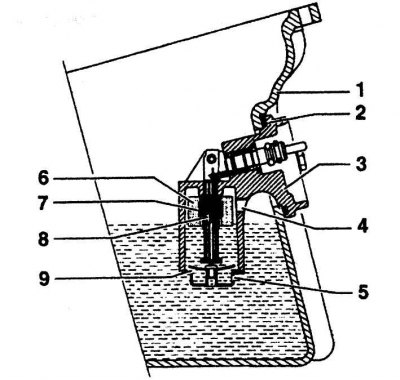
Fig. 5.19. Oil level sensor: 1 – oil pan; 2 – sealing ring; 3 – oil level sensor; 4 – ventilation hole with a diameter of 8 mm; 5 – drain hole with a diameter of 4 mm; 6 – float; 7 – magnet; 8 – sensor contact; 9 – bimetallic washer-valve
The oil level in the sump is determined by a float. When the oil level is low, contact 8 (Fig. 5.19) closes under the action of a magnet in the float chamber, and the control lamp lights up on the instrument panel. When the oil level drops due to driving conditions, the control lamp first flashes, then lights up continuously.
In order to avoid unnecessary warnings related to driving modes, for example when turning sharply, a deceleration relay is installed in the control unit. It switches on the warning lamp if the low oil level signal is given within 60 seconds.
To avoid incorrect readings when the engine is cold, when unheated oil drains into the oil pan for a long time, the oil level sensor is equipped with a bimetallic valve that prevents oil from draining from the float chamber. The oil level sensor ensures that the control lamp on the instrument panel turns on shortly before the oil level becomes minimal.
Models produced since 07.1997 with ASSYST maintenance system
The oil level sensor transmits readings to the ASSYST active service system unit. The microcomputer, based on information received from various sensors, such as oil level and temperature, coolant temperature, engine speed, engine load, registers the actual condition of the engine oil and creates an engine maintenance plan. One of the indicators of oil "aging" is the content of iron particles in it, which increases sharply after 5,000 km when driving short distances. Mercedes-Benz has developed a special sensor. It heats up when the oil level is high or low, determines the time for a necessary oil change, as well as changes in the oil structure, such as metal additives, fuel or coolant, and warns the driver about this. Information about a high or low oil level is displayed on the instrument panel display.
Automatic indication
Automatic indication starts to operate no earlier than 60 seconds after the engine is started and when the oil temperature is above +60°C.
If the oil level exceeds the norm, the instrument panel displays the "oil can" symbol with the inscription "OLSTAND UBER MAX" accompanied by a sound signal. Excess oil must be removed.
If the oil level in the pan is low, the instrument panel displays the "oil can" symbol with the inscription "OLSTAND UNTER MIN" accompanied by a sound signal. In this case, it is necessary to replenish the oil level to the norm as quickly as possible.
If the amount of oil is too low, the instrument cluster displays the oil can symbol with the inscription "OLSTAND MINIMUM" (oil level below acceptable) accompanied by a sound signal. In this case, it is necessary to immediately replenish the oil level to the norm.
Note: On vehicles without a multi-function indicator, the "-2L" indicator appears next to the "oil can" symbol.
Attention! Information about the oil level does not change during the filling process. The system must be manually requested about the amount of oil received in the engine.
Retrieving information manually
Turn off the ignition. Set the ignition key to position "2". After 10 seconds, the message will appear on the instrument cluster "OLSTAND ANZEEIGEN?" ("Show oil level?") and the "oil can" and "clock" symbols will light up.
At this time, within one second, press the reset button of the daily mileage counter twice. After a while, a message will appear, for example, "1,0 L OI einfullen" ("Fill with 1.0 l of oil"). The message will not appear immediately: at an oil temperature of +60°C, the waiting time will be 1 min.
Removal and installation the oil level sensor


Removal
1. Remove the engine compartment shield from below.
2. Drain or vacuum out the engine oil.
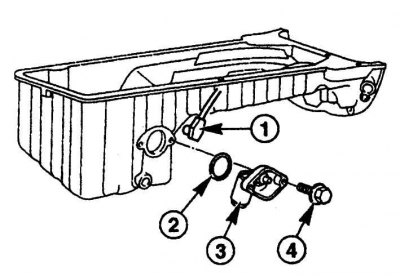
Fig. 5.20. Removing the oil level sensor: 1-pin connector; 2 – sealing ring; 3 – oil level sensor; 4 – bolt
3. Disconnect contact connector 1 from the oil level sensor (Fig. 5.20).
4. Unscrew bolt 4.
5. Tilt the oil level sensor 3 and remove it from the oil pan.
Installation
6. Install oil level sensor 3 with a new sealing ring 2 and tighten bolt 4 to a torque of 10 Nm.
7. Connect contact connector 1 to the sensor.
8. Install the engine compartment shield from below.
9. Fill the engine with engine oil.
10. Warm up the engine during a test drive and check the sensor for leaks.
Supplement for 6-cylinder V-engine:
1. Remove the lower part of the oil pan.
2. Unscrew the mounting screws (Torx) of the oil level sensor from below next to the oil drain tube.
3. Tighten the oil level sensor mounting bolts to a torque of 10 Nm.
Checking the oil level sensor


The oil level indicator light comes on when the oil level is normal and the engine is running
1. Disconnect the oil level sensor connector.
2. Use an ohmmeter to check the contact between the sensor and ground.
3. If there is no contact, remove and replace the sensor.
4. If there is contact on the sensor, check the circuit from the sensor to the instrument cluster.
5. If the circuit is in good condition, the cause of the malfunction may be a defect in the instrument cluster.
The indicator lamp does not light when the ignition is turned on
6. The lamp may have burned out. Replace it.
The control lamp does not light when the engine is running, the oil temperature is above +60°C and the oil level is below the minimum mark
7. Disconnect the wire from the sensor.
8. Check the contact between the sensor connector and ground.
9. Under the above conditions, there should be no contact on the sensor. A break in the circuit is possible.
10. If the lamp does not turn on, even though there is contact on the sensor, then the lamp has burned out.
11. If there is no contact on the sensor, remove, check and replace the sensor if necessary.