



Contents: Removal ↡ Installation ↡
During long-term operation of the car, the cross-sections of the channels in the radiator narrow due to the deposition of salts on their walls. As a result, the cooling efficiency of the radiator decreases, which leads to engine overheating. In this case, the radiator requires replacement.
Removal


1. Disconnect the cable from the negative terminal of the battery.
Please note: This will delete codes entered into memory devices, such as the radio code.
2. Remove the lower engine compartment shield.
3. Drain the coolant.
4. Remove the fan with viscous coupling.
5. Remove the fan shroud.
6. If there is an electric fan, remove it together with the casing.
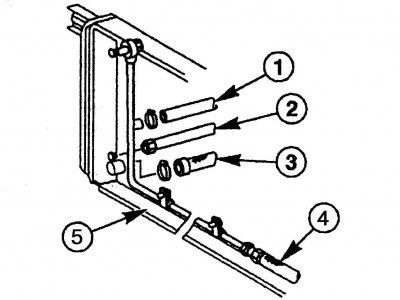
Fig. 5.33. Disconnecting the cooling system hoses from the radiator: 1, 3 – cooling system hose; 2, 4 – oil pipeline; 5 – radiator
7. Disconnect hoses 1 and 3 (Fig. 5.33) of the cooling system from the radiator, having first loosened and moved the fastening clamps.
For models with automatic transmission:
8. Clamp oil lines 2 and 4 (Fig. 5.33) going to and from the gearbox. Observe sterility when doing this. Clean the outside of the connection points with alcohol.
9. After disconnecting, cover the ends of the pipes with plastic bags and secure them to the tubes.
For all models:
10. Remove the air intake.
For models with air conditioning:
11. Disconnect the radiator grille from the front cross member and remove it by turning the clamps 90°.
For all models:
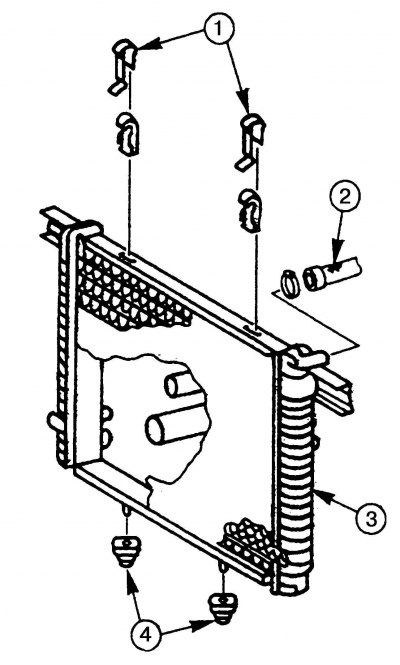
Fig. 5.34. Removing the radiator spring clamps: 1 – spring clamp; 2 – Upper radiator hose; 3 – radiator; 4 – rubber radiator support
Text republished from the website (MercedesMan.ru)
12. Disconnect radiator hose 2 from radiator 3 (Fig. 5.34), having first loosened and moved the clamp back.
13. Remove spring clips 1.
For models with air conditioning:
14. Unscrew the five bolts and remove the front crossmember.
15. Disconnect the hood release rod from the crossmember and remove it.
For all models:
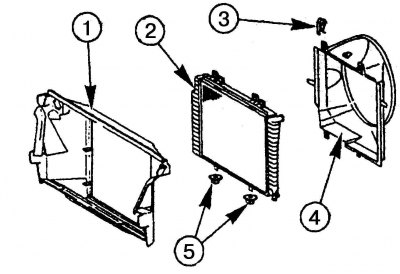
Fig. 5.35. Disconnecting the air duct: 1 – air duct; 2 – radiator; 3 – Fan shroud retainer; 4 – fan casing; 5 – rubber radiator support
16. Disconnect air duct 1 (Fig. 5.35) from radiator 2.
Warning! Do not open the air conditioning system circuit. If the refrigerant comes into contact with the skin, it may cause local frostbite.
For models with air conditioning:
17. Unscrew the condenser from the radiator and, without disconnecting the hoses, hang it up.
For all models:
18. Remove the radiator with an upward movement.
Installation
19. Check the hoses for cracks, cuts and other damage.
20. Check the condition of rubber supports 5 (Fig. 5.35).
21. Install radiator 2 on top so that its guides enter the holes in the rubber supports 5 on the lower cross member.
22. Attach air duct 1 to the radiator.
For models with air conditioning:
23. Attach the capacitor to the radiator.
24. Install the front cross member and secure it with five bolts.
25. Secure the hood lock release rod to the crossbar.
For all models:
26. Install the air intake.
27. Insert spring clamps 1 (Fig. 5.34) of the radiator from above.
28. Connect the cooling system hoses to the radiator and secure them with clamps.
29. Tighten the oil line union nuts to a torque of 20 Nm and remove the clamps.
For models with air conditioning:
30. Install the radiator grille, insert both clips into the holes and turn 90° to the right.
For all models:
31. Install the fan cover if it was removed.
32. Install the fan with viscous coupling.
33. Install the electric fan with the guide housing, if it was removed.
34. Fill the cooling system with coolant.
35. Connect the wire to the negative terminal of the battery.
36. Start the engine and warm it up to operating temperature.
37. Check the tightness of all connections.
38. Check the coolant level and top up if necessary.
39. Enter the codes into the memory device.