



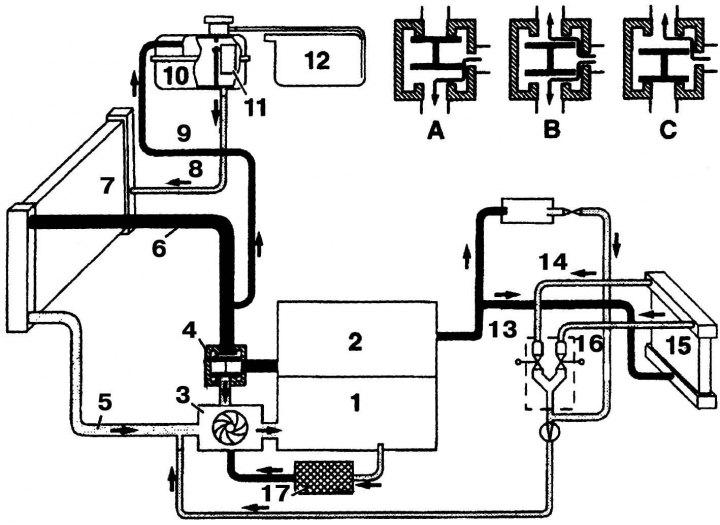
Fig. 5.25. Diagram of coolant circulation in a gasoline engine: A - the thermostat is closed, the liquid circulates in the engine through a small circuit at a temperature below +85°C (+87°C); B – the thermostat is partially open, the liquid circulates through the small and large circuits at a temperature from +85 (+87) to +94°C (+102°C); C - the thermostat is fully open, the liquid circulates through the large circuit, through the radiator, at a temperature of more than +94°C (+102°C); 1 – cylinder block; 2 – cylinder head; 3 – coolant pump; 4 – thermostat; 5 – lower branch pipe of the cooling system; 6 – upper branch pipe of the cooling system; 7 – radiator; 8 – connecting pipe; 9 – air outlet pipe; 10 – expansion tank; 11 – float; 12 – flush tank; 13 – coolant supply pipe to the heater radiator; 14 – right coolant outlet pipe from the heater radiator; 15 – heater radiator; 16 – left coolant outlet pipe from the heater radiator; 17 – oil radiator
After starting a cold engine, the coolant circulates in a small circle, which is limited by the engine cooling water jacket and the heater radiator (Fig. 5.25). The thermostat remains closed until the engine warms up to operating temperature.
In the small circuit, the thermostat closes the path of the liquid to the radiator.
The amount of coolant circulating in the small circle is smaller, so the engine reaches operating temperature faster. Then the thermostat opens, and hot coolant begins to circulate through the radiator from top to bottom. In the radiator, as a result of the oncoming air flow, heat from the engine is removed to the atmosphere. The thermostat regulates the temperature of the coolant, protecting the engine from overheating and cooling.
The coolant is fed directly back to the engine. This way it heats up faster, ensuring the engine is warmed up. The radiator is only connected when the coolant reaches a certain temperature. The thermostat opens, the cold liquid coming out of the outer circuit gradually mixes with the heated water from the small circuit. This prevents the so-called cold shock of the engine.
As soon as the coolant temperature begins to rise, the thermostat opens and the liquid begins to circulate through the large circuit, while the small circuit closes. At operating temperature, the coolant circulates through the lower hose from the left radiator tank to the water pump, which pumps the liquid into the engine block, oil cooler and cylinder head. Most of the liquid is then fed back through the open thermostat through the upper hose to the right radiator tank, while the rest is fed to the car's interior heater radiator. The cooled liquid flowing out of the radiator from below, passing the engine, warms up and enters the radiator from above. As it passes through the radiator, the hot liquid cools. If, while the car is moving, the coolant temperature drops below the operating temperature, the thermostat again closes the passage through the radiator until the coolant warms up to the required operating temperature.
To improve the efficiency of radiator cooling, the fan speed can be increased by using a viscous clutch or, depending on the configuration, an electric fan. When the clutch is disengaged, the fan rotates at the same speed as the engine crankshaft, but not faster than 1000 min⁻¹. The viscous clutch or electric fan is activated by a bimetallic switch or thermal switch if the coolant temperature exceeds a certain value. The fan is switched off when the coolant temperature drops below the operating temperature.
Attention! The radiator electric fan may turn on even when the ignition is off due to aerodynamic heating of the engine.