



Checking the Thermostat
As the engine warms up, the thermostat opens a large circulation loop. If this does not happen, the engine overheats. At the same time, the radiator remains cold.


1. Remove the thermostat as shown below.
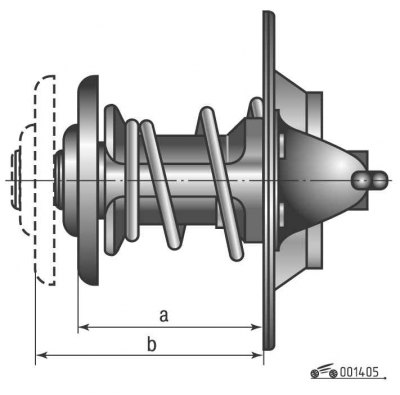
Fig. 5.30. Checking the thermostat
2. Measure the dimension "a" (Fig. 5.30) of the thermostat.
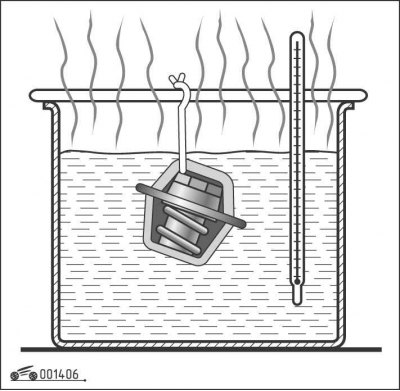
Fig. 5.31. Heating the thermostat in the container
3. Lower the thermostat into the container so that it does not touch the walls of the container, and slowly heat the water (Fig. 5.31). At a temperature of +85°C, the bimetallic spring of the thermostat should begin to lengthen. The spring reaches its greatest length at a temperature of +94°C. As soon as the water heats up to the opening temperature, the control valve should begin to open.
4. Bring the water to a boil, then remove the thermostat and measure the dimension "b". Compare the value with the original "a", the difference should be 8 mm.
5. Check if the thermostat closes completely during cooling.
6. Reinstall the thermostat.
Removal and installation the thermostat


1. Disconnect the cable from the negative terminal of the battery.
Please note: This will delete codes entered into memory devices, such as the radio code.
2. Drain the coolant as described previously.
3. Remove the front upper engine cover.
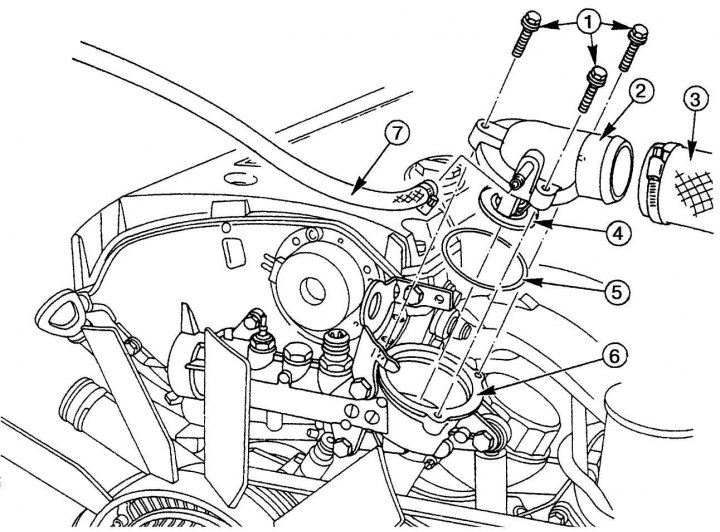
Fig. 5.32. Removing the thermostat: 1 – bolt; 2 – thermostat housing cover; 3, 7 – hose; 4 – thermostat; 5 – sealing ring; 6 – thermostat housing
4. Loosen the clamps and disconnect hoses 3 and 7 (Fig. 5.32) of the cooling system.
5. Unscrew bolts 1 securing the thermostat housing cover and remove thermostat 4.
Warning! Do not remove the thermostat from the cover on 4-cylinder and V6 engines, it may be damaged. It cannot be reinstalled. If the thermostat is faulty, it must be replaced together with the cover.
6. Before installing the thermostat, clean the connection points with the gasket on the housing and engine.
7. Install the thermostat housing cover with a new gasket and tighten the bolts 1 to a torque of 10 Nm.
8. Connect hoses 3 and 7 of the cooling system. Pay attention to its correct fit and secure tightening of the clamps.
9. Fill with coolant.
10. Connect the cable to the negative terminal of the battery.
11. Warm up the engine to operating temperature and make sure the radiator at the bottom is hot.
12. Check the tightness of the thermostat installation and hose connections.