
Cars BMW Cars Volkswagen Cars Chevrolet Cars Land Rover Cars Lada Cars Honda Cars Peugeot
English Русский
Български
Беларускі
Український
Српски
Hrvatski
Română
Polski
Slovenský
Magyar
Bookmark News and articles Sitemap Feedback Site search
MercedesMan.ru


A-Class C-Class E-Class G-Class M-Class S-Class Others
W123 (1976-1985) W124 (1984-1995) W210 (1996-2002)
  • Main
  • E-Class
  • W210 (1996-2002)
  • Diesel engines
  • Cooling system
  • Fan — Checking the serviceability

Fan — Checking the serviceability (Mercedes-Benz E-Class W210)

0
Contents: Fan with viscous coupling ↡ Checking the fan with viscous…↡ Electric fan ↡ Checking the fan for proper operation ↡
The fan serves to increase the intensity of radiator cooling with air. The more intense the blowing, the more intense the heat exchange. Depending on the model and configuration, electric fans or fans with a viscous coupling are installed on the engines. Both types of fans are mounted directly in front of the radiator and are switched on as needed.

Fan with viscous coupling
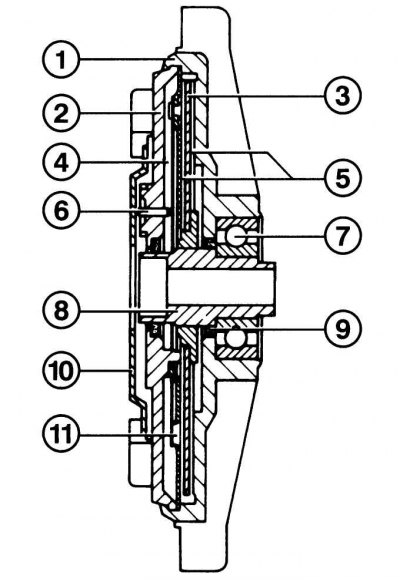


Fig. 4.50. Viscous coupling in section: 1 – coupling body; 2 – housing cover; 3 – pressure washer;…

Fig. 4.50. Viscous coupling in section: 1 – coupling body; 2 – housing cover; 3 – pressure washer; 4 – reserve cavity; 5 – working cavity; 6 – pin; 7 – bearing; 8 – bearing axis; 9 – gasket; 10 – bimetallic plates; 11 – valve


The viscous coupling (Fig. 4.50), filled with silicone oil, is located in the middle of the fan impeller and is controlled by bimetallic plates. There is a steel pin on the bimetallic plates, which at an ambient temperature of about +85°C opens the oil passage into the working cavity. The viscous silicone oil creates a force closure between the pulley and the fan, under the action of which the latter begins to drive air.


When the engine is cold, the clutch is practically disconnected - the oil is in the reserve cavity, so there is no energy consumption for ventilation. The fan speed remains below 1000 min⁻¹. It changes along with the engine speed, but only at low speeds. When 4500 min⁻¹ is reached, the safety valve is triggered, which limits the fan speed to around 3300 min⁻¹.

Checking the fan with viscous coupling


1. With the engine off, check that the fan moves easily.

2. Make sure that the fan does not have significant axial or radial play.

3. Make sure there are no traces of oil on the viscous coupling. If there is oil, it must be replaced.

4. With the engine warmed up and the hood closed, set the speed to 3000 min⁻¹.
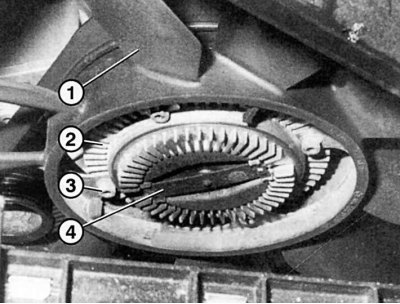
Fig. 4.51. Viscous coupling: 1 – impeller; 2 – coupling body; 3 – impeller mounting bolts; 4 –…

Fig. 4.51. Viscous coupling: 1 – impeller; 2 – coupling body; 3 – impeller mounting bolts; 4 – bimetallic plates


5. The coupling (Fig. 4.51) should start working at a coolant temperature of +90...+95°C. Otherwise, replace the coupling.

Electric fan


An electric fan is installed only on 4-cylinder engines. The cooling system of a 4-cylinder engine is immediately "loaded" when the engine is idling or, for example, when driving in mountainous terrain. If the coolant temperature indicator light suddenly starts to light up periodically, this indicates a fan malfunction. In this case, you can continue driving to the repair site, after letting the engine cool down. In this case, the engine should not experience heavy loads and should idle as little as possible.

Caution! When the engine is stopped but still hot, do not keep your hands near the fan impeller! The fan may start working even when the ignition is off.


Checking the fan for proper operation


1. Check the fuse.

2. Disconnect the plug from the socket located next to the thermostat housing.

3. Short-circuit the plug with a wire. If the fan starts, the thermal switch is faulty. If it does not start, the fan is faulty or the cable is broken.

4. To continue driving, short-circuit the plug and insulate it. Also, to avoid short circuits and dirt ingress, insulate the mating part.

5. When stopping or parking for a long time, be sure to remove the jumper wire to avoid discharging the battery.
This article is available at: russian, bulgarian, belarusian, ukrainian, serbian, croatian, romanian, polish, slovak, hungarian
The article has been verified: Polyakov Zakhar Grigorievich
Share with friends:
◀ Previous
E-Class W210 / Cooling system
Next ▶

Thermostat — Removal and Checking
Possible malfunctions of the cooling system, their causes and methods of elimination
Possible malfunctions of the hydraulic tappet thermostat and their causes
Cooling system filling volumes
Replacing the coolant
Replacing cooling system hoses
Radiator — removal and installation
Air filter — removal and installation
More similar articles for repairing other models

☛ Checking the engine oil level using a dipstick Mercedes W168 (1997-2004)
☛ Checking the condition of the V-belt Mercedes W202 (1993-2000)
☛ Checking fluid levels, leak control Mercedes W463 (1999-2019)
☛ Checking fluid levels, leak control Mercedes W163 (1997-2005)
☛ Checking fluid levels, leak control Mercedes W140 (1991-1998)
☛ Checking the tightness and serviceability of the brake system Mercedes Sprinter (1995-2000, diesel)
Link in different formats to this article
Comments and feedback from visitors
No comments yet


How much will 25 + 14 ?


W210 (1996-2002) 
  • General information
  • Vehicle description
  • Working conditions and tools
  • Car care
  • Diesel engines
  • Engine repair
  • Lubrication system
  • Cooling system
  • Injection system
  • Supply system
  • Exhaust system
  • Gasoline engines
  • Engine repair
  • Lubrication system
  • Cooling system
  • Control system
  • Power and exhaust system
  • Transmission
  • Clutch
  • Mechanical gearbox
  • Automatic gearbox
  • Drive shafts
  • Chassis
  • Car suspension
  • Steering
  • Tires and wheels
  • Brake system
  • Body
  • Exterior (external elements)
  • Interior (internal elements)
  • Doors and windows
  • Heating and ventilation
  • Electrical equipment
  • Equipment and devices
  • Power devices
  • Lighting and signaling
  • Electrical circuits
W124 (1984-1995) 
  • General information
  • Governing bodies
  • Driving and operation
  • Weekly care
  • Maintenance (gasoline)
  • Maintenance (diesel)
  • Troubleshooting
  • Power unit
  • I4 petrol engine
  • V6 petrol engine (SOHC)
  • V6 petrol engine (DOHC)
  • Diesel engines
  • Engine overhaul
  • Cooling system
  • Heating and ventilation
  • Fuel system (carburetor)
  • Injection system «Bosch CIS-E»
  • Injection system «Bosch HFM»
  • Diesel fuel system
  • Supply system
  • Starting and charging system
  • Ignition system (I4)
  • Ignition system (V6)
  • Preheating
  • Transmission
  • Clutch
  • Mechanical gearbox
  • Automatic gearbox
  • Drive shafts
  • Chassis
  • Brake system
  • Car suspension
  • Steering
  • Body
  • Exterior (external elements)
  • Interior (internal elements)
  • Doors, locks and windows
  • Electrical equipment
  • Equipment and devices
  • Switches
  • Headlights and lighting
  • Electrical circuits
W123 (1976-1985) 
  • General information
  • Introduction to the guide
  • Power unit
  • Engine device
  • Repair M102 engines
  • Repair M110 and M123 engines
  • Cooling and lubrication (M102)
  • Cooling (M110 and M123)
  • Ignition system
  • Power system «Stromberg»
  • Power system «Solex 4A1»
  • Fuel injection «K-Jetronic»
  • Fuel injection «L-Jetronic»
  • Transmission
  • Clutch
  • Mechanical gearbox
  • Automatic gearbox
  • Cardan and rear axle
  • Chassis
  • Front suspension
  • Rear suspension
  • Steering
  • Brake system
  • Body
  • Exterior (external elements)
  • Interior (internal elements)
  • Doors, locks and windows
  • Electrical equipment
  • Equipment and devices
  • Power devices
  • Electrical circuits
 
MercedesMan.ru © 2017–2026 · Mobile version · Read about Mercedes · Sitemap: EN BG BY UA RS HR RO PL SK HU · Feedback · Site search · Bookmark A-Class (W168) · C-Class (W201) · C-Class (W202) · C-Class (W203) · E-Class (W123) · E-Class (W124) · E-Class (W210) · G-Class (W463) · M-Class (W163) · S-Class (W116, petrol) · S-Class (W126, petrol) · S-Class (W140) · S-Class (W220) · Sprinter · Vito 1 · Vito 2 · Vario 814D ·
 
We only use cookies without which some of the site's features may not be available.