



The sensor's operation is based on measuring the so-called Nernst potential, which is proportional to the concentration of oxygen ions in the controlled gas environment.
The oxygen sensor sensing element (G3/2) consists of a combination of a Nernst element and (41a) a diffuse element (41b) (ion pump), which moves ions from the cathode to the anode. To increase the accuracy of measurements, the concentration of oxygen in the surrounding air is compared. For this purpose, the sensor has an air channel (41 d).
The sensor provides satisfactory measurement accuracy of the ratio 1 within the range of (0.7 < k < 4.0).
The condition for stable operation of the sensor is constant temperature. For this purpose, the sensor has a heater that constantly maintains the sensor temperature at about 750°C.
The ratio X=1 corresponds to a voltage on the Nernst element U - 450 mV.
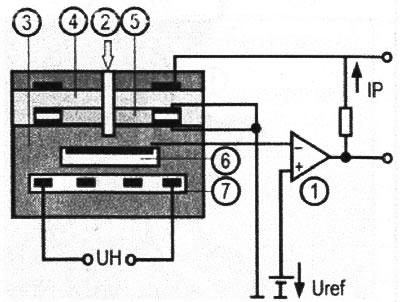
VN 9.031 Oxygen Sensor Schematic 48. Control Circuit; 81. OG flow; 41a. Nernst element; 41b. Ion pump; 41s. Diffusion gap; 41d. Air channel; 41st. Heater; IP. Ion pump current; UH. Heater voltage; Uref. Comparative voltage
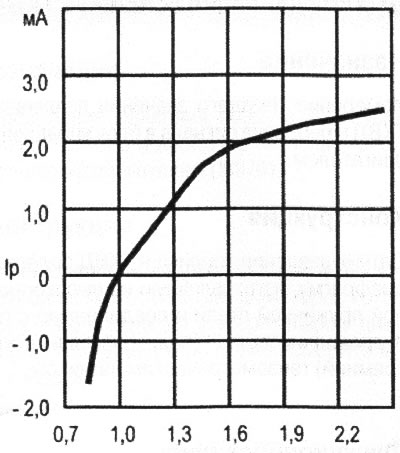
VN 9.032 Ion pump current versus λ. Ion pump signal (IP). IP. Ion pump current (mA)
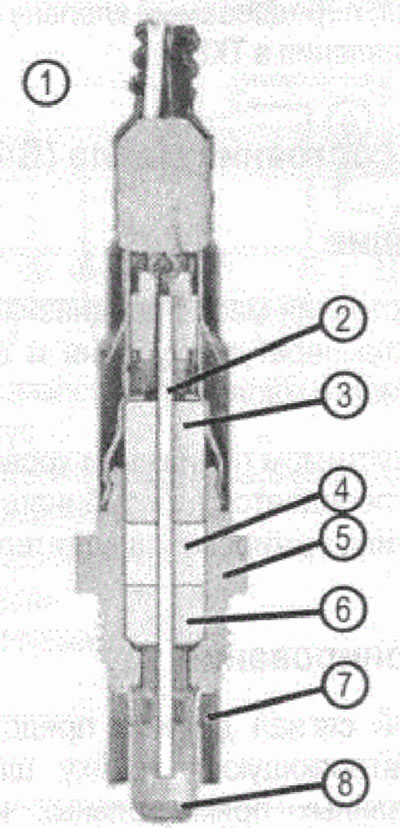
VN 9.033 1. Input oxygen sensor G3/2; 2. Sensitive element; 3. Upper insulator; 4. Sealing filler; 5. Sensor housing; 6. Lower insulator; 7. Outer protective tube; 8. Inner protective tube
(Article obtained from this portal MercedesMAN.ru)