
Cars BMW Cars Volkswagen Cars Chevrolet Cars Land Rover Cars Lada Cars Honda Cars Peugeot
English Русский
Български
Беларускі
Український
Српски
Hrvatski
Română
Polski
Slovenský
Magyar
Bookmark News and articles Sitemap Feedback Site search
MercedesMan.ru


A-Class C-Class E-Class G-Class M-Class S-Class Others
W116 (1972-1980, petrol) W126 (1979-1991, petrol) W140 (1991-1998) W220 (1998-2005)
  • Main
  • S-Class
  • W126 (1979-1991)
  • Chassis
  • Brake system
  • Anti-lock braking system (ABS system)

Anti-lock braking system (ABS system) (Mercedes-Benz S-Class W126)

0
Mercedes cars can be equipped with an anti-lock braking system upon separate request. It is no longer possible to install ABS on a car that is not adapted for this.

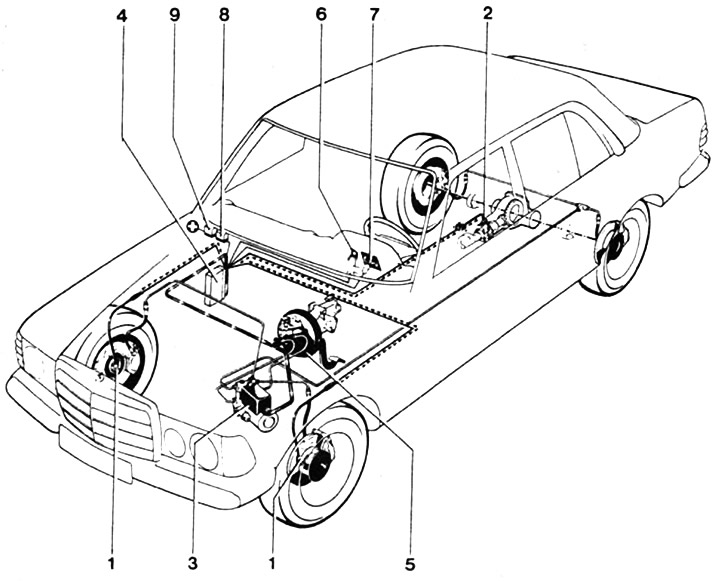
1. Speed sensor for front wheels. 2. Speed sensor for rear axle. 3. Hydraulic unit. 4. Electronic…

1. Speed sensor for front wheels. 2. Speed sensor for rear axle. 3. Hydraulic unit. 4. Electronic control unit. 5. Servocylinder. 6. Steering column lock. 7. ABS indicator light. 8. High voltage protection device. 9. Relay.


The ABS system prevents the brakes from locking during sudden braking, which reduces the braking distance, since slightly turning wheels improves positive control between them and the road. In addition, even during sudden braking, the car does not lose control.

The ABS system comes into readiness after the ignition is turned on and the speed reaches 5-7 km/h. It begins to regulate all braking processes that can lead to blocking when the car exceeds the speed of 12 km/h.

The rotation speed of the wheels is measured by rotation speed sensors (two for the front wheels and one for the rear axle). Based on the signals received from the sensors, the electronic control device calculates the average speed of the vehicle, which more or less coincides with the actual speed. By comparing the rotation speed of an individual wheel with the average speed, the control device quickly recognizes a possible skid and determines which wheel is close to locking.


As soon as the wheel shows a tendency to lock and the pressure in the caliper becomes too high for the wheel to hold the road, the control unit sends a signal to the hydraulic system, and the pressure in the caliper is reduced to a certain constant level. This means that the pressure in the caliper will not increase even if the brake pedal is pressed further. If the tendency to lock the wheel does not disappear, the release valve opens and the fluid pressure decreases.

If the wheel speed increases beyond a certain value, the hydraulic system will increase the pressure in the calipers, which, however, will not be able to exceed the pressure in the brake system as a whole.

When braking hard, this process will be repeated until the brake pedal is released or until the vehicle speed drops to a very low value (5-7 km/h).

The electronic control unit safety switch ensures that the ABS system automatically switches off if any defects occur or if the operating voltage becomes too low (battery discharge to voltages below 10.5 V). In this case, when driving, the control lamp of the system will light up on the dashboard. The normal braking system will continue to work, but with sharp braking, wheel locking is no longer excluded.

The hydraulic unit consists of a rear drop pump and three electromagnetic valves (one for each of the front wheels and one valve for the rear axle).

Pressure build-up: The inlet valve of the solenoid valve is open. The fluid pressure in the caliper can increase to a value determined by the master cylinder.


Maintaining constant pressure: the inlet and outlet valves of the electromagnetic valve are closed. The fluid pressure in the caliper does not change even when the pressure between the master cylinder and the electromagnetic valve increases.

Pressure release: The solenoid valve outlet valve is open. Brake fluid flows through the manifold block to the rear feed pump, which pumps it to the master cylinder.

The pump is necessary to prevent the brake fluid from being forced out of the master cylinder under pressure. The pump's operation is felt by the pulsation of the brake pedal. Each of the brake circuits has one muffler, which eliminates the noise from the operating pump.
If the ABS warning light comes on while driving, this means that the ABS system has switched off automatically.

Turn off the engine and start it again.

Check the battery voltage. If it is below 10.5 V, the battery needs to be recharged.

Note: If the ABS warning light comes on at the very beginning of driving and then goes out, this indicates that the battery voltage was initially too low, but then increased due to charging from the generator.


Raise and support the car, remove the front wheels. Check the electrical wiring for external damage.

Further testing of the anti-lock braking system should be carried out in a specialized workshop.
This article is available at: russian, bulgarian, belarusian, ukrainian, serbian, croatian, romanian, polish, slovak, hungarian
The article has been verified: Burova Vera Semenovna
Share with friends:
◀ Previous
S-Class W126 / Brake system
Next ▶

Adjusting the handbrake
Handbrake brake pads
Replacing the rear brake cable
Replacing the front brake cable
Servo cylinder — checking operation
Checking the Low Brake Fluid Warning Light
Checking the thickness of brake pads
Checking the thickness of brake discs
Visual inspection of brake pipes
Replacing brake fluid
More similar articles for repairing other models

☛ General description of the braking system Mercedes W168 (1997-2004)
☛ Anti-lock braking system (ABS) wiring diagram Mercedes W203 (2000-2007)
☛ Anti-lock braking system (ABS) Mercedes W124 (1984-1995)
☛ Anti-lock brake system (ABS) Mercedes W463 (1999-2019)
☛ Anti-lock brake system (ABS) Mercedes W163 (1997-2005)
☛ Anti-lock braking system ABS Mercedes Vito 1 (1996-2003)
Link in different formats to this article
Comments and feedback from visitors
No comments yet


How much will 20 + 12 ?


W220 (1998-2005) 
  • General information
  • Introduction to guide
  • User manual
  • Maintenance
  • Power unit
  • Engine repair
  • Cooling and heating systems
  • Power and exhaust systems
  • Ignition and control system
  • Charge and launch systems
  • Transmission
  • Automatic gearbox
  • Drive shafts
  • Chassis
  • Brake system
  • Front suspension
  • Rear suspension
  • Steering
  • Body
  • Body elements
  • Electrical equipment
  • Equipment and devices
  • Electrical circuits
W140 (1991-1998) 
  • User manual
  • Controls and instruments
  • Driving and operation
  • Maintenance
  • Power unit
  • Petrol engine V6
  • Petrol engine V8
  • Petrol engine V12
  • Diesel engine OM603
  • Diesel engine OM606
  • Cooling system
  • Power supply and injection system
  • Control system HFM-SFI
  • Control system LH-SFI
  • Control systems ME-SFI
  • Diesel control system
  • Ignition system
  • Charge and launch system
  • Transmission
  • Mechanical gearbox 717.438
  • Mechanical gearbox 717.454
  • Automatic gearbox 722.5
  • Automatic gearbox 722.6
  • Clutch and drive shafts
  • Differential
  • Chassis
  • Brake system
  • Steering
  • Front suspension
  • Rear suspension
  • Body
  • Exterior (external elements)
  • Interior (internal elements)
  • Electrical equipment
  • Equipment and devices
  • Electrical circuits
W126 (1979-1991, petrol) 
  • Power unit
  • Engine repair
  • Ignition system
  • Lubrication system
  • Cooling system
  • Fuel system
  • Fuel injection system
  • Transmission
  • Clutch and cardan
  • Mechanical gearbox
  • Automatic gearbox
  • Chassis
  • Front suspension
  • Rear suspension
  • Steering
  • Brake system
  • Electrical equipment
  • Power devices
  • Electrical circuits
W116 (1972-1980, petrol) 
  • General information
  • Introduction to guide
  • Power unit
  • 8-cylinder V8 engine
  • 6-cylinder I6 engine
  • Cooling and lubrication system
  • Power system (carburetor)
  • Fuel injection system
  • Ignition system
  • Transmission
  • Clutch and cardan
  • Car gearbox
  • Chassis
  • Front suspension
  • Rear suspension
  • Steering
  • Brake system
  • Electrical equipment
  • Power devices
  • Electrical circuits
 
MercedesMan.ru © 2017–2026 · Mobile version · Read about Mercedes · Sitemap: EN BG BY UA RS HR RO PL SK HU · Feedback · Site search · Bookmark A-Class (W168) · C-Class (W201) · C-Class (W202) · C-Class (W203) · E-Class (W123) · E-Class (W124) · E-Class (W210) · G-Class (W463) · M-Class (W163) · S-Class (W116, petrol) · S-Class (W126, petrol) · S-Class (W140) · S-Class (W220) · Sprinter · Vito 1 · Vito 2 · Vario 814D ·
 
We only use cookies without which some of the site's features may not be available.