
Cars BMW Cars Volkswagen Cars Chevrolet Cars Land Rover Cars Lada Cars Honda Cars Peugeot
English Русский
Български
Беларускі
Український
Српски
Hrvatski
Română
Polski
Slovenský
Magyar
Bookmark News and articles Sitemap Feedback Site search
MercedesMan.ru


A-Class C-Class E-Class G-Class M-Class S-Class Others
W123 (1976-1985) W124 (1984-1995) W210 (1996-2002)
  • Main
  • E-Class
  • W210 (1996-2002)
  • General information
  • Vehicle description
  • Side impact protection

Side impact protection (Mercedes-Benz E-Class W210)

0
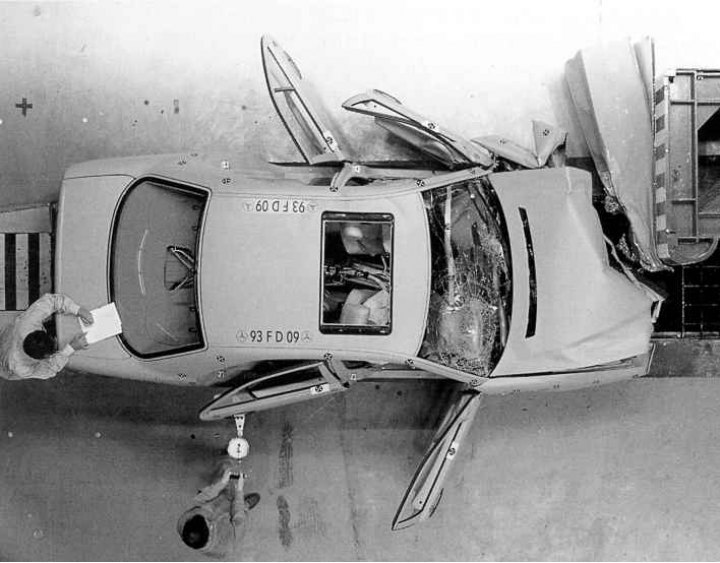
Fig. 1.18. Crash test (frontal impact)
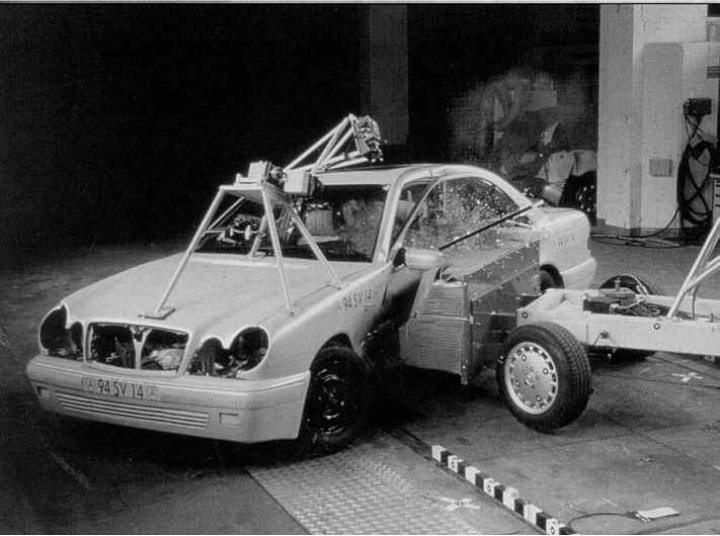
Fig. 1.18. Crash test (frontal impact)


Fig. 1.19. Crash test (side blow)

Fig. 1.19. Crash test (side blow)


According to statistics, side impacts are the cause of almost 25% of all serious and fatal injuries to passengers and drivers in accidents. Therefore, Mercedes-Benz engineers have developed crash tests for frontal impacts (Fig. 1.18) and side impacts (Fig. 1.19) that are close to reality, thereby creating the basis for continuously optimizing the protection of passengers from such accidents in Mercedes models.

With the new crash test, engineers simulate typical vehicle collisions in a particularly realistic way. The test is carried out using a moving structure whose deformation characteristics correspond to the front of the vehicle involved in the collision


The new E-class has a whole range of measures to increase passive safety:
  • 1. The bottom structure is reinforced under the front seats with impact-resistant cross beams. There are reinforcement elements for the middle tunnel and the cross-connection of the thresholds.
  • 2. The driver and passenger seats have high lateral strength, proven in crash tests.
  • 3. There are rigid support beams under the windshield and instrument panel.
  • 4. The side section of the new E-class car is reinforced with a three-profile middle pillar welded to the sills to create a strong connection between the roof and the bottom.
  • 5. Under the rear seat and between the C-pillars there are cross-supporting beams that provide high body strength in the rear area.
  • 6. The deformation-resistant doors are additionally reinforced with pipes.
  • 7. Foam elements located under the inner door trim absorb some of the impact energy and reduce the risk of chest damage. Non-deformable units, such as window lift motors or audio system speakers, are located outside the possible contact zones with the passenger in an accident.

Body safety requirements


In order for the body to meet all the requirements for a modern car, it must meet the following criteria.

Rigidity. At high speeds, forces arise that the body must withstand under all conditions. Changes in structure due to bending and deflection under the action of centrifugal forces can affect driving performance and impact safety. The hood and doors must not be subject to strong elastic deformations while the car is moving in order to maintain the fit and density.


Deformation. As much of the collision energy as possible should be converted into deformation. Deformation absorbs the kinetic energy of the impact. The structure of the body parts should deform in such a way as to ensure the least possible damage to the car interior.

Aerodynamics. The behavior of the car in the air flow is an important prerequisite for high power and low fuel consumption. Thanks to good aerodynamics, air resistance and fuel consumption can be reduced with the same power. In addition, the aerodynamic shape of the body must ensure that the car does not "lift off" the ground at high speeds.

Durability. A reliable body structure is only a step towards its durability. Efficient anti-corrosion protection and the use of materials with high corrosion resistance are also important. This is the only way to guarantee the functionality and reliability of the body for a long time.

Ease of repair. It is necessary to guarantee the possibility of repairing and replacing individual damaged parts of the body while maintaining its geometric dimensions and the relative cheapness of these works.

Behaviour during vibration. Acoustic vibrations and vibrations of the chassis, engine or gearbox must be compensated so that their impact is not transmitted to the people sitting in the car.
This article is available at: russian, bulgarian, belarusian, ukrainian, serbian, croatian, romanian, polish, slovak, hungarian
The article has been verified: Polyakov Zakhar Grigorievich
Share with friends:
◀ Previous
E-Class W210 / Vehicle description
Next ▶

Passive safety system
Brake system
Improved driving dynamics
Safety when driving and cornering
Automatic transmission
Frontal collision protection
Technical data and characteristics of the car
More similar articles for repairing other models

☛ Driver's side wind deflector trim — removal and installation Mercedes W168 (1997-2004)
☛ Anti-corrosion protection of the underbody Mercedes W202 (1993-2000)
☛ Antifreeze is a means of protection against freezing Mercedes W463 (1999-2019)
☛ Antifreeze is a means of protection against freezing Mercedes W163 (1997-2005)
☛ Antifreeze is a means of protection against freezing Mercedes W140 (1991-1998)
☛ Side turn signal repeaters Mercedes Sprinter (1995-2000, diesel)
Link in different formats to this article
Comments and feedback from visitors
No comments yet


How much will 31 + 44 ?


W210 (1996-2002) 
  • General information
  • Vehicle description
  • Working conditions and tools
  • Car care
  • Diesel engines
  • Engine repair
  • Lubrication system
  • Cooling system
  • Injection system
  • Supply system
  • Exhaust system
  • Gasoline engines
  • Engine repair
  • Lubrication system
  • Cooling system
  • Control system
  • Power and exhaust system
  • Transmission
  • Clutch
  • Mechanical gearbox
  • Automatic gearbox
  • Drive shafts
  • Chassis
  • Car suspension
  • Steering
  • Tires and wheels
  • Brake system
  • Body
  • Exterior (external elements)
  • Interior (internal elements)
  • Doors and windows
  • Heating and ventilation
  • Electrical equipment
  • Equipment and devices
  • Power devices
  • Lighting and signaling
  • Electrical circuits
W124 (1984-1995) 
  • General information
  • Governing bodies
  • Driving and operation
  • Weekly care
  • Maintenance (gasoline)
  • Maintenance (diesel)
  • Troubleshooting
  • Power unit
  • I4 petrol engine
  • V6 petrol engine (SOHC)
  • V6 petrol engine (DOHC)
  • Diesel engines
  • Engine overhaul
  • Cooling system
  • Heating and ventilation
  • Fuel system (carburetor)
  • Injection system «Bosch CIS-E»
  • Injection system «Bosch HFM»
  • Diesel fuel system
  • Supply system
  • Starting and charging system
  • Ignition system (I4)
  • Ignition system (V6)
  • Preheating
  • Transmission
  • Clutch
  • Mechanical gearbox
  • Automatic gearbox
  • Drive shafts
  • Chassis
  • Brake system
  • Car suspension
  • Steering
  • Body
  • Exterior (external elements)
  • Interior (internal elements)
  • Doors, locks and windows
  • Electrical equipment
  • Equipment and devices
  • Switches
  • Headlights and lighting
  • Electrical circuits
W123 (1976-1985) 
  • General information
  • Introduction to the guide
  • Power unit
  • Engine device
  • Repair M102 engines
  • Repair M110 and M123 engines
  • Cooling and lubrication (M102)
  • Cooling (M110 and M123)
  • Ignition system
  • Power system «Stromberg»
  • Power system «Solex 4A1»
  • Fuel injection «K-Jetronic»
  • Fuel injection «L-Jetronic»
  • Transmission
  • Clutch
  • Mechanical gearbox
  • Automatic gearbox
  • Cardan and rear axle
  • Chassis
  • Front suspension
  • Rear suspension
  • Steering
  • Brake system
  • Body
  • Exterior (external elements)
  • Interior (internal elements)
  • Doors, locks and windows
  • Electrical equipment
  • Equipment and devices
  • Power devices
  • Electrical circuits
 
MercedesMan.ru © 2017–2026 · Mobile version · Read about Mercedes · Sitemap: EN BG BY UA RS HR RO PL SK HU · Feedback · Site search · Bookmark A-Class (W168) · C-Class (W201) · C-Class (W202) · C-Class (W203) · E-Class (W123) · E-Class (W124) · E-Class (W210) · G-Class (W463) · M-Class (W163) · S-Class (W116, petrol) · S-Class (W126, petrol) · S-Class (W140) · S-Class (W220) · Sprinter · Vito 1 · Vito 2 · Vario 814D ·
 
We only use cookies without which some of the site's features may not be available.