



Contents: Tire pressure ↡ Correct wheel rotation ↡
The pressure should always be checked on cold tires: during driving, the tires heat up and the pressure in them increases. If you measure the pressure immediately after driving, the result will be distorted.
Below are some tips for checking your tire pressure.
1. Check your tire pressure regularly every 3-4 weeks.
2. A pressure drop of about 1.5% per month is normal for a branded tire. If this value is higher, have the tire checked at a service station.
3. Always keep the filler valve caps on, as dirt getting into the valve can cause the valve to jam and not close properly.
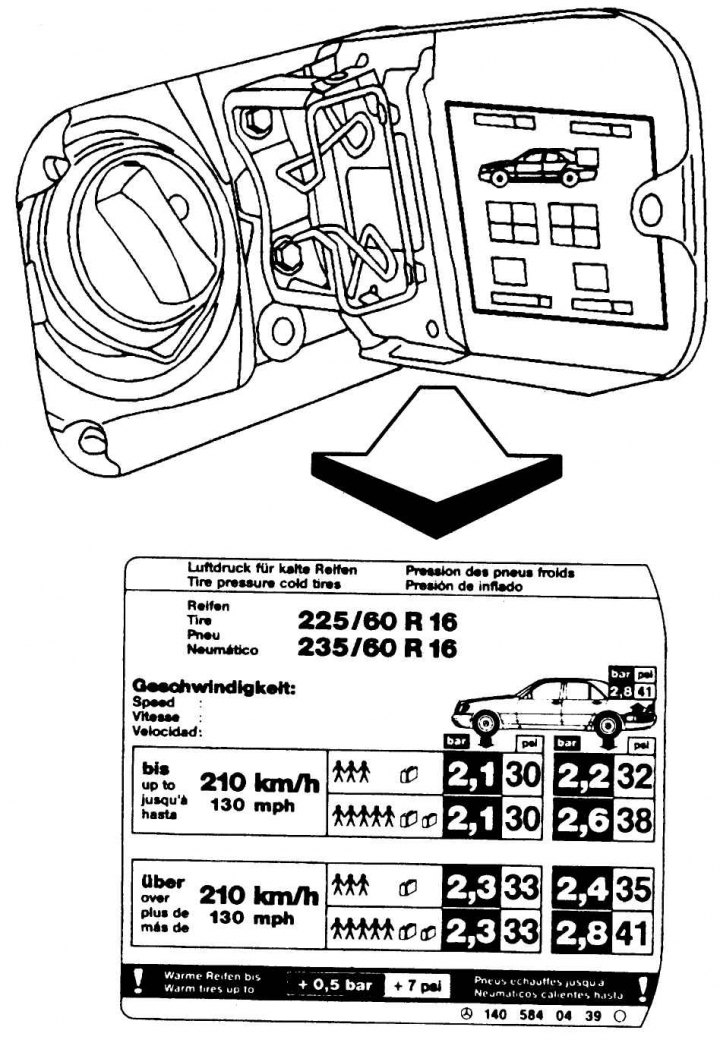
Fig. 7.27. In the Mercedes E-Class, the prescribed tire pressure values are indicated on a sticker on the back of the fuel filler flap
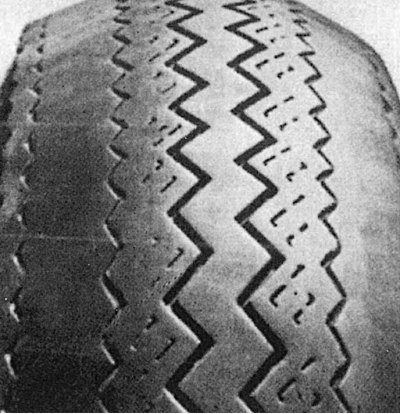
Fig. 7.28. Tire wear due to long-term use with insufficient pressure in it
4. The tire pressure should not fall below the established values indicated in the table on the back of the fuel filler flap (Fig. 7.27), as this leads to characteristic increased tire wear (Fig. 7.28).
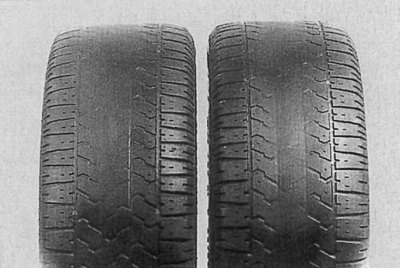
Fig. 7.29. Tire wear due to long-term use with increased air pressure in it or frequent trips at maximum speed
Text republished from the website mercedesman
5. Pressure 0.2–0.3 bar higher than normal has some advantages: steering becomes more sensitive, tires wear out more slowly (Fig. 7.29), and even fuel consumption decreases slightly. Disadvantage: damping properties of tires decrease.
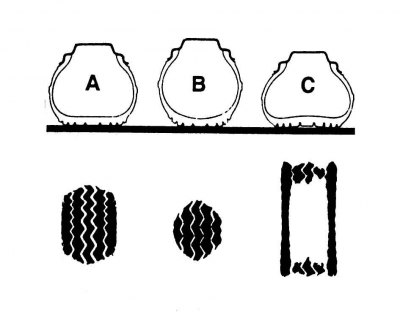
Fig. 7.30. Contact patch of the tire with the road: A - at normal pressure, the entire working surface of the tire is in contact with the road surface; B - at increased pressure, the tire contacts the road only with the middle part of its working surface; C - at low pressure the contact patch is on the edges of the tire
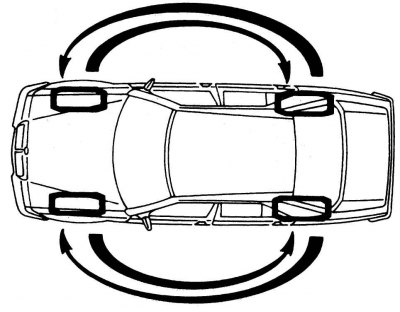
Fig. 7.31. Wheel rotation diagram
Tire pressure
Tire pressure determines the shape and size of the tire contact patch with the road surface (Fig. 7.30) and, thus, its service life, as well as fuel consumption and driving performance (if the pressure is insufficient, the tires react inaccurately and with a delay to steering movements).
Correct wheel rotation
1. If you have a new spare tire in your trunk, you can save money. It is only important that tires with the same tread pattern from the same manufacturer are available. Then you can buy another tire, and "shoes" for one axle are provided.
2. You can postpone the purchase of new tires if you rotate the wheels as follows: rear and front on one side (not diagonally!) and maintaining the same direction of rotation (Fig. 7.31). In this case, more uniform wear occurs.
3. The disadvantage of this method is that when worn out, all four tires must be replaced at once. In addition, because of the rearrangement at certain mileage intervals, it is more difficult to recognize possible problems in the suspension, steering or shock absorbers by the nature of the wear.
4. When replacing, always ensure that in any case, tires of the same manufacturer, with the same profile and service life are installed on the same axle.
5. Another option for rearranging takes into account that the tires on the front wheels wear out faster. When they reach the minimum permissible tread depth of 1.6 mm, the tires from the rear wheels can be moved forward (with the preservation of the side), unless they are worn to the limit, of course. So you only need two new tires for the rear axle.
6. The basic principle is that the rear axle should be fitted with tyres with less tread wear, as this has a decisive effect on the directional stability of the vehicle. If a front tyre is damaged on the road, the vehicle will still be controllable, whereas damage to the rear tyre will almost inevitably result in skidding.