



Contents: Maximum speed ↡ Production time and ECE standard ↡ Wheel rims ↡ Winter tires - for snow and ice ↡ Mounting winter tires on wheels ↡ Proper storage of tires ↡ How to increase the life of your…↡
On the sidewall of the tire there are a number of digital and letter designations, with the help of which the manufacturer codes the characteristics of the tires prescribed by the technical documentation. Many drivers are primarily interested in the tire size. For example, 205/65 R15 means that the width of the tire section is 205 mm. The second number shows the ratio of the height and width of the tire. In this example, it is 65%. The lower this figure, the flatter and wider the tires are. The letter "R" means that the tire is radial. The number following the letter expresses the tire diameter in inches.
Maximum speed
Another letter in this row indicates the maximum speed for the tire. A tire with the letter "S" in its designation is designed for a maximum speed of up to 180 km/h, the letter "T" - up to 190 km/h. For a maximum speed of 210 km/h, the tire has the letter "H".
If you drive in winter on regular winter tires of the "M+S" type, you should limit your speed. A tire with the letter "Q" allows driving at a speed of no more than 160 km/h.
Production time and ECE standard

Fig. 7.22. The ECE number is easily identified by the capital letter E and the following digital code of the country of manufacture: for example, 1 - Germany, 4 - Holland
The three-digit "DOT" number provides information about the tire's manufacturing date. Since 1990, a small triangle has been placed under this number. For example, the number 187 indicates that the tire was manufactured in the 18th week of 1997. New tires manufactured after October 1, 1998, must have an ECE certificate number on the sidewall (Fig. 7.22). This number certifies that the tire is a product certified by the ECE for compliance with the quality standards it has established. If tires manufactured after October 1, 1998 are installed on a vehicle without a certificate number, the vehicle's operating permit is cancelled.
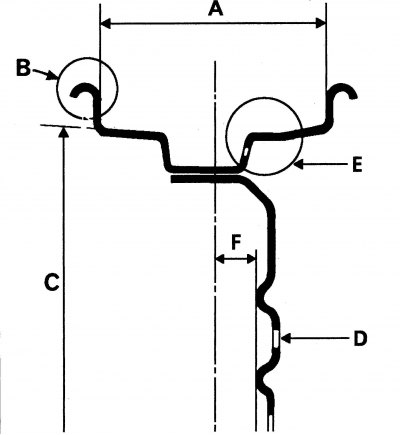
Fig. 7.23. Wheel parameters: A – rim width in inches; B – profile of the rim flange; C – wheel diameter, in inches; D – diameter of the fastener hole; E – combined annular projection on the rim seat; F – pressing depth, mm
Wheel rims
The size of a wheel disk according to standards is always indicated in inches. For example, the code 7 1/2 J x 15 means a disk with a deep rim (x) 7.5 inches wide and 15 inches in diameter. The letter J means the shape of the rim flange. The feature of a deep rim is as follows: to improve the fit of the tires, there is a round protrusion (hump) on the base of the rim. It prevents the tire from coming off the disk when turning at high speed (Fig. 7.23).
Winter tires - for snow and ice
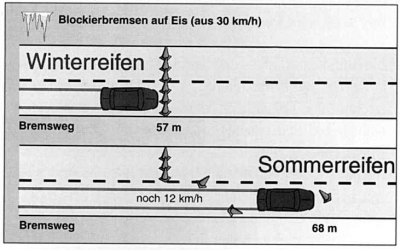
Fig. 7.24. Comparison of the braking distance of summer and winter tires on a car without ABS when braking with locking on ice (from a speed of 30 km/h):
- winter tires:
- braking distance - 57 m
- summer tires:
- the residual speed of the car is 12 km/h;
- braking distance - 68 m
Winter tires improve safety when driving on snow and ice compared to summer tires (fig. 7.24 and 7.25).
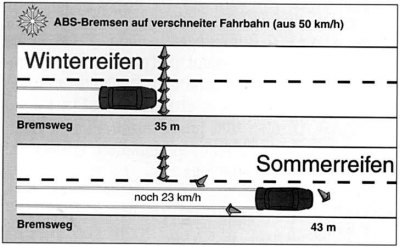
Fig. 7.25. Comparison of the braking distance of summer and winter tires on a car with ABS on a snowy road surface (from a speed of 50 km/h):
- winter tires:
- braking distance - 35 m
- summer tires:
- the residual speed of the car is 23 km/h;
- braking distance - 43 m
Winter tires are made from a special rubber compound with a large proportion of natural rubber, which behaves better on the road surface at temperatures below +7°C. A minimum 4 mm tread height is also a guarantee of reliable transmission of forces during movement and braking - less is not allowed for winter tires. Winter tires should be installed on all four wheels at once - a combination of summer and winter tires can be dangerous.
Mounting winter tires on wheels
You can save on expensive tire changes at the beginning of winter and autumn by purchasing a second set of matching rims. The wheels should be rebalanced after each remount. When driving on snow, it is recommended to increase the tire pressure by 0.2 bar.
If the maximum speed limit for winter tires is lower than the speed limit of your vehicle, it is recommended to stick it in your field of vision as a reminder (not on the windshield) a reminder of this.
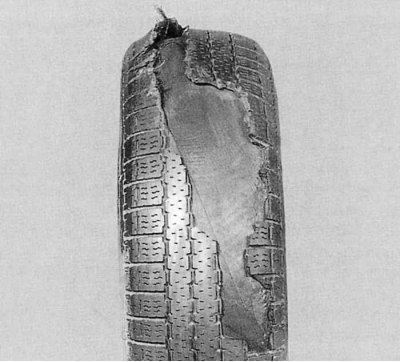
Fig. 7.26. If you frequently drive on flat tires and with a heavy load, this can lead to partial delamination of the tire
Proper storage of tires
After the seasonal "change of shoes", the removed set of tires must be stored properly. A dry, cool and dark room is best for this. Gasoline, oil, grease and chemicals should be kept away from tires - all this destroys rubber.
Perform the following operations:
1. Mark the direction of travel and the position of the tires (FR - front right, FL - front left, RRR - rear right, RLL - rear left).
2. Wash the removed tires with water and dry thoroughly. Remove foreign objects from the tread grooves.
3. Place tires and rims lying down, preferably on an old wooden pallet.
4. Tires without rims should be stored in an upright position, turning them from time to time.
How to increase the life of your tires
1. Do not exceed the maximum speed for which your tires are designed. This applies especially to tires marked "M+S" of category Q (160 km/h). Exceeding the speed increases tire wear and, in the worst case, leads to tire failure (Fig. 7.26).
2. Avoid driving at maximum speed if your car is heavily loaded. You can do a simple check by touching the tires with your hand. If the temperature does not exceed body temperature, everything is fine. Hot tires are an alarm signal indicating insufficient pressure or another malfunction. In this case, the tire should be removed and checked by a specialist.
3. If you often drive at high speed, install tires of a higher speed class than required by the vehicle's registration document (for example, "V" instead of "H").
4. When parking, make sure that the sidewalls of the tires do not rub against the curb. Drive slowly onto curbs or bumps and always at a right angle.