



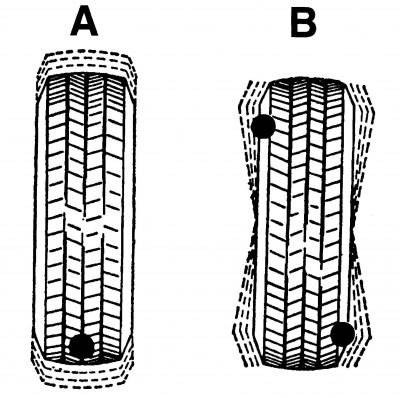
Fig. 7.34. Wheel imbalance: a - in statics; b - in dynamics
Wheel imbalance is felt by vibrations in the steering wheel or shaking of the front of the car. Both are especially noticeable at certain speeds. The reason for this is the uneven distribution of weight on the wheel. A distinction is made between static and dynamic wheel imbalance. Static imbalance occurs when a freely suspended rotating wheel constantly swings in the same place (fig. 7.34, a). Such a wheel will jump when moving, and the shock absorbers will wear out faster.
Dynamic imbalance occurs when the wheel is positioned at an angle to the axle (fig. 7.34, b). At high speeds it experiences vibrations and swaying.
Wheel imbalance
If an imbalance occurs, first of all, it is necessary to thoroughly wash the wheels, especially from the inside. Perhaps after this the cause will be eliminated.
Precise balancing is recommended at least for the front wheels, as even the slightest imbalance is felt on the steering wheel. Balancing the rear wheels directly on the car is dangerous. The differential may be damaged. Therefore, the wheels must be driven by the engine.
Therefore, wheels in statics and dynamics require balancing. There are two methods for this:
1. The wheel is removed from the car and screwed onto a special balancing stand. The wheel rotates on it, and the imbalance points are indicated. The imbalance is leveled by attaching special balancing weights to the wheel.
2. Sometimes a more precise final balancing is used. For this, the front wheels already installed on the car are rotated at the required speed on the stand by means of a contact shaft driven by an electric motor. The shown imbalance areas are also leveled using weights. However, Mercedes considers this procedure unnecessary, since the wheels of the cars they produce are very well centered.
Balancing is not an easy task. It is necessary to limit the number of weights as much as possible, which may require repeated rearrangement. Tires with a height runout of more than 1 mm and a lateral runout of more than 1.6 mm cannot be finally balanced. The same applies to tires with a damaged frame, for example, as a result of hitting a curb or other obstacle at high speed.