



Since some parts may come off underneath the vehicle, four stable stands are needed, which are also used to support the jack. Before starting work in the engine compartment, protect the vehicle fenders with a covering. The front hood is not removed when dismantling the engine.
The engine can be removed without the gearbox. In this case, the steps marked (*) do not need to be followed. Support the gearbox with a repair jack and a wooden spacer, then loosen the engine/gearbox connecting bolts and press the engine away from the gearbox with a crowbar.
Depending on the year and model of the car, electrical wires, vacuum hoses and coolant hoses may be laid in the engine compartment differently. Before disconnecting the corresponding wire, mark it with adhesive tape. The dismantling of a 4-cylinder engine is described below; when dismantling a 6-cylinder engine, follow the meaning.
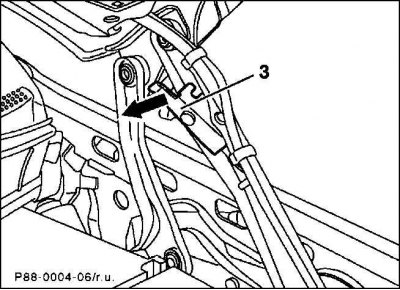
1. To open the hood, pull the support lever (3) on the left hood support in the direction of the arrow and lift the hood slightly so that the locking lever is not locked. Remove the locking lever from the right hood support and position the hood vertically.
Caution! The left locking lever must be locked into the upper lock.
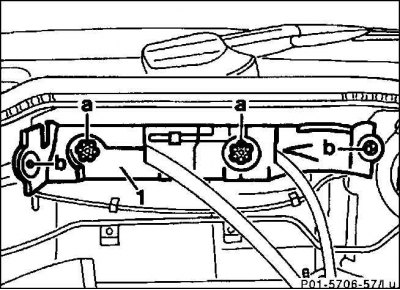
2. Remove the cover (1) from the front body wall. To do this, unscrew the knurled nut (a) and release the knurled rivet (b).
3. Disconnect the ground (–) cable from the battery.
Attention! This will erase the radio's anti-theft code.
4. Disconnect the positive battery cable that runs from the battery connector to the engine, route it through the bulkhead, and lay it on the engine.
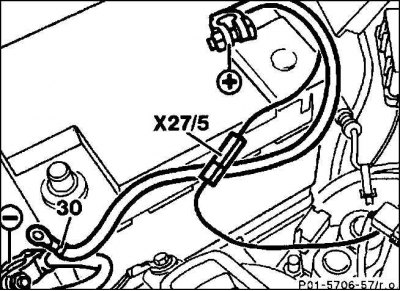
5. Disconnect the plug connection (X27/5) of the oil pressure switch.
6. Unscrew the wire (30) from the connector.
7. If you have an air mass meter, remove it.
8. Disconnect all vacuum hoses that go to the engine. For example:
- regeneration valve vacuum hose(s);
- vacuum hose to the right of the intake pipe;
- brake booster vacuum hose from the intake manifold.
9. Disconnect the throttle cable.
10. Open the fuel tank cap briefly and relieve excess pressure in the fuel system.
11. Disconnect all electrical wires leading to the engine. To facilitate subsequent installation, pre-mark the wires with adhesive tape. For example:
- disconnect the plug connection from the lambda probe on the front wall of the body;
- 2.2L: Remove the control unit cover behind the front body wall, first remove the plastic cover of the wire connector;
- 1.8/2.0L: Remove the multi-pin connector and crankshaft position sensor, as well as the vacuum line from the PMS tool;
- disconnect individual wires from the connector on the left wing, after removing the cover from the connector;
- disconnect the plug connection from the temperature sensor;
- unscrew the ground cable from the hydraulic unit holder;
- air Conditioner: Disconnect the electrical wire from the air conditioner compressor.
12. Disconnect the cable connector and remove the wires from the holders.
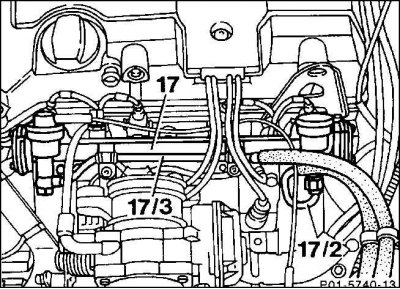
13. Mark the fuel lines (17/2) and (17/3) with adhesive tape and remove them from the fuel distributor (17). First disconnect the hoses with clamps.
Caution! Place a rag underneath as fuel will leak out.
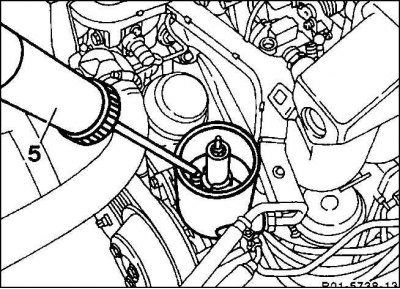
14. Using a suitable syringe, draw hydraulic oil from the power steering reservoir.
15. Unscrew the hoses and close them with plugs.
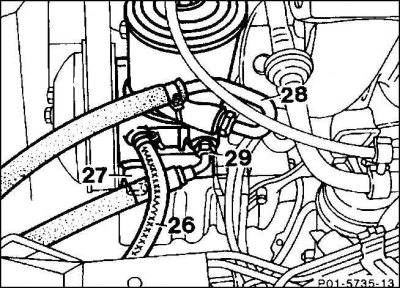
16. Unscrew the recirculation hose (28) and the high-pressure hose (29) for the power steering. In vehicles with height adjustment, additionally unscrew the high-pressure hose (26) and the oil line (27) for the dual-circuit pump.
17. Raise the car.
18. Remove the lower engine compartment trim.
19. Remove the fan with the hydraulic clutch.
20. Drain the coolant from the radiator.
21. Disconnect the coolant hoses from the cylinder head at the rear and from the coolant pump at the front. Loosen the hose clamps first and disconnect completely.
22. Remove the radiator.
Caution: For vehicles with air conditioning, install the protective cover on the condenser immediately after removing the radiator.
Article borrowed from the web portal: MercedesMAN.ru