



Engine displacement 2.2 l
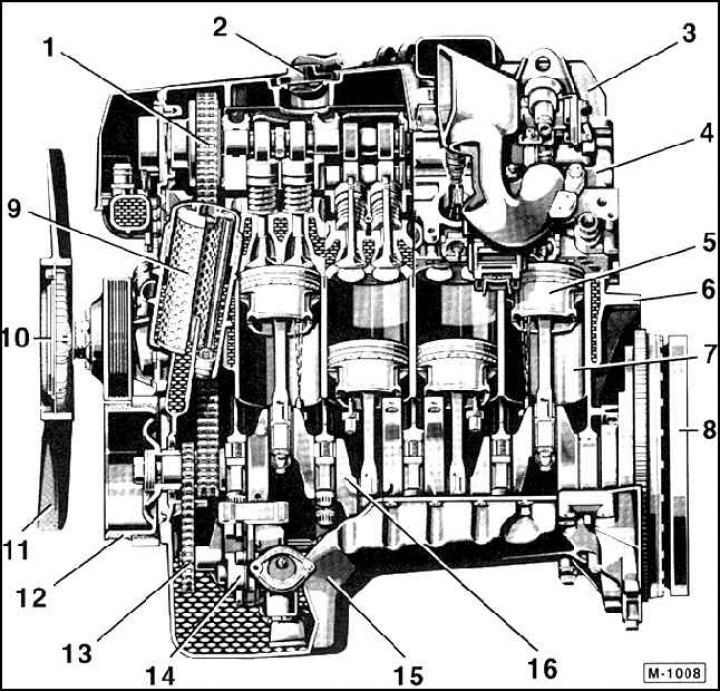
1. Double roller chain; 2. Oil filling cap; 3. Cylinder head cover; 4. Cylinder head; 5. Piston; 6. Flywheel; 7. Cylinder; 8. Flywheel 9. Oil filter; 10. Hydraulic coupling; 11. Fan; 12. Crankshaft pulley; 13. Oil pump drive chain; 14. Oil pump; 15. Oil pan; 16. Crankshaft
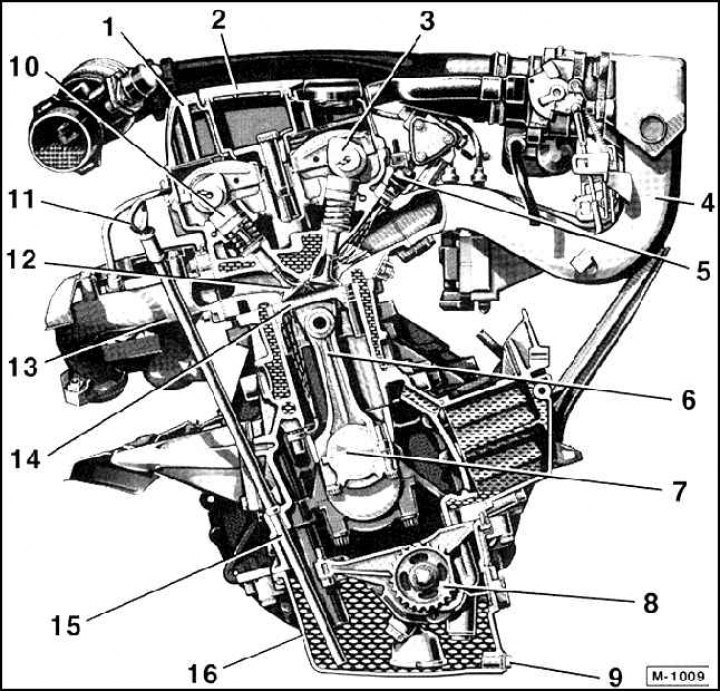
1. Cylinder head cover; 2. Ignition wire cover; 3. Intake camshaft; 4. Suction manifold; 5. Injection valve; 6. Connecting rod; 7. Crankshaft; 8. Oil pump; 9. Oil drain bolt 10. Hydraulic plate tappet; 11. Oil dipstick; 12. Exhaust valve; 13. Exhaust manifold; 14. Piston; 15. Oil dipstick guide tube; 16. Oil pan
The Mercedes C-Class models are equipped with in-line, 4- or 6-cylinder engines.
The engine block made of grey cast iron has bores for the working cylinders. If there are any nicks or scratches on their walls, they can be bored in a specialized workshop. Therefore, the pistons must be installed in the working cylinders with interference. The crankshaft is located at the bottom of the engine block, which is secured in bearings 5 and 7 of the crankshaft. The connecting rods that drive the pistons are connected to the crankshaft with a plain bearing. An oil pan is attached to the bottom of the engine, where the engine oil required for lubrication and cooling is collected. The cylinder head is attached to the top of the engine block, made of aluminum, which has good thermal conductivity and is significantly lighter than grey cast iron. The cylinder head is made according to the cross-flow principle. That is, the fuel-air mixture enters on one side of the cylinder head, while the hot gases are pushed out on the opposite side. Thanks to the cross-flow principle, better gas exchange is achieved. The cylinder head contains two camshafts: one for the intake valves and one for the exhaust valves. The four valves are directly driven by the camshaft via bucket tappets. The hydraulic bucket tappets automatically ensure uniform valve clearance under all operating conditions, making valve clearance adjustments unnecessary as part of maintenance.
The engine is lubricated by an oil pump. It is mounted at the front of the cylinder block and is driven by an additional roller chain. The oil sucked from the oil pan reaches the crankshaft and camshaft bearings and the working surfaces of the cylinders through holes and channels.
The coolant pump is mounted on the front of the engine block for 4-cylinder engines, and on the side of the engine block for 6-cylinder engines. The pump is driven by a ribbed V-belt, which also drives the generator and the steering pump. Keep in mind that the cooling system circuit must be filled annually with a fresh mixture of antifreeze and anti-corrosion agent based on decalcified water.
The flammable fuel-air mixture is prepared using a fully electronically controlled injection and ignition device, which requires virtually no maintenance.
Engine model | ||||
C180 | C200 | C220 | C280 | |
| Start of release with | 6/93 | 1/94 | 6/93 | 6/93 |
| Type | 202.018 | 202.020 | 202.022 | 202.028 |
| Engine | 111.920 | 111.941 | 111.961 | 104.941 |
| Working volume of cylinders, cm³ | 1799 | 1998 | 2199 | 2799 |
| Power, kW at rpm. hp at rpm. | 90/5500 122/5500 | 100/5500 135/5500 | 110/5500 150/5500 | 142/5000 193/5000 |
| Torque, Nm at rpm. | 170/4200 | 190/4000 | 210/4000 | 270/3750 |
| Cylinder diameter, mm | 85,3 | 89,9 | 89,9 | 98,9 |
| Piston stroke, mm | 78,7 | 78,7 | 86,6 | 73,5 |
| Compression ratio | 9,8 | 9,6 | 9,8 | 9,8 |
| Number of cylinders | 4 | 4 | 4 | 6 |
| Injection / Ignition | PMS | PMS | HFM | HFM |
| Cylinder firing order | 1–3–4–2 | 1–3–4–2 | 1–3–4–2 | 1–5–3–6–2–4 |
| Fuel / ROZ lead free | Super/95 | Super/95 | Super/95 | Super/95 |
| Filling capacities: | ||||
| - motor oil (with filter), l | 5,8 | 5,8 | 5,8 | 7,5 |
| – coolant, l | 8,0 | 8,0 | 8,0 | 10,0 |