



The coolant circulates under the action of a pump, which, like other additional units, is driven by a belt drive from the crankshaft.
A thermostat located in a special housing is used to regulate the thermal conditions of the cooling system. Depending on the required degree of cooling, the thermostat regulates the circulation of liquid through the radiator. There are three phases of thermostat operation: warming up (coolant does not flow into the radiator), working mode (variable circulation of liquid through the radiator) and maximum cooling (all liquid passes through the radiator).
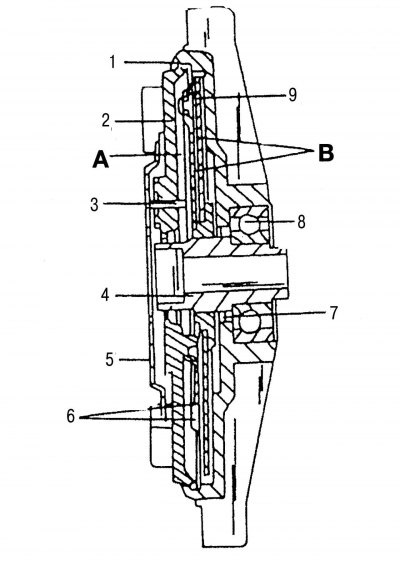
Figure 134. Viscous coupling of the cooling system fan (cross section): 1 — body; 2 - lid; 3 - contact pin; 4 — bearing sleeve; 5 - bimetallic element; 6 — valve; 7 - sealing ring; 8 - ball bearing; 9 - drive disk; A - preliminary chamber; B — working chamber
For more efficient cooling of the liquid passing through the radiator, a fan is installed behind it. It complements the cooling effect of the oncoming air flow while driving by forcing it through the radiator. The fan is driven by a viscous coupling located in the center of the impeller and controlled by a bimetallic spring depending on the temperature. A special silicone filler in the viscous coupling drives the fan when cooling is needed. When the engine is cold, the viscous coupling drive mechanism is open and the fan rotates at low speed. When the operating temperature rises to 85–90°C, the viscous coupling mechanism is activated and the rotation speeds of the fan and engine become equal. Figure 134 shows the internal structure of this mechanism.
(Full article available on the resource: «www.mercedesman.ru»)
Low coolant level
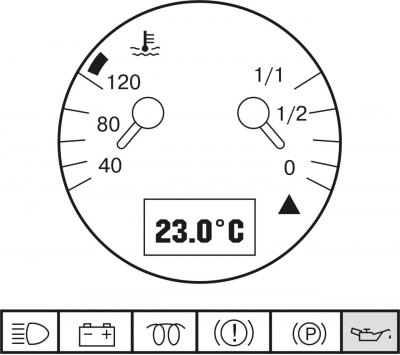
Figure 121. Oil pressure indicator light
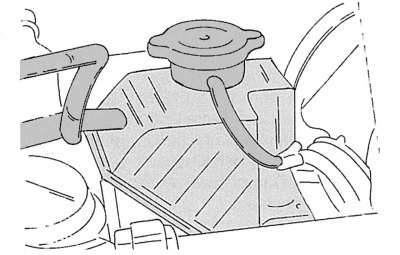
Figure 135. Location of the expansion tank of the cooling system
If the indicator light in the instrument cluster lights up when the vehicle is accelerating or turning (to the right of the oil pressure lamp shown in the figure 121), the amount of coolant in the system is insufficient. In this case, you should stop the car and add coolant through the filler hole of the expansion tank. Figure 135 shows a radiator expansion tank, which is often made opaque. Therefore, to check the fluid level, you need to unscrew the plug (the hot engine must cool down, the coolant temperature should not be higher than 50°C) and add fluid. If more than 0.75 l is required for topping up, the system connections must be checked. There is a high probability that there are coolant leaks in it.
There is a coolant level sensor in the tank. If the level is below the MIN mark, the sensor contacts close and the indicator lamp in the instrument cluster lights up. Through the pipe coming from the bottom of the expansion tank, the coolant enters the system or, conversely, back into the tank, depending on the volume of liquid poured in. The upper pipe serves for ventilation. The cooling system is ventilated independently through a ball valve in the thermostat. The expansion tank cap regulates the pressure in the system.
The cooling system contains antifreeze, the volume of which depends on the engine type and the vehicle's air conditioning.
The coolant pump is secured with four bolts through a sealing ring on the cylinder block. The pump cannot be repaired.