



Fuel tank
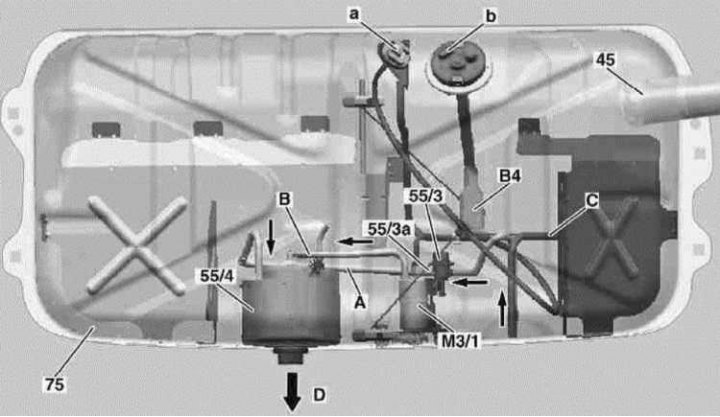
45 - Filler neck; 55/3 - Fuel pressure regulator (5.3 atm.); 55/3a - Damper (50 liters per hour); 55/4 - Intake chamber; 75 - Fuel tank; B4 - Fuel level sensor; M3/1 - Pump built into the fuel tank; A - Fuel tank pump wiring connector; B - Fuel level sensor wiring connector; A - Return of fuel from the pressure regulator (5.0 atm.) to the spray chamber; B - Filling line of the intake chamber from the pump built into the fuel tank; C - Fuel tank ventilation line; D - To fuel pump
Functional diagram of the ME SFI 2.0 microprocessor control system. V6 and V8 engines
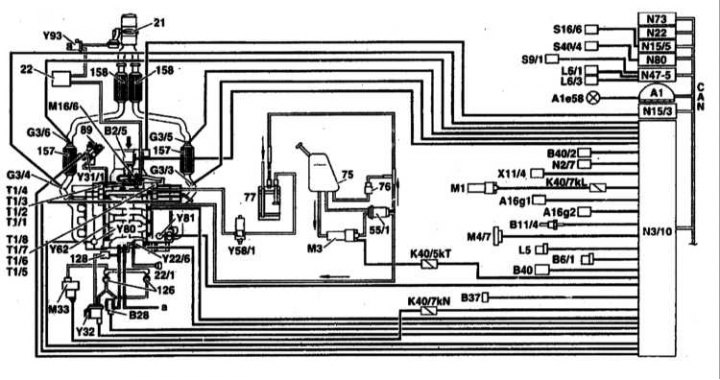
Shown on the example of engine 113
21 - Exhaust flap¹; 22 - Vacuum tank¹; 22/1 - Intake manifold diaphragm switch; 55/1 - Fuel filter with built-in pressure regulator; 75 - Fuel tank; 76 - Ventilation valve; 77 - Carbon adsorber; 89 - EGR valve; 126 - Secondary air mixing shut-off valve (combustion chamber valve: built-in non-return valve); 128 - Non-return vacuum valve; 157 - Three-function catalytic converter at the engine compartment bulkhead; 158 - Three-function catalytic converter under the bottom; a - Other consumers; A1 - Instrument panel; A1e58 - Engine Failure Diagnostic Indicator Lamp; A16g1 - Knock Sensor 1 (right side of the engine); A16g2 - Knock Sensor 2 (left side of the engine); B2/5 - Film air mass sensor (MAF) (integrated intake air temperature [IAT] sensor); B6/1 - Camshaft Hall Effect Sensor; B11/4 - Coolant Temperature Sensor (CTS); B28 - Pressure sensor¹; B37 - Pedal Position Sensor; B40 - Oil level/temperature/quality sensor; B40/2 - Cylinder deactivation system oil pressure sensor¹; G3/3 - Left (upstream) oxygen sensor; G3/4 - Right (upstream) oxygen sensor; G3/5 - Left (downstream) oxygen sensor; G3/6 - Right (downstream) oxygen sensor; K40/5kT - Fuel pump relay; K40/7kL - Starter relay; K40/7kN - Secondary air mixing system relay; L5 - Crankshaft Position Sensor (CKP); L6/1 - Left front wheel sensor; L6/3 - Left rear wheel sensor; M1 - Terminal 50 starter; M3 - Fuel pump; M16/6 - Throttle actuator; M33 - Electric Air Pump; N3/10 - ECM (ME-SFI); N15/3 - Electronic Traction Control (ETC) Control Module; N19 - Additional Air Control System (AAC) Push Button Control Module; N₂2 - Additional Air Control System (AAC) Push Button Control Module; N47-1 - Traction Control System (ASR)/Speed-Sensitive Power Steering (SPS) Control Module; N54-1 - IR DAS Control Module; S16/10 - Transmission position detection switch; S40/4 - Variable speed cruise control; T1/1 —; T1/8 - Ignition coils for cylinders 1-8 (dual coils); X11/22 - Diagnostic connector DLC II; Y22/6 - Variable Length Intake Manifold Switch Valve; Y31/1 - EGR Vacuum Transducer; Y32 - Secondary Air Mixing System (AIR) Air Pump Switch Valve; Y58/1 - Evaporative Canister Purge Control Valve; Y62 - Fuel injection injectors; Y80 - Right Bank Cylinder Shutoff Valve¹; Y81 - Left Bank Cylinder Shutoff System Valve¹; Y93 - Exhaust flap¹; CAN - Data bus.
¹ Only engine 113.960 with cylinder deactivation system (code 479)
Information copied from the website: MercedesMan.ru
Location of some electrical components
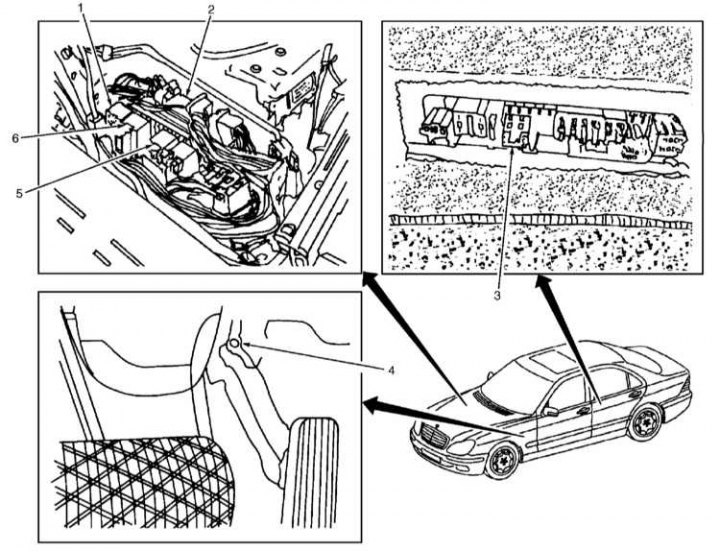
1 - Relay for electronic engine and chassis control systems; 2 - ECM (ME-SFI); 3 - Fuel pump relay; 4 - Pedal pressure sensor; 5 - Air pump relay; 6 - Starter relay
Variable geometry intake manifold air flows
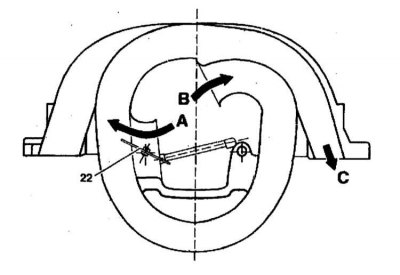
A - Air flow with the control valve open at engine speeds above 3900 rpm; 22 - Control flap (one for each cylinder); B - Air flow with the damper closed, at low loads in the speed range of 1750-3900 rpm; C - To the engine
Valve timing control. V6 and V8 engines
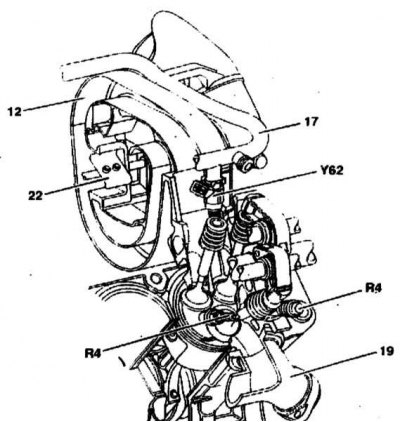
12 - Inlet manifold; 17 - Fuel distribution line; 19 - Exhaust manifold with air gap insulation; 22 - Resonant damper; R4 - Spark plugs (2 per cylinder); Y62 - Injector
Variable geometry intake manifold elements
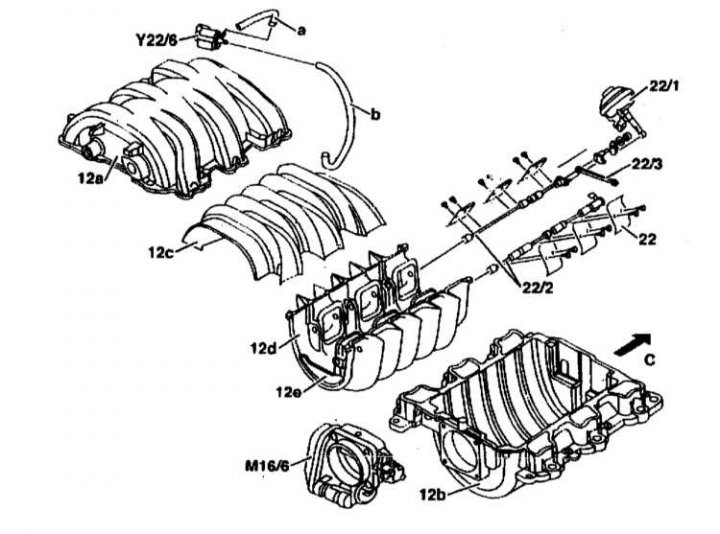
12a - Upper part of the pipeline; 12b - Lower part of the pipeline; 12c - Upper part of the pipeline insert; 12d - Lower part of the pipeline insert; 22 - Control flap; 22/1 - Diaphragm switching unit for pipeline; 22/2 - Damper axles; 22/3 - Connecting rods; a - Tube to the diaphragm unit; b - Tube to pipeline switching valve; M16/6 - Throttle actuator; Y22/6 - Inlet manifold
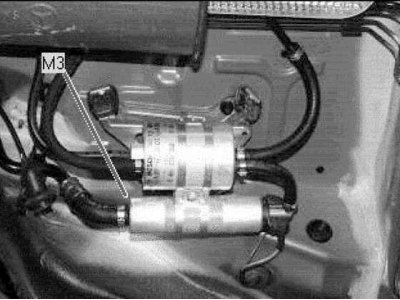
Fuel pump assembly (under the bottom, left rear)
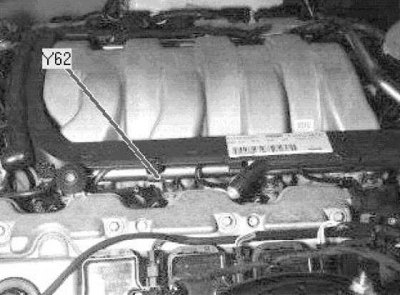
Fuel injectors (engine sides)
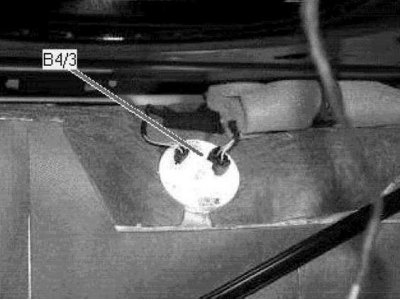
Fuel tank pressure sensor (front center part of the trunk)
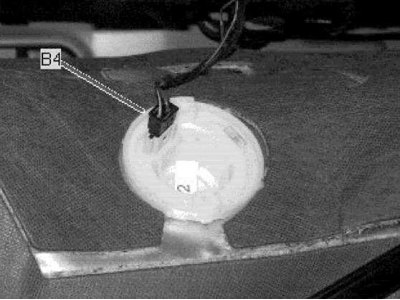
Fuel gauge (front center part of the trunk)
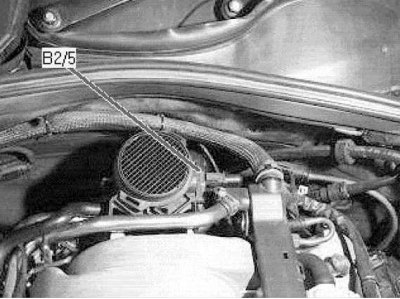
Thermometric air intake mass meter (central rear of the engine)
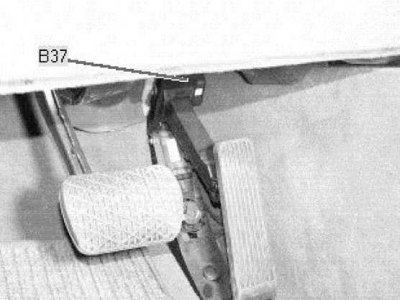
Accelerator pedal sensor
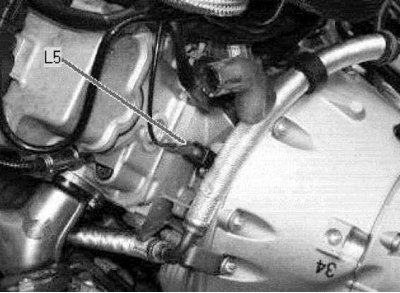
Crankshaft position sensor
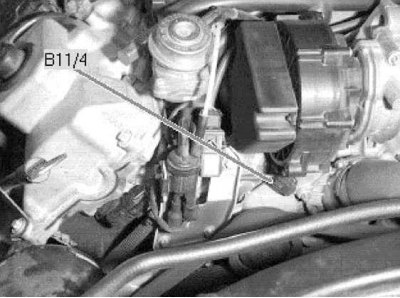
Coolant temperature sensor (front, central part of the engine)
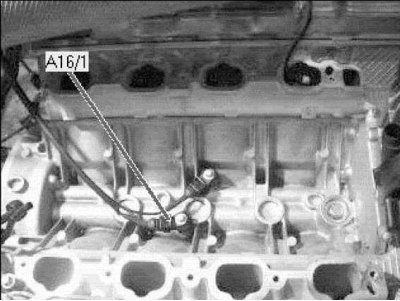
Knock sensors
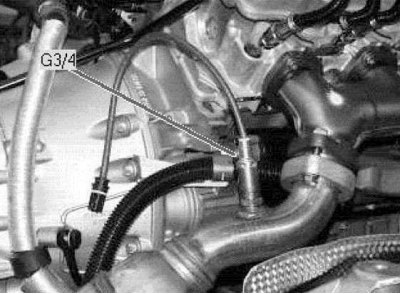
Right pre-catalytic lambda probe
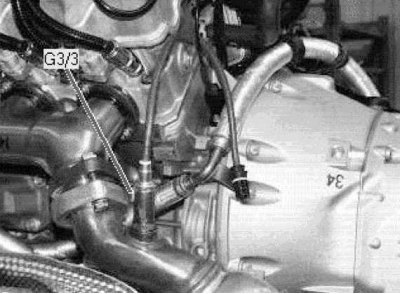
Left pre-catalytic lambda probe
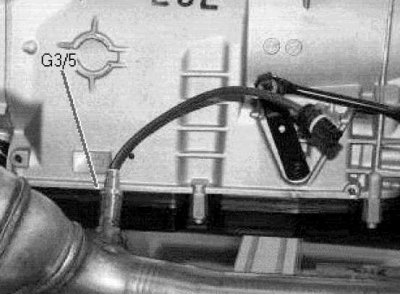
Left post-catalytic lambda probe
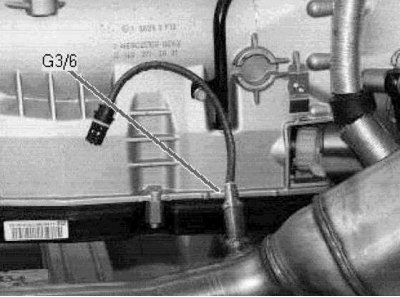
Right post-catalytic lambda probe
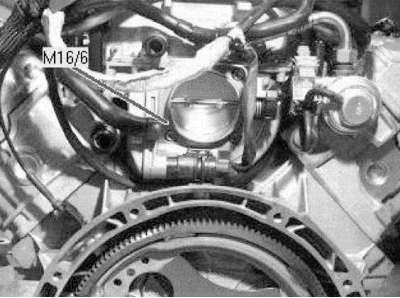
Throttle valve installation element (central rear of the engine)
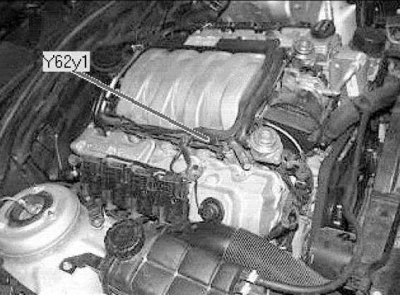
Fuel injection injector in cylinder 1 (right side of the engine)
Petrol engines
The fuel system consists of: installed in the rear of the vehicle (under the rear seat cushion) fuel tank with activated carbon canister, fuel lines, electric fuel pump, and electronic sequential injection system controlled by the control unit. The functional diagram of the control system and the location of the sensors are shown in the accompanying illustrations.
The fuel reserve is shown to the driver on the instrument panel. In a gasoline engine, gasoline vapors are collected in the adsorber and fed into the combustion chambers of the engine.
Driving style has a significant impact on fuel consumption. Tips for reducing fuel consumption:
- After starting the engine, move off immediately, even if it is in cold weather.
- If the vehicle is stopped for more than 40 seconds, turn off the engine.
- Always drive in the highest possible gear.
- When driving long distances, maintain a steady speed whenever possible. Avoid driving at high speeds. Drive carefully. Do not brake unnecessarily.
- Do not carry unnecessary loads on the vehicle. If the luggage rack is not in use, remove it from the roof.
- Check the air pressure in your tires. Do not allow the pressure to drop too much.
Diesel engines
The fuel system consists of: installed in the rear of the vehicle (under the rear seat cushion) fuel tank, fuel filter, injectors, fuel lines and hoses, fuel level sensor located inside the tank and the engine control unit.
Fuel is supplied by a special pump through a filter. The filter collects dirt and water contained in the fuel.
The engine is controlled by an electronic system similar to that of gasoline engines. The system controls the engine by analyzing information from a large number of sensors.
Diesel models do not have an accelerator cable. Instead, a pedal position sensor is installed on the pedal.
There is no fuel shut-off valve when the ignition is turned off. In order to shut off the engine when the ignition is turned off, the engine control unit sends a signal to the fuel injection pump control unit, which, in turn, stops the fuel supply to the injectors.
The fuel tank components are not removable. The fuel system is designed to prevent air from being sucked in when there is no fuel in the tank. The control unit constantly checks the fuel level in the tank, processing information from the fuel level sensor located in the tank. When the fuel level drops to a certain level, the control unit lights a warning lamp on the instrument panel, after which it forcibly causes fuel misfires, thereby limiting the maximum speed. This continues until the fuel level in the tank exceeds the permissible mark.
The fuel system of diesel engines is very reliable. If clean fuel is used and regular maintenance is performed, it should function properly until the end of the vehicle's service life. After very high mileage, the internal components of the injectors may wear out and need to be repaired. Since the pump-injectors have a complex design, it is recommended that repairs be carried out in a specialized workshop.
The fuel pump takes fuel (D) from the bottom of the damper (55/4), which serves to prevent air from entering the pump intake tract when cornering with a low fuel level in the tank (75).
The submersible fuel pump (M3/1) is controlled by an electronic module that monitors the quality of filling the damper and provides a flow rate of 220 l/h with an effective pressure of 0.3 atm.
Additionally, fuel is pumped into the damper by an auxiliary suction pump, which operates due to the flow of excess fuel returned to the tank from the pressure regulator (5.0 atm.).
Components placed inside the tank (including fuel pump) cannot be removed or repaired, and in case of their failure the entire tank assembly must be replaced. The only exception is the fuel level sensor (B4).
The throttle (55/3a) reduces fuel consumption in the return line (A) connected to the booster pump to 50 l/h at a pressure of 5.0 atm. The pressure regulator prevents the pressure from increasing above 5.3 atm.
Safety precautions and rules for maintaining cleanliness when working with the fuel system
When working with the fuel system, the following safety and cleanliness measures must be observed:
Note on safety precautions
Do not use open fire near the workplace, do not smoke or hold any very hot objects. There is a risk of accident! Keep a fire extinguisher at hand.
Ensure adequate ventilation of the work area. Fuel vapors are toxic.
The fuel system is under pressure. When opening the system, fuel may escape under pressure. Collect the fuel with a rag. Use safety glasses.
When working with diesel engine fuel system components, take special precautions. This applies especially to injectors. Keep in mind that the fuel pressure when leaving the injectors is about 1100 atmospheres. Do not allow any part of your body to come into contact with the fuel stream.
Hose connections are secured using band or clamp clamps. Clamp clamps must be replaced with band clamps or clamps of the latest design. A special device is available for installing band clamps, such as HAZET 796-5.
Clean connections and adjacent areas thoroughly before opening.
Place the removed parts on a clean lining and cover. Use polyethylene or paper for this. Do not use fibrous fabric!
Carefully cover open parts or install process plugs if the repair will take some time.
Install only clean parts. Remove spare parts from their packaging only immediately before installation. Do not use parts that have been stored unpackaged (for example, stored in a toolbox).
If possible, do not work with compressed air when the fuel system is open. If possible, do not move the vehicle while doing this.
Do not use sealants containing silicone. Silicone elements that get into the engine do not burn out and damage the oxygen sensor.
Safety precautions when removing the fuel tank:
- Before removing the tank, drain the fuel from it or pump out the fuel using a pump specially designed for this purpose.
- The fuel tank is removed from the underside of the vehicle. Before disconnecting the tank mounting clamps, place a jack and shims underneath the tank.
- An empty tank is explosive and cannot be disposed of in this form. Before disposal, the tank must be cut into pieces. Make sure that no sparks are generated. To do this, hand the fuel tank over to a specialized company.
- After installing the tank in place, start the engine and check the tightness of all connections.