



Cylinder deactivation to reduce fuel consumption
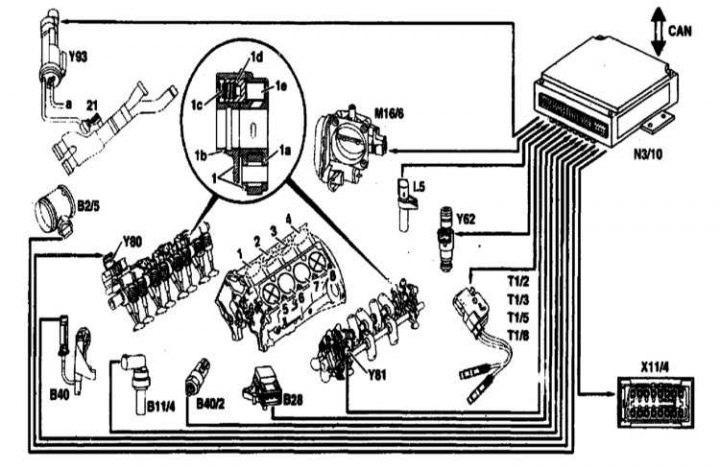
1-8 - Cylinders. Disabling cylinders 2, 3, 5 and 8 is possible under certain conditions; 1 - Rocker arm switching (blocked); 1a - Roller lever; 1b - Valve lever; 1c - Spring; 1d - Connecting pin; 1e - Pressure finger; 21 - Exhaust flap; B2/5 - Film type MAF air mass meter; B11/4 - Coolant temperature sensor; B28 - Pressure sensor; B40 - Oil level and temperature sensor; B40/2 - Cylinder shut-off oil pressure sensor; Y62 - Injectors for cylinders No.2, 3, 5 and 8; Y80 - Right bank cylinder shut-off valve; Y81 - Left Bank Cylinder Shut-Off Valve; Y93 - Exhaust plate valve; L5 - Crankshaft Position Sensor (CKP); M16/6 - Throttle actuator; N3/10 - Engine Control Module (ME-SFI); T1/2 - Ignition coil 2; T1/3 - Ignition coil 3; T1/5 - Ignition coil 5; T1/8 - Ignition coil 8; X11/4 - Diagnostic connector DLC; a - To the vacuum tank; CAN - Data Bus
Cylinder Shut-Off Drive
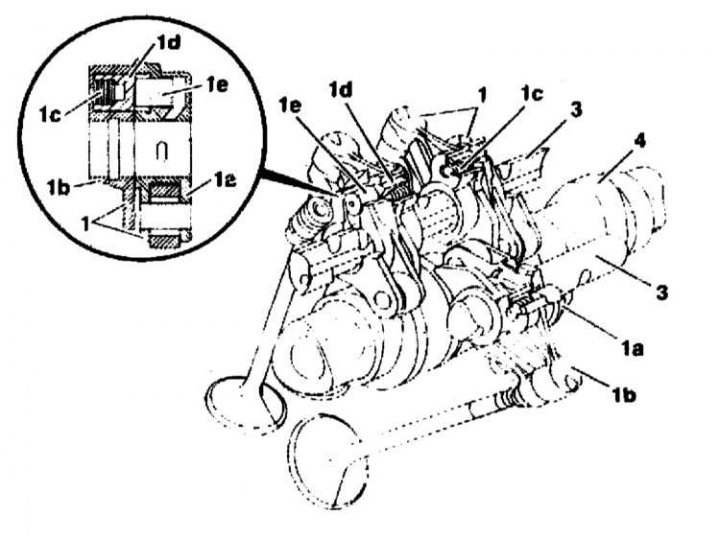
1 - Switching rocker arms; 1a - Roller lever; 1b - Valve lever; 1c - Spring; 1d - Connecting pin; 1e - Pressure finger; 3 - Rocker arm axles; 4 - Camshaft
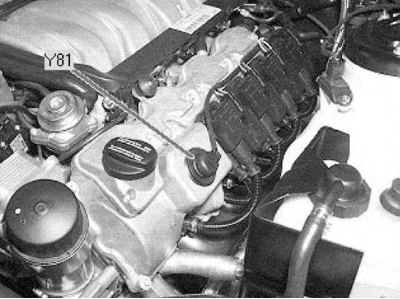 |
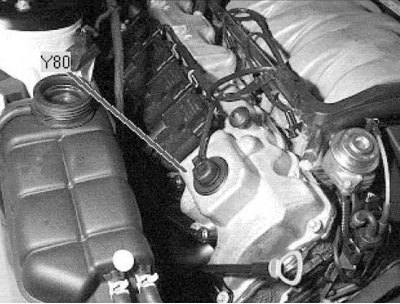 |
The valves of cylinders 2 and 3 of the right bank, as well as cylinders 5 and 8 of the left bank, are switched off under certain engine operating conditions.
Design/operating principle
To disable cylinders 2 and 3 (right bank of cylinders) and 5 and 8 (left row) their intake and exhaust valves stop functioning. When the cylinders are switched off, their valves remain permanently closed, and at the same time, fuel injection into them and the supply of high voltage to the ignition system are stopped.
(Article obtained from this portal MercedesMAN.ru)
The shutdown function is organized in the engine control module (ECM):
- Activation of the shut-off valve for the right bank cylinders (Y80).
- Activation of the shut-off valve for the left bank cylinders (Y81).
- Activation of the exhaust reed valve (Y93).
- Cylinder deactivation system oil pressure sensor signal (B40/2).
- Pressure sensor signal (B28), absolute pressure in the intake manifold.
- Detection of shutdown failures.
Input signals used in ECM:
- From CKP and engine speed sensors.
- From the throttle position sensor (TPS).
- Gear engagement signal.
- From the oil temperature sensor.
The applied ECM (ME-SFI) parameters are adjusted to the cylinder deactivation function. For example:
- Disconnection of fuel supply and supply voltage to certain cylinders with subsequent restructuring of valve timing and ignition timing to suit the new conditions (cylinders are disabled).
- Activation of the throttle actuator.
- Extrapolation of operating parameters for further changes in conditions (cylinders off/on).
- Adaptation of the mixture composition to current changes in air supply and pressure.
- Correction of the STAR diagnostic algorithm.
Cylinder deactivation function is deactivated
Both sections of the rocker arm are locked together by means of a movable connecting pin. A spring presses the pin into the locked position.
Cylinder deactivation function activated
The right and left bank cylinder shut-off valves (Y80 and Y81) are activated by the ECM and open. Pressurized oil is supplied under the pressure pin through the rocker shafts, which causes the connecting pins to be pushed back. The rocker sections receive individual degrees of freedom and acquire the ability to move freely relative to each other. The intake and exhaust valves cease to function.
The disengaged valve lever rests on the heel of the cam, which ensures that the sliding locking pin enters the roller cam socket to cancel the cylinder deactivation function.
Working moments of the cylinder shutdown procedure
Due to design features, cylinder deactivation can only be implemented in certain engine positions:
- The valves must be closed. Operation is only possible when the rocker arms are unloaded.
- At the end of the working cycle, the exhaust valves are always switched off first, the intake valves - last. In this case, gas under pressure enters the switched-off cylinder. The pressure prevents the oil from leaving the crankcase. Lambda control remains switched off when the cylinders are switched on again, and the exhaust gases are released.
- First, cylinders 2 and 3 on the right bank are switched off, then 8 and 5 on the left (in the order listed).
Cylinder deactivation function activation status
- Shutdown period (about 20 seconds) expires after the engine is started.
- Engine coolant temperature is higher than +20°C.
- Engine speed at normal operating temperature is:
- 925÷1700 per minute with 3rd gear engaged.
- 925÷1700 per minute with 4th gear engaged.
- 925÷3500 per minute with 5th gear engaged.
- AT mode: 3, 4 or D.
- The throttle opening angle does not exceed the threshold value determined by engine requests.
- Oil pressure exceeds 2.5 atm.
- The engine oil temperature is within the range of 20÷130°C.
- The intake air temperature is approximately -40÷100°C.
- The altitude of the place does not exceed 2500 m above sea level.
- The battery output voltage is not less than 10.5V.
- Cylinder disabling occurs for the STAR diagnostic coding option.
- The traction control system (ASR) controller is not activated.
Cylinder deactivation function deactivation state
- Misfires harmful to the 3-way catalytic converter (TWC) are detected.
- A malfunction in the cylinder shutdown function has been detected.
- The emergency mode of the electronic gas pedal control is activated
- There was a failure to output a signal from the oil temperature sensor.
- There was a failure to output a signal from the oil pressure sensor.
- At the request of the functional circuit diagnostic device.
- There is a disruption in the stability of revolutions that is excessive for the conditions of the cylinders being switched off.
- The maximum continuous operation time has been exceeded (about 25 seconds).
The cylinder deactivation function will be activated again after approximately 20 seconds.
Cylinder deactivation function activation threshold
The activation threshold determines the conditions for disabling and enabling the cylinder deactivation function at medium crankshaft speeds and moderate engine loads and depends on the correct programming of the STAR diagnostic parameters. The following adjustments are allowed to correct the program:
- The threshold is selected from the basic settings of the engine output parameters
- A restriction on activation at speeds below 1500 rpm is introduced.
- A limitation is introduced on the current state of the engine output parameters.
- The shutdown function is disabled.
Note: When the cylinder deactivation function is activated, only temporary adjustments to the STAR diagnostic parameters are allowed to restore the impaired comfort. It should be remembered that introducing restrictions on cylinder deactivation has a negative effect on fuel consumption.
Throttle actuator activation
When the function is activated, 4 engine cylinders are switched off. The torque is kept as constant as possible. The throttle valve opens again, depending on the load and engine speed. When the cylinders are switched off, the reverse is engaged and the throttle valve is closed accordingly.
The throttle valve is briefly activated before the cylinder deactivation function is switched on and off.
When switching between two engine operating modes, the same torque should be developed, if possible, in order to eliminate a noticeable difference in the power developed by the engine and to achieve smooth switching.
Exhaust flap activation
When the cylinder deactivation function is activated, the electromagnetic valve-switch of the exhaust flap is triggered by the ECM (ME-SFI) at engine speeds up to 2500 rpm. A vacuum is applied to the actuator diaphragm and the flap partially closes the cross-section of the exhaust pipe, which reduces the noise level.
Activation of cylinder shut-off valves
The cylinder shut-off valves for the right and left banks (Y80 and Y81) are activated by a pulsed voltage signal issued directly by the engine control module (ME-SFI).
When the cylinder cut-off function is activated, the switching speed reaches 95% in about 0.5 seconds to increase the starting current and improve the response speed. The coil windings are protected from thermal overload by introducing a time limit.
Additional measures applied to the power unit with the cylinders disabled
- A high-performance oil pump is selected (as on engine 120).
- A vibration damper is installed on the belt drive.
- In order to reduce background noise, a rotation converter with a turbine damper of torsional forces is used.