
Cars BMW Cars Volkswagen Cars Chevrolet Cars Land Rover Cars Lada Cars Honda Cars Peugeot
English Русский
Български
Беларускі
Український
Српски
Hrvatski
Română
Polski
Slovenský
Magyar
Bookmark News and articles Sitemap Feedback Site search
MercedesMan.ru


A-Class C-Class E-Class G-Class M-Class S-Class Others
W123 (1976-1985) W124 (1984-1995) W210 (1996-2002)
  • Main
  • E-Class
  • W210 (1996-2002)
  • Gasoline engines
  • Control system
  • Operation of the engine management system

Operation of the engine management system (Mercedes-Benz E-Class W210)

0
Contents: Elements of the engine management…↡ Electronic control system Motronic…↡
Fuel from the fuel tank is supplied to the fuel system via an electric fuel pump and then to the injectors. The pressure regulator ensures constant pressure in the system. Electrically controlled fuel injectors inject fuel into the intake manifold directly in front of the intake valves. The engine control unit determines the moment of fuel injection and its quantity.

In a 2.0-liter engine, fuel is injected simultaneously by two injectors every crankshaft revolution. In other engines, injection occurs sequentially, in accordance with the firing order of the cylinders.

The air sucked in by the engine passes through the air filter, the throttle body and then is directed to the intake valves.
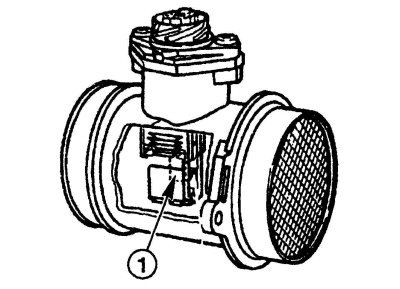
Fig. 5.37. Mass air flow sensor: 1 – plate

Fig. 5.37. Mass air flow sensor: 1 – plate


The required amount of fuel to be injected is determined based on the mass of air entering the engine and measured by the mass air flow sensor (HFM). The mass air flow sensor has a sensitive heated plate 1 (Fig. 5.37) cooled by the air passing through it. To maintain a constant temperature of the plate, the current value changes according to the mass of air being sucked in. The engine control unit determines the required amount of fuel to be injected based on the current value received from the mass air flow sensor.


The electronic control unit, receiving signals from various sensors and controls, ensures optimal engine operation depending on driving conditions. If one of the sensors is damaged, the control unit switches to emergency mode to prevent engine damage and ensure the vehicle's movement to the nearest auto repair shop. In this mode, the engine operates unstably and may stop when the accelerator pedal is pressed more.

Elements of the engine management system


The crankshaft position sensor is mounted on the cylinder block near the flywheel ring gear. It informs the control unit of the position and rotation speed of the crankshaft.

The camshaft position sensor is located on the cylinder head and indicates the current position of the camshaft.

The throttle position sensor transmits a signal about its angular position.

The idle switch informs the control unit about the throttle position when the engine is idling. In this case, the full load switch signals that the throttle valve is in the position corresponding to the operation of the engine at full load.

The coolant temperature sensor is a resistor whose resistance decreases as the coolant temperature increases.

The intake air temperature sensor is designed similarly to the coolant temperature sensor.

Fuel vapors from the fuel tank are captured by an absorber with an electromagnetic valve. Activated carbon accumulates fuel vapors, which, when the engine is running, as a result of the formation of a vacuum in the intake manifold, enter the cylinders, where they are burned.


(Article was borrowed from the website: mercedesman.ru)

Oxygen concentration sensor (lambda probe) is necessary for the correct operation of the catalytic converter, it sends a signal to the control unit about the amount of oxygen in the exhaust gases, as a result of which the control unit changes the fuel supply.

The idle speed control valve of the crankshaft regulates the amount of air entering the throttle bypass. As a result, a constant speed of rotation of the crankshaft is ensured, regardless of the number of connected consumers, such as, for example, a power steering pump or an air conditioning compressor.

Knock sensor (except for 2.0 l engine manufactured before 04.1996.) designed to determine the optimal ignition timing angle.

Camshaft Adjustment Device (except for 2.0L engines manufactured before 04.1996 and V6 engines). As a result of the action of the electrohydraulic actuator after the command of the control unit, the intake camshaft is rearranged relative to the chain drive. When rearranging in the "retard" direction, the engine operation at idle speed becomes softer, and accordingly, when the engine is running at a high crankshaft speed, the power increases. At low and medium crankshaft speeds, with early closing of the intake valves, the filling of the cylinders is improved, resulting in an increase in torque.

The use of a so-called resonant intake pipe on in-line 6-cylinder engines, which changes the length of the intake tract to the cylinders depending on the crankshaft speed, improves the torque characteristics.


Electronic control system Motronic ME, used on V6 and V8 engines


The Motronic ME system is an advanced HFM system. The fuel injectors, like those in the HFM system, operate sequentially in accordance with the cylinder firing order. The main difference is that the throttle valve is controlled by an actuator, which in turn regulates the crankshaft speed at idle. The accelerator pedal in this system has an electronic connection with the engine control unit. An electronic sensor monitors the pedal position. The throttle valve is controlled by the control unit using a servomotor. The accelerator pedal control system has a built-in system that ensures that the vehicle speed is maintained at a constant level.
This article is available at: russian, bulgarian, belarusian, ukrainian, serbian, croatian, romanian, polish, slovak, hungarian
The article has been verified: Polyakov Zakhar Grigorievich
Share with friends:
◀ Previous
E-Class W210 / Control system
Next ▶

Safety precautions when working with the engine management system
Engine Management Systems — General Description
Removal and installation ignition coils
Removal and installation the fuel distributor
Removal and installation fuel injectors
Checking the technical condition of fuel injectors
Possible malfunctions of the injection system, their causes and methods of elimination
More similar articles for repairing other models

☛ Engine lubrication system Mercedes W168 (1997-2004)
☛ Diagnostics of faults in the ignition and engine management system Mercedes W203 (2000-2007)
☛ The operating principle of the control and injection system of a… Mercedes W463 (1999-2019)
☛ Engine Management System (ML 430) Mercedes W163 (1997-2005)
☛ Engine Management System for 3.2L Models Mercedes W140 (1991-1998)
☛ Engine management system 111.948 and 111.978 Mercedes Vito 1 (1996-2003)
Link in different formats to this article
Comments and feedback from visitors
No comments yet


How much will 12 + 23 ?


W210 (1996-2002) 
  • General information
  • Vehicle description
  • Working conditions and tools
  • Car care
  • Diesel engines
  • Engine repair
  • Lubrication system
  • Cooling system
  • Injection system
  • Supply system
  • Exhaust system
  • Gasoline engines
  • Engine repair
  • Lubrication system
  • Cooling system
  • Control system
  • Power and exhaust system
  • Transmission
  • Clutch
  • Mechanical gearbox
  • Automatic gearbox
  • Drive shafts
  • Chassis
  • Car suspension
  • Steering
  • Tires and wheels
  • Brake system
  • Body
  • Exterior (external elements)
  • Interior (internal elements)
  • Doors and windows
  • Heating and ventilation
  • Electrical equipment
  • Equipment and devices
  • Power devices
  • Lighting and signaling
  • Electrical circuits
W124 (1984-1995) 
  • General information
  • Governing bodies
  • Driving and operation
  • Weekly care
  • Maintenance (gasoline)
  • Maintenance (diesel)
  • Troubleshooting
  • Power unit
  • I4 petrol engine
  • V6 petrol engine (SOHC)
  • V6 petrol engine (DOHC)
  • Diesel engines
  • Engine overhaul
  • Cooling system
  • Heating and ventilation
  • Fuel system (carburetor)
  • Injection system «Bosch CIS-E»
  • Injection system «Bosch HFM»
  • Diesel fuel system
  • Supply system
  • Starting and charging system
  • Ignition system (I4)
  • Ignition system (V6)
  • Preheating
  • Transmission
  • Clutch
  • Mechanical gearbox
  • Automatic gearbox
  • Drive shafts
  • Chassis
  • Brake system
  • Car suspension
  • Steering
  • Body
  • Exterior (external elements)
  • Interior (internal elements)
  • Doors, locks and windows
  • Electrical equipment
  • Equipment and devices
  • Switches
  • Headlights and lighting
  • Electrical circuits
W123 (1976-1985) 
  • General information
  • Introduction to the guide
  • Power unit
  • Engine device
  • Repair M102 engines
  • Repair M110 and M123 engines
  • Cooling and lubrication (M102)
  • Cooling (M110 and M123)
  • Ignition system
  • Power system «Stromberg»
  • Power system «Solex 4A1»
  • Fuel injection «K-Jetronic»
  • Fuel injection «L-Jetronic»
  • Transmission
  • Clutch
  • Mechanical gearbox
  • Automatic gearbox
  • Cardan and rear axle
  • Chassis
  • Front suspension
  • Rear suspension
  • Steering
  • Brake system
  • Body
  • Exterior (external elements)
  • Interior (internal elements)
  • Doors, locks and windows
  • Electrical equipment
  • Equipment and devices
  • Power devices
  • Electrical circuits
 
MercedesMan.ru © 2017–2026 · Mobile version · Read about Mercedes · Sitemap: EN BG BY UA RS HR RO PL SK HU · Feedback · Site search · Bookmark A-Class (W168) · C-Class (W201) · C-Class (W202) · C-Class (W203) · E-Class (W123) · E-Class (W124) · E-Class (W210) · G-Class (W463) · M-Class (W163) · S-Class (W116, petrol) · S-Class (W126, petrol) · S-Class (W140) · S-Class (W220) · Sprinter · Vito 1 · Vito 2 · Vario 814D ·
 
We only use cookies without which some of the site's features may not be available.