



By adding so-called "viscosity index improvers", all-season oils are stabilized when hot.
This ensures the necessary lubrication of the engine both in cold and hot conditions. The SAE designation indicates the viscosity of the motor oil.
SAE - Society of Automotive Engineers (Society of Automotive Engineers)
For example, SAE 10 W 40 means:
10 - oil viscosity when cold. The lower this number, the lower the viscosity of the cold motor oil.
W - indicates that the oil is suitable for winter operating conditions.
40 - viscosity of oil when hot. The higher this number, the higher the viscosity of hot motor oil (see illustration 8.0).
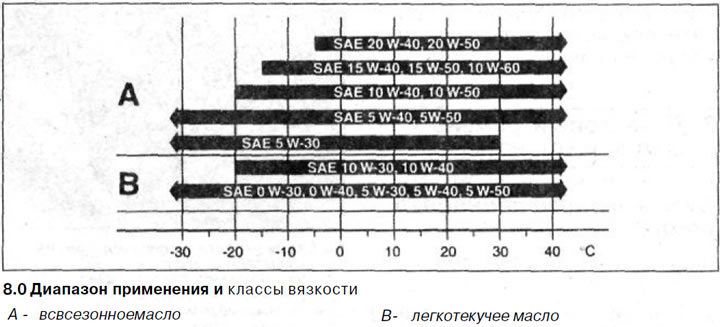
Easy-flowing oils can also be used (low friction oils). We are talking about all-season oils, which contain additives that reduce the friction coefficient, as a result of which the friction of internal engine parts is reduced.
The base of easy-flowing oils is synthetic oil.
Figure 8.0 shows the viscosity of motor oils depending on the ambient temperature.
Since the application areas of related oils according to SAE classification overlap, short-term temperature fluctuations can be ignored.
It is permissible to mix oils of different viscosity if it is necessary to add oil and the air temperature does not correspond to the viscosity class of the oil poured into the engine.
Caution! Lubricating additives of any kind must not be added to either fuel or lubricating oils.
Motor oil specification
The quality of motor oil is indicated by the corresponding standard of car and oil manufacturers.
Classification of motor oils of American manufacturers is carried out according to the API system: an abbreviation of the first letters of the American Petroleum Institute (american Petroleum Institute).
The designation is made using two letters. The first letter indicates the area of application:
- S - for internal combustion engines;
- C - for diesel engines.
The second letter in the designation indicates the quality of the oil and is used in alphabetical order.
The highest quality oils are those of the SL specification for internal combustion engines and CF for diesel engines.
European oil manufacturers use the ACEA (Association des Constructeurs Europens d'Automobiles) specification, which takes into account European engine production technologies.
Oils for gasoline engines of passenger cars have ACE A classes from A1-96 to AZ-96; for diesel engines - classes from B1-96 to B4-96. The highest quality oils are A3 for gasoline and B3 for diesel engines.
Oils with the B4 designation are intended for use in direct fuel injection engines only. However, they can only be used if the B3 specification is also indicated on the packaging.
The numbers 96 indicate the beginning of the ACEA specification validity. This means that this specification was introduced in 1996. Motor oils with earlier specifications can also be used.
Attention! Motor oils on which the manufacturer has indicated that they are intended for diesel engines cannot be used in gasoline engines. However, there are oils that are suitable for both gasoline and diesel engines. In such cases, both specifications are indicated on the packaging of motor oils intended for both gasoline and diesel engines (for example, ACEA A3-96/B3-96 or API SH/CF).
Recommended motor oil for A-class car engines
Petrol engines:
- API-SG or higher;
- ACEA A3-96.
Diesel engines:
- API-CE or higher;
- ACE A B 3-96;
- ACEA A3-96/B3-96.