



Contents: Removal ↡ Removal the engine from the front…↡ Installation ↡ Installing the engine together with…↡ Diesel Engine Cars ↡
The power plant, together with the transmission, rack and pinion steering gear and auxiliary units, is mounted on the front beam, connected to the body with bolts at eight points.
To remove the engine, it is necessary to dismantle all units mounted on the front beam.
Since performing this set of works on the engine requires a certain amount of experience, it is recommended to entrust them to a workshop.
For this reason, the chapters in this section only cover the basic steps to be taken when working on the engine.
The given procedure for removing and installing the power unit is given using the example of cars with gasoline engines. The features of removing and installing diesel engines are described at the end of the chapter.
Removal
1. Cars with automatic transmission: Drain the oil from the transmission.
2. Screw in the drain plug after the transmission oil has drained, installing a new sealing ring on the plug. The tightening torque of the plug is 22 Nm.
3. Drain the coolant from the radiator and engine block.
4. Disconnect the ground (-) wire terminal from the battery terminal, turning off the ignition.
Attention! When disconnecting the battery from a radio with an access code that prevents its unauthorized use, the specified code is deleted, as well as the settings on the radio station. Therefore, before disconnecting the battery, make sure that the code is written down and can be re-entered into the radio after connecting the battery. If the code is unknown to the car owner, then only a specialized workshop or its manufacturer can put the radio into operation.
5. Press the locking lever, remove the windshield washer reservoir from the supports and hang it up.
Caution: In vehicles with heated windshield washer reservoirs, first disconnect the coolant hoses.
6. Disconnect the ground (-) wire at the front engine mount bracket on the right side.
7. Remove the air intake, air intake hose, and on vehicles with 1.6/1.9 L engines, also the resonator.
8. Remove the low pressure hose from the intake manifold.
9. Disconnect the multi-pin connector from the engine control unit by lifting the clamp upward and unlocking it.
10. Disconnect the fuel line from the fuel distribution line and plug it with a suitable plug.
11. Disconnect the low pressure hoses from the canister valve and intake manifold and set them aside from the work area.
12. Disconnect the cooling system hoses from the radiator and expansion tank.
13. Cars produced since 6/99 with a separate expansion tank. Press the locking bracket and remove the tank.
14. Remove the coolant hose from the fitting on the thermostat housing.
15. Cars with automatic transmission. Disconnect the oil line hoses from the oil cooler and plug them with suitable plugs. The oil cooler is built into the engine cooling system radiator.
16. Disconnect the heater supply and outlet hoses.
17. Disconnect steering coupling 1 from steering shaft 2. To do this, unscrew clamping bolt 3 with a socket head and remove stop 4 (see illustration).
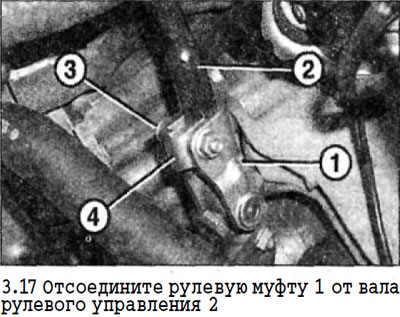
18. Open the cover of the wiring distribution box on the left frame side member and disconnect the positive wire and the power steering power wire.
19. Vehicles with manual transmission: Turn the lug nuts counterclockwise to loosen them and disconnect the shift rods from the ball heads.
20. Vehicles with automatic clutch. Disconnect the connectors on the gearbox, release the wiring harness from the holder and put it aside from the work area.
21. Disconnect the hose from the air pump, if equipped.
22. Disconnect the upper supports of both shock absorber struts.
23. Unscrew both calipers from the steering knuckles and secure them with wire under the fenders without removing the brake pads or disconnecting the brake hoses.
24. Right wheel brake mechanism. Disconnect the connector of the brake pad wear sensor and wheel speed sensor.
25. Disconnect the exhaust pipe from the catalytic converter.
26. Disconnect the flange at the junction of the inlet pipe and the catalytic converter. Depending on the car model, the flange may be secured with bolts or the junction of the inlet pipe and the catalytic converter is connected with a clamp.
27. Engine with two lambda probes. Release the lambda probe connecting wire secured to the bottom and disconnect the plug.
28. Feed the connecting hose down and remove it from the gearbox, after removing the safety clamp. Plug the hose opening with a suitable plug.
29. Cars with air conditioning. Loosen the V-belt and remove it from the air conditioning compressor pulley.
30. Cars with air conditioning. Unscrew the compressor mounting bolts and, without disconnecting the hoses and power wires from it, secure it to the bottom with wire.
31. Support the front axle beam with a garage jack, placing a wooden block on it.
32. Unscrew the bolts securing the strut that connects the beam to the bottom.
33. Unscrew the bolts securing the left and right mudguards to the bottom and move them down to gain access to the front axle beam mounting bolts.
34. Unscrew the eight bolts securing the front axle beam. The bolts have heads for a multi-sided socket wrench.
35. Lower the engine down on the front axle beam to gain access to the starter and generator.
36. Cars with automatic transmission. Disconnect the gearshift rod from the gearbox. To do this, disconnect the rod mount on the gearbox and remove it from its seat, and also disconnect the plug on the gearbox.
37. Disconnect the ground (-) wire from the oil pan together with the holder.
38. Disconnect the power wires from the starter.
39. Disconnect the power wires from the generator.
40. Lower the power unit down on the beam, taking precautions. Ask an assistant to guide the engine as it is lowered.
Removal the engine from the front axle beam
41. Raise the engine and gearbox with a suitable lifting device (talya, etc.), to relieve the engine mounts.
Attention! To lift the engine, three chains must be passed through the right and left sides of the engine and oil pan. The chains must be positioned as vertically as possible, which is possible with the help of an appropriate frame.
42. Remove the flange bolts that secure the engine mount supports.
43. Using a suitable screwdriver, pry the left half shaft out of the gearbox.
44. Unscrew the bolts securing the intermediate shaft support bearing to the cylinder block.
45. Using a suitable screwdriver, pry the intermediate shaft of the right half-axle out of the gearbox.
46. Carefully lift the engine together with the gearbox and carefully remove the tail of the left half-shaft, as well as the intermediate shaft from the gearbox. Check the condition of the drive shaft retaining rings and, if damaged, replace them with new ones.
47. Unscrew the bolts securing the catalytic converter bracket to the gearbox.
48. Unscrew the bolts that connect the engine and gearbox.
49. Remove the starter and push the gearbox away from the engine. Be careful not to lose the centering bushings.
Installation
The engine is installed on the front axle beam in the reverse order.
50. Lower the power unit down and carefully insert the tailpieces of the left drive shaft and intermediate shaft into the splined holes on the gearbox until fully engaged.
Tightening torques for threaded connections:
- starter to gearbox - 20 Nm
- engine and gearbox - 20 Nm
- engine mounts to suspension bracket - 55 Nm
- intermediate shaft support bearing to the engine - 20 Nm
Installing the engine together with the front axle beam
Installation is performed in the reverse order of removal. In this case, the following steps should also be performed:
51. Connect the power wires to the starter and generator.
52. Raise the engine together with the front axle beam and guide them so that the guides on the front axle beams fit exactly into the holes on the side members.
53. Tighten all axle beam mounting bolts with a socket head first, then tighten all the others.
Tightening torques:
- m12 bolt with socket head - 120 Nm
- m10 socket head bolt - 60 Nm
54. Insert the connecting hose with a new sealing ring into the gearbox and secure it by inserting the stopper on the side.
55. Fasten the inlet pipe with bolts, installing a new sealing gasket, on the connecting flange of the catalytic converter and tighten them with a torque of 25 Nm. If damaged, replace the blind nut. If the inlet pipe is connected to the catalytic converter using a clamp, then install the clamp.
56. Screw on the brake calipers with new bolts and tighten them to a tightening torque of 115 Nm.
57. Secure the upper supports of both shock absorber struts to the mudguards. Tighten their mounting bolts to a torque of 40 Nm.
58. Cars with manual transmission. After connecting the gear shift rods, check that they are securely fastened.
Original can be found on the website www.mercedesman.ru
59. Attach the steering coupling to the steering shaft by screwing on a new self-locking flange nut or installing a new bolt and tightening to 20 Nm.
60. Vehicles with automatic transmission. Connect the oil line hoses and tighten them to a tightening torque of 25 Nm.
61. Connect the multi-pin plug to the engine control unit and secure it with the bracket by pressing it down.
62. Connect the negative (-) wire terminal to the battery terminal with the ignition off. Enter the access code that is supplied with the radio and set the clock.
63. Vehicles with automatic transmission: Screw in the drain plug, install a new sealing gasket and tighten the plug to 22 Nm.
64. Fill the gearbox with oil.
65. Remove air from the clutch hydraulic drive.
66. Fill the cooling system with coolant and check the system for leaks.
Diesel Engine Cars
67. Remove the front bumper.
68. Remove the charge air cooling radiator and disconnect the charge air hose from the mixer.
69. Disconnect the low pressure hoses from the turbocharger, EGR valve, boost pressure sensor and vacuum pump by squeezing the clamp lugs.
70. Disconnect the fuel hoses from the fuel filter and plug them with suitable plugs.
Attention! On cars produced since 03/01, the generator power wire on the D+ terminal is not screwed, but simply inserted.
71. Remove the engine from the front axle beam. Before doing this, disconnect the ground (-) wire secured to the front left engine support bracket.