



Checking the technical condition of the auxiliary drive belt


"30,000 km 2 years"
1. Turn off the ignition.
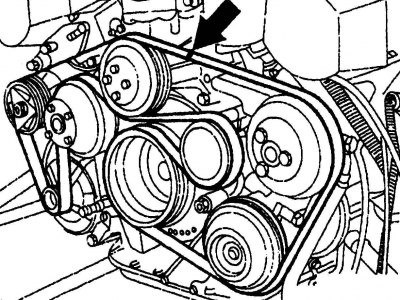
Fig. 5.4. Checking the technical condition of the auxiliary drive belt
2. Mark the belt with chalk in a clearly visible place (fig. 5.4, arrow).
3. Set the gear shift lever to neutral position.
4. Apply the parking brake to the vehicle.
5. Turn the engine with a socket wrench until a chalk mark appears on the belt.
Attention! Rotate the engine only clockwise.
6. Turn the crankshaft a few more times. This is the only way to inspect the entire belt. Often there is only one, but very deep cut on it, which is not visible during inspection, because in this place the belt lies on the pulley.
7. Check the outer surface of the belt.
8. The belt should be replaced if you find the following defects:
- uneven wear marks on the edges of the belt;
- porous surface or "fringe";
- cuts;
- traces of oil or grease.
Removal, installation and tensioning the accessory drive belt
4-cylinder in-line engine


Removal
For models with automatic control of the heating system or exhaust air conditioning system up to 08.1996.:
1. Remove the fan viscous coupling.
For all models:
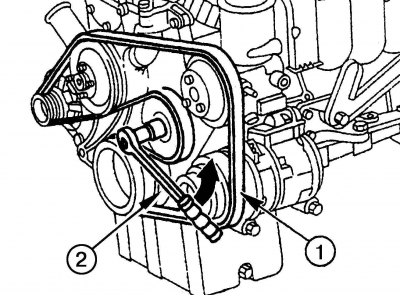
Fig. 5.5. Changing the tension of the auxiliary drive belt: 1 – belt; 2 – key
2. Install key 2 (Fig. 5.5) with Torx E10 socket head on the tension roller bolt and loosen the tension of belt 1 by turning the key counterclockwise.
3. Remove the belt.
Caution! Do not tilt the tension lever by the tension roller mounting nut.
Installation
4. Check the pulley profiles and tensioner for damage and contamination. Clean or replace parts if necessary.
5. Check the tensioner bearings and pulley ribs for chips.
6. Check the condition of the belt. If there is contamination of grooves, fraying, transverse cracks or breaks, the belt must be replaced.
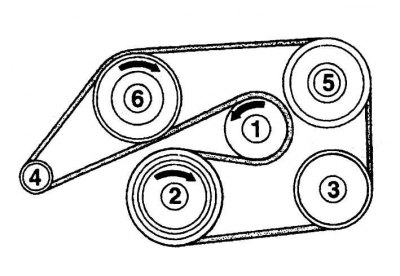
Fig. 5.6. Installing the accessory drive belt on a 4-cylinder in-line engine: 1 – tension roller; 2 – crankshaft; 3 – compressor (air conditioning system); 4 – alternating current generator; 5 – Power steering pump; 6 – coolant pump
7. Place the belt on the pulleys, starting with tension roller 1 (Fig. 5.6) and then according to the numbering shown in the diagram.
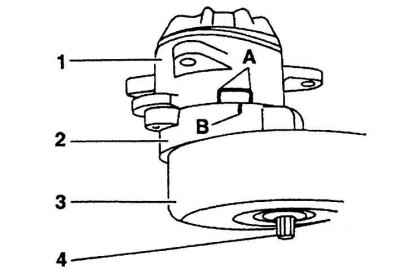
Fig. 5.7. Installing the tension roller: 1 – holder; 2 – tension lever; 3 – tension roller; 4 – Torx bolt E10
8. Release tension roller 3 (Fig. 5.7). Mark "B" should be located in working zone "A". If the mark goes beyond this zone, this indicates that the belt length is not suitable for this engine or that the tensioner is faulty.
9. Check the position of the belt on the pulleys.
10. Install the fan viscous coupling.
6-cylinder in-line engine (additional information)
Attention! Since the engine is equipped with two types of tension rollers - 92 mm and 80 mm in diameter, belts of different lengths are required. When installing a tension roller with a diameter of 80 mm, a belt 20 mm shorter is required than when installing a roller with a diameter of 92 mm.


Removal
1. Remove the fan shroud.
2. Place a SW15 socket wrench on the tension roller nut and turn the wrench counterclockwise to loosen the belt tension.
3. Remove the belt.
Installation
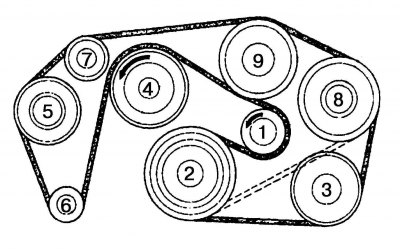
Fig. 5.8. Installing the accessory drive belt on a 6-cylinder in-line engine: 1 – tension roller; 2 – crankshaft; 3 – compressor (air conditioning system); 4 – fan; 5 – air pump; 6 – alternating current generator; 7 – upper guide roller; 8 – Power steering pump; 9 – coolant pump
4. Place the belt on the pulleys, starting with tension roller 1 (Fig. 5.8) and then according to the numbering shown in the diagram.
5. Loosen the tension roller by turning the key clockwise. Put the belt on completely.
6. Check the position of the belt on the pulleys.
7. Insert the fan shroud ring, turn and lock.
6-cylinder V-engine (additional information)


Removal
1. Remove the fan with viscous coupling.
2. Remove the fan shroud.
3. Loosen the belt tension by placing a Torx socket on the tension roller bolt and turning it counterclockwise.
4. Remove the belt.
Installation
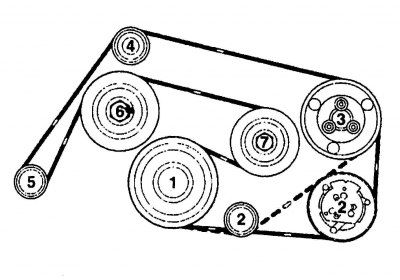
Fig. 5.9. Installing the auxiliary drive belt on a 6-cylinder V-engine M112: 1 – crankshaft; 2, 4 – guide roller; 3 – Power steering pump; 5 – generator; 6 – Coolant pump/fan; 7 – tension roller
5. Place the belt on the pulleys, starting with pulley 1 (Fig. 5.9) of the crankshaft and then according to the numbering shown in the diagram.
6. Loosen the tension roller by turning the key clockwise. Put the belt on completely.
7. Check the position of the belt on the pulleys.
8. Install the fan shroud.
9. Install the fan with viscous coupling.