
Cars BMW Cars Volkswagen Cars Chevrolet Cars Land Rover Cars Lada Cars Honda Cars Peugeot
English Русский
Български
Беларускі
Український
Српски
Hrvatski
Română
Polski
Slovenský
Magyar
Bookmark News and articles Sitemap Feedback Site search
MercedesMan.ru


A-Class C-Class E-Class G-Class M-Class S-Class Others
W123 (1976-1985) W124 (1984-1995) W210 (1996-2002)
  • Main
  • E-Class
  • W210 (1996-2002)
  • General information
  • Car care
  • Paintwork care

Paintwork care (Mercedes-Benz E-Class W210)

0
Contents: Car paint coating products ↡ Preservation of paintwork ↡ Paint care and conservation ↡
When a car is moving, its entire outer surface is subject to damage, and is exposed to the negative influence of the environment.

Repairing paintwork damage is very expensive, especially if the car is new. Regularly washing the car, removing dirt and dust from it will allow the body of your car to last longer.

Car paint coating products


What products your car needs depends on its paintwork. For a new car that has been maintained in good conditions, it is enough to use a "soft" polish. It removes small scratches, damage and wear. In addition, this softening polish preserves damaged areas from rust and combines well with old paintwork.

The more often the paintwork is serviced, the more reliable it is. All damage, defects and scratches must be treated in a timely manner.

Preservation of paintwork


It is generally recommended to renew the old coating and protect the new one by applying protective preparations two or three times a year. This will help the gloss last longer and improve the long-term protection of the coating. Most protective preparations and paint cleaners are quite aggressive. Therefore, never work in direct sunlight. Otherwise, the chemical compounds of the polish will "stick" to the paint.

Paint care and conservation


Polishing


1. Before polishing, be sure to wash and dry your car.
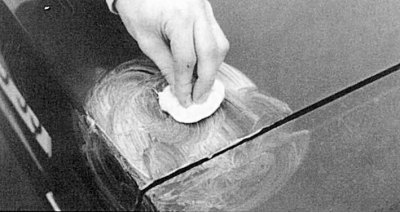


Fig. 3.19. Checking the quality of polishing

Fig. 3.19. Checking the quality of polishing


2. Test how the polishing agent lays on the surface. First polish a small area of the surface (Fig. 3.19). Be careful, since the agent can damage the surface if applied in a thick layer.
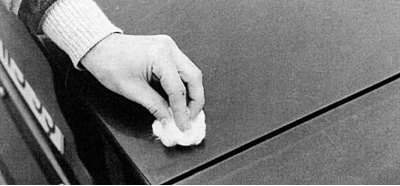
Fig. 3.20. Applying polishing agent and varnish cleaner to the body surface with a woolen or cotton…

Fig. 3.20. Applying polishing agent and varnish cleaner to the body surface with a woolen or cotton cloth


3. If the product is applied well, you can begin polishing all surfaces of the car body. Apply the polishing product and varnish cleaner with a wool or cotton cloth (Fig. 3.20). Do not apply too much force, otherwise you may damage the surface. If you feel that the material you are polishing with does not glide smoothly over the surface, turn it over or replace it.


4. After a short treatment, a small white spot appears, which is then removed with a piece of cotton wool in a circular motion. Do not treat the openings that are subject to air pressure when the car is moving too much.

5. After some time, more effort will have to be applied to polish, as the preparation will penetrate into internal microcracks and scratches. Therefore, it is advisable to replace the material with a new one.
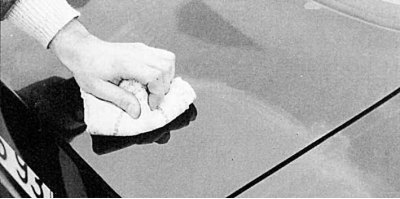
Fig. 3.21. Wiping the surface with a clean woolen cloth after polishing

Fig. 3.21. Wiping the surface with a clean woolen cloth after polishing


6. After polishing, wipe the surface with a clean woolen cloth (Fig. 3.21) to remove any remaining lint and polishing agent.

Preservation of paintwork
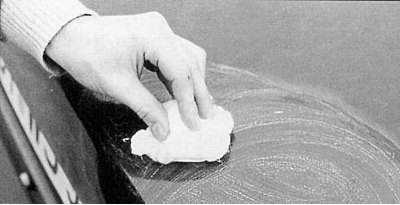


Fig. 3.22. Applying preservative with a cotton swab

Fig. 3.22. Applying preservative with a cotton swab


1. Apply a layer of preservative using a cotton swab (Fig. 3.22). The consumption of preservative depends on the size of the surfaces to be coated.


Caution: Since preservatives contain harmful gradients, ensure good ventilation where you are working.


2. Remove the wettest areas with a cotton swab using circular motions.

3. When applying the preservative, do not press the pad hard against the surface and turn it over or change it as often as possible. If you feel a "squeak" when applying the preservative, this means that the surface is not prepared enough, so try polishing it again.

4. If after applying the preservative the coating looks uneven (bumpy) in some areas, treat these areas again with polishing paste.
This article is available at: russian, bulgarian, belarusian, ukrainian, serbian, croatian, romanian, polish, slovak, hungarian
The article has been verified: Polyakov Zakhar Grigorievich
Share with friends:
◀ Previous
E-Class W210 / Car care
Next ▶

Possible malfunctions of the windshield wiper, their causes and methods of elimination
Possible malfunctions of the windshield wiper system, their causes and methods of elimination
Removal and installation the rear window wiper motor (T-model)
Removal the rear window wiper arm (T-model)
Windscreen wiper motor terminals
Repairing paintwork damage
Mercedes E-Class Maintenance Schedule
More similar articles for repairing other models

☛ Vehicle care Mercedes W168 (1997-2004)
☛ Periodic care and maintenance Mercedes W202 (1993-2000)
☛ Routine care and maintenance — general information Mercedes W463 (1999-2019)
☛ Checking battery condition, care and charging Mercedes W140 (1991-1998)
☛ Maintenance and care — general information Mercedes Sprinter (1995-2000, diesel)
Link in different formats to this article
Comments and feedback from visitors
No comments yet


How much will 20 + 18 ?


W210 (1996-2002) 
  • General information
  • Vehicle description
  • Working conditions and tools
  • Car care
  • Diesel engines
  • Engine repair
  • Lubrication system
  • Cooling system
  • Injection system
  • Supply system
  • Exhaust system
  • Gasoline engines
  • Engine repair
  • Lubrication system
  • Cooling system
  • Control system
  • Power and exhaust system
  • Transmission
  • Clutch
  • Mechanical gearbox
  • Automatic gearbox
  • Drive shafts
  • Chassis
  • Car suspension
  • Steering
  • Tires and wheels
  • Brake system
  • Body
  • Exterior (external elements)
  • Interior (internal elements)
  • Doors and windows
  • Heating and ventilation
  • Electrical equipment
  • Equipment and devices
  • Power devices
  • Lighting and signaling
  • Electrical circuits
W124 (1984-1995) 
  • General information
  • Governing bodies
  • Driving and operation
  • Weekly care
  • Maintenance (gasoline)
  • Maintenance (diesel)
  • Troubleshooting
  • Power unit
  • I4 petrol engine
  • V6 petrol engine (SOHC)
  • V6 petrol engine (DOHC)
  • Diesel engines
  • Engine overhaul
  • Cooling system
  • Heating and ventilation
  • Fuel system (carburetor)
  • Injection system «Bosch CIS-E»
  • Injection system «Bosch HFM»
  • Diesel fuel system
  • Supply system
  • Starting and charging system
  • Ignition system (I4)
  • Ignition system (V6)
  • Preheating
  • Transmission
  • Clutch
  • Mechanical gearbox
  • Automatic gearbox
  • Drive shafts
  • Chassis
  • Brake system
  • Car suspension
  • Steering
  • Body
  • Exterior (external elements)
  • Interior (internal elements)
  • Doors, locks and windows
  • Electrical equipment
  • Equipment and devices
  • Switches
  • Headlights and lighting
  • Electrical circuits
W123 (1976-1985) 
  • General information
  • Introduction to the guide
  • Power unit
  • Engine device
  • Repair M102 engines
  • Repair M110 and M123 engines
  • Cooling and lubrication (M102)
  • Cooling (M110 and M123)
  • Ignition system
  • Power system «Stromberg»
  • Power system «Solex 4A1»
  • Fuel injection «K-Jetronic»
  • Fuel injection «L-Jetronic»
  • Transmission
  • Clutch
  • Mechanical gearbox
  • Automatic gearbox
  • Cardan and rear axle
  • Chassis
  • Front suspension
  • Rear suspension
  • Steering
  • Brake system
  • Body
  • Exterior (external elements)
  • Interior (internal elements)
  • Doors, locks and windows
  • Electrical equipment
  • Equipment and devices
  • Power devices
  • Electrical circuits
 
MercedesMan.ru © 2017–2026 · Mobile version · Read about Mercedes · Sitemap: EN BG BY UA RS HR RO PL SK HU · Feedback · Site search · Bookmark A-Class (W168) · C-Class (W201) · C-Class (W202) · C-Class (W203) · E-Class (W123) · E-Class (W124) · E-Class (W210) · G-Class (W463) · M-Class (W163) · S-Class (W116, petrol) · S-Class (W126, petrol) · S-Class (W140) · S-Class (W220) · Sprinter · Vito 1 · Vito 2 · Vario 814D ·
 
We only use cookies without which some of the site's features may not be available.