



Engines with a capacity of 1.8/2.0 l
PMS diagram – fuel injection system (1.8/2.0 l engines)
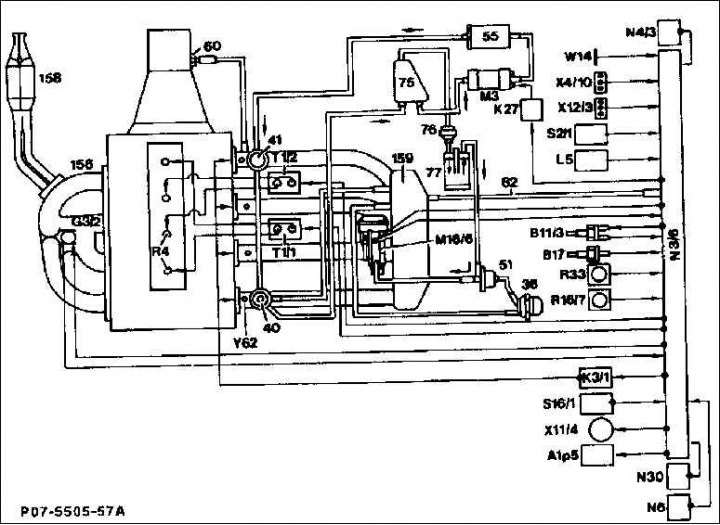
36. Thermostat (only for type 124); 40. Diaphragm pressure regulator; 41. Membrane pressure damper (only for type 124); 55. Fuel filter; 60. System of modulating pressure of membrane mechanism of vacuum regulator of ignition advance (only with automatic transmission); 75. Fuel tank; 77. Activated carbon tank; 82. Pipeline under vacuum; 156. Intake gas pipeline; 158. Catalyst; 159. Exhaust manifold; A1p5. Coolant temperature indication; B11/3. Coolant temperature sensor; B17. Intake air temperature sensor; G3/2. Oxygen sensor; K3/1. Partial heating system of the intake gas pipeline (only for type 124); K27. Fuel pump relay; L5. Crankshaft position sensor; M3. Fuel pump; M16/6. Executive element of the engine idle speed control system N3/6. Engine management system (PMS); N6. Air conditioner control device; N30.ABS control unit; R16/7. Equalizing plug connector; R33. CO-potentiometer, only for vehicles without a catalytic converter (abroad); S2/1. Ignition and starter switch; S16/1. Starter interlock switch and reversing light switch; T1/1. Ignition coil 1 for cylinders 1 and 4; T1/2. Ignition coil 2 for cylinders 2 and 3; W14. Ground point on the ABS hydraulic unit holder; X4/10. Connecting block; X11/14. Central plug for connecting the diagnostic stand; X12/3. Terminal 30/15 of the junction block without a fuse; Y62. Valve injectors
Attention! Instead of thermostat (36) and regeneration valve (51), engine type 202 (C-class) is equipped with a changeover valve, which is directly controlled by the PMS control device.
Fuel is sucked from the fuel tank by an electric fuel pump and supplied to the valve injectors through the fuel filter and the distribution pipe. The pressure regulator on the distribution pipe maintains constant pressure in the fuel system depending on the vacuum in the intake pipe. The valve injectors are controlled by electrical systems, and fuel is injected periodically, in bursts into the intake pipe in front of the intake valves. In this case, the valve injectors are controlled semi-sequentially, i.e. for each revolution of the crankshaft, two valve injectors simultaneously alternately inject. In case of malfunctions in the ignition system, the corresponding group is switched off to protect the catalytic converter.
Air is sucked into the engine through the air filter and the intake manifold. The vacuum in the intake manifold is registered by a sensitive element and serves as a criterion for the amount of air admitted. Since the vacuum depends on the position of the throttle valve (accelerator pedal position), then the amount of air admitted is a criterion for the actual engine load. Therefore, this control system is called P-control, where "P" is a physical quantity of pressure.
The control system regulates the injection time and thus the injected fuel quantity in accordance with the vacuum and the given engine speed. More fuel is injected with a comparatively long opening of the injector valve. An additional sensor and actuators also ensure that the fuel quantities are measured accordingly in extreme driving situations.
The fuel injection system control unit regulates the engine idle speed using its adjuster, which regulates the amount of air in idle mode around the throttle valve. This ensures a constant engine idle speed, regardless of whether direct additional consumers such as power steering or air conditioning compressor are connected.
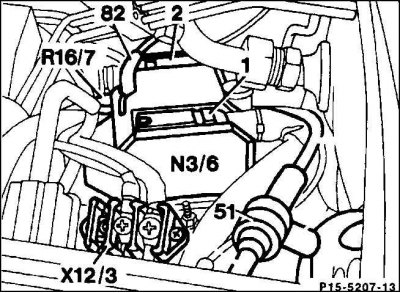
1. Multi-pin plug (side of the car); 2. Multi-pin plug (on the engine side); 83. Pipeline to the intake gas pipeline, located under vacuum; R16/7. Fuel matching plug; X12/3. Terminal 15 of the connection block without a fuse
The engine control unit (N3/6) is located in the engine compartment on the left side.
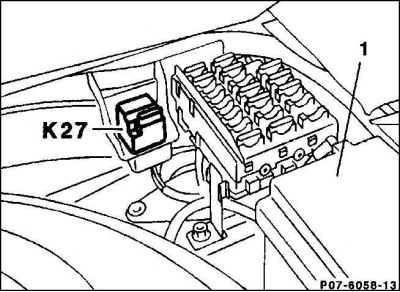
The fuel pump relay (27) supplies electricity to the fuel pump. A safety circuit interrupts the current supply as soon as there are no more speed pulses, for example if the engine has been stopped. The relay is located in the trunk on the right side; 1 – battery.
Oxygen sensor (lambda probe) measures the oxygen content in the exhaust gas flow and sends corresponding voltage signals to the control unit. The control unit then regulates the injected amount of fuel so that the exhaust gases are optimally burned on the catalytic converter.
The intake air temperature sensor measures its temperature, the second temperature sensor on the coolant supply regulator body changes the temperature of the latter.
The electromagnetic valve for venting the fuel tank is controlled depending on the engine operating mode. The released fuel vapors are captured by the activated carbon filter and fed through the valve for combustion. Consequently, thanks to the filter filled with activated carbon, the fuel vapors are mostly used economically and do not escape into the atmosphere.
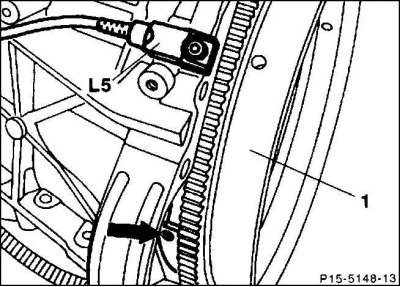
Inductive sensors (L5) are installed on the flywheel (1) and on the intake drive gear of the camshaft. They transmit information about the actual engine speed and the position of the crankshaft to the fuel injection system control unit.
The ignition system no longer has moving parts and is therefore not subject to wear up to the spark plugs. If you disconnect (pull off) the equalizing plug connector in the engine compartment, you can refuel with lower-quality fuel. If you refill with gasoline for cars with high-performance engines (octane number 96-98, at least 95 ROZ), then put the equalizing plug connector back on.