
Cars BMW Cars Volkswagen Cars Chevrolet Cars Land Rover Cars Lada Cars Honda Cars Peugeot
English Русский
Български
Беларускі
Український
Српски
Hrvatski
Română
Polski
Slovenský
Magyar
Bookmark News and articles Sitemap Feedback Site search
MercedesMan.ru


A-Class C-Class E-Class G-Class M-Class S-Class Others
190 (W201) (1982-1993) W202 (1993-2000) W203 (2000-2007)
  • Main
  • C-Class
  • W202 (1993-2000)
  • Power unit
  • Injection system (gasoline)
  • Intake Air Sensor — Removal, Checking and Installation

Intake Air Sensor — Removal, Checking and Installation (Mercedes-Benz C-Class W202)

0
Contents: Removal ↡ Examination ↡ Installation ↡
The temperature sensor measures the temperature of the intake air. This value, together with the signal from the intake manifold pressure sensor (pMS management system) serves as a criterion for assessing the amount of air being admitted. The intake air temperature sensor is an NTC resistor (NTC – negative temperature coefficient), the resistance of which decreases with increasing temperature.

The temperature sensor is located on the left side of the air filter cross pipe.

Removal
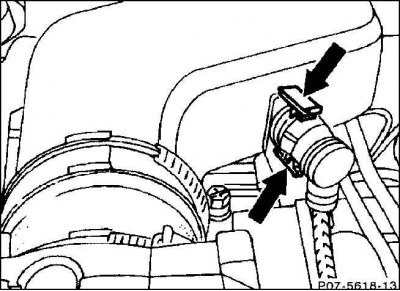


Removal


Remove the temperature sensor together with the plug connector by squeezing both clamps (arrows).

Examination


1. Remove the plug connector.

2. Suspend the thermometer in a water bath and heat it slowly.

3. Check the resistance of the temperature sensor with an ohmmeter. The measured value is considered normal if it is within the 5% tolerance (see table Temperature sensor resistance).

4. If the temperature sensor does not reach the specified values during measurements, it should be replaced.

Installation


1. Place the plug connector on the wire.

2. Check the O-ring for damage and porosity.


3. Insert the temperature sensor with the sealing ring. Press the brackets outward until they click into place.

Temperature sensor resistance


TemperatureResistance
+10°Capprox. 9670 Ohm
+20°Capprox. 6060 Ohm
+30°Capprox. 3900 Ohm
+40°Capprox. 2600 Ohm
+50°Capprox. 1760 Ohm
+60°Capprox. 1220 Ohm
+70°Capprox. 860 Ohm
+80°Capprox. 620 Ohm
This article is available at: russian, bulgarian, belarusian, ukrainian, serbian, croatian, romanian, polish, slovak, hungarian
The article has been verified: Khromov Roman Mikhailovich
Share with friends:
◀ Previous
C-Class W202 / Injection system (gasoline)
Next ▶

Coolant Temperature Sensor — Removal, Checking and Installation
Air flow meter — removal and installation
Self-diagnosis of the ignition and fuel injection system
How the HFM system works
How PMS works
Vacuum piping system
Fuel distributor with valve injectors
Valve injectors — removal and installation
Oxygen sensor (lambda probe) — removal and installation
Diagnostics of faults of the petrol injection system
More similar articles for repairing other models

☛ Checking the engine oil level using a dipstick Mercedes W168 (1997-2004)
☛ Checking the ignition distributor sensor Mercedes W123 (1976-1985)
☛ Checking fluid levels, leak control Mercedes W463 (1999-2019)
☛ Removal and installation the intake fan of the cabin air temperature… Mercedes W163 (1997-2005)
☛ Checking the temperature sensor Mercedes W126 (1979-1991, petrol)
☛ Checking the coolant level sensor Mercedes Sprinter (1995-2000, diesel)
Link in different formats to this article
Comments and feedback from visitors
No comments yet


How much will 26 + 19 ?


W203 (2000-2007) 
  • General information
  • Introduction to guide
  • User manual
  • Maintenance
  • Power unit
  • Gasoline engines
  • Diesel engines
  • Cooling system
  • Ventilation and heating
  • Supply system
  • Injection system (gasoline)
  • Injection system (diesel)
  • Exhaust system
  • Ignition and control system
  • Charge and launch systems
  • Transmission
  • Mechanical gearbox
  • Automatic gearbox
  • Clutch and drive shafts
  • Differential
  • Chassis
  • Brake system
  • Car suspension
  • Steering
  • Body
  • Exterior (external elements)
  • Interior (internal elements)
  • Electrical equipment
  • Equipment and devices
  • Lighting system
  • Electrical diagrams (2000)
  • Electrical diagrams (since 2001)
W202 (1993-2000) 
  • General information
  • User manual
  • Driving a car
  • Car care
  • Maintenance
  • Power unit
  • Gasoline engines
  • Diesel engines
  • Lubrication system
  • Cooling system
  • Heating and ventilation
  • Ignition system
  • Fuel system
  • Injection system (gasoline)
  • Injection system (diesel)
  • Exhaust system
  • Transmission
  • Clutch
  • Car gearbox
  • Chassis
  • Suspension, wheels and tires
  • Steering
  • Brake system
  • Body
  • Exterior (external elements)
  • Interior (internal elements)
  • Doors and windows
  • Electrical equipment
  • Equipment and devices
  • Power devices
  • Lighting system
  • Electrical circuits
190 (W201) (1982-1993) 
  • General information
  • Introduction to the guide
  • Operation and care
  • Maintenance (gasoline)
  • Maintenance (diesel)
  • Troubleshooting
  • Power unit
  • Petrol engine I4
  • Petrol engine V6
  • Diesel engines
  • Engine overhaul
  • Cooling and heating
  • Power system (carburetor)
  • Injection system (gasoline)
  • Injection system (diesel)
  • Exhaust system
  • Charge and start system
  • Ignition system (I4)
  • Ignition system (V6)
  • Diesel heating system
  • Transmission
  • Clutch
  • Mechanical gearbox
  • Automatic gearbox
  • Cardan shaft and axle shafts
  • Chassis
  • Brake system
  • Car suspension
  • Steering
  • Body
  • Exterior (external elements)
  • Interior (internal elements)
  • Doors, locks and windows
  • Electrical equipment
  • Equipment and devices
  • Electrical circuits
 
MercedesMan.ru © 2017–2026 · Mobile version · Read about Mercedes · Sitemap: EN BG BY UA RS HR RO PL SK HU · Feedback · Site search · Bookmark A-Class (W168) · C-Class (W201) · C-Class (W202) · C-Class (W203) · E-Class (W123) · E-Class (W124) · E-Class (W210) · G-Class (W463) · M-Class (W163) · S-Class (W116, petrol) · S-Class (W126, petrol) · S-Class (W140) · S-Class (W220) · Sprinter · Vito 1 · Vito 2 · Vario 814D ·
 
We only use cookies without which some of the site's features may not be available.