



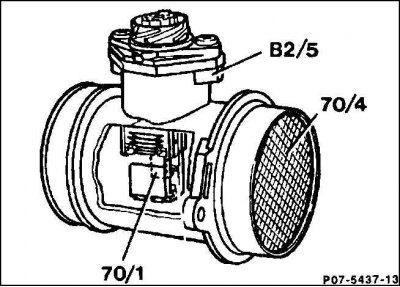
The air flow meter (B2/5) enables even more precise fuel dosing. The air flow meter operates on the following principle: the sensor plate (70/1), which is heated electrically, is cooled by the incoming air flowing past.
In order to maintain a constant temperature of the sensor plate, the heating current varies according to the density and temperature of the incoming air. Based on the fluctuations in the heating current, the control device determines the mass of the incoming air and adjusts the amount of fuel injected accordingly. (70/4 - protective grille.)
The valve injectors are controlled in turn according to the firing order of the cylinders, which allows the fuel metering to be matched even more precisely to the respective engine operating modes. The professional term for the process is sequential injection.
The anti-knock control system is used to determine and establish the optimal moment of fuel ignition, even with its lower quality. In case of a malfunction of the ignition system, the fuel supply to the corresponding cylinder is stopped.
The electrohydraulic actuator shifts the intake camshaft relative to the control device sprocket. By shifting in the direction of late ignition, the smooth running of the engine in idle mode is improved, or at high speeds the power is increased. In the lower and middle valve range, the filling of the cylinders and thus the torque are improved.
6-cylinder engine: To improve the torque character at low engine speeds, a resonant commutation intake manifold is used, which changes the air route to the cylinders depending on the engine speed. For this purpose, the air manifold behind the throttle valve is divided into two halves by a pneumatically actuated flap: one air flow is supplied to 3 cylinders each. The length of the intake tract at low engine speeds ensures good cylinder filling due to the resonance effect and thus high torque. At high engine speeds, the flap opens in order to be able to fully exploit the engine's power potential.