



Note: Installation will require new lower control arm axle bolt nuts, ball joint clamp bolt nut, and stabilizer bar support clamp nuts.
Removal
1. Place chocks under the rear wheels, apply the parking brake, then raise the front of the vehicle with a jack and securely support it on stands (see "Lifting the car with a jack and placing it on supports"). Remove the corresponding wheel.
2. Loosen the mounting screws and remove the plastic cover under the power unit.
3. Loosen and unscrew the nuts securing the stabilizer bar support clamp to the front of the lower arm and remove the support rubber.
4. Install the spring compressor and compress the spring to release the upper and lower cups (see paragraph 8).
5. Place a jack with a block of wood under the lower control arm and raise the jack to securely support the arm.
6. Loosen and remove the nut and bolt securing the lower control arm ball joint to the steering knuckle. Carefully lower the lower control arm, freeing the ball joint from the steering knuckle clamp so that the spring and spring cup can be removed.
7. Apply alignment marks between the eccentric washers of the lower arm axle bolt and the subframe. This is necessary to maintain the previous camber angles and longitudinal tilt of the strut axis during installation.
8. Loosen and remove the lower arm pivot bolt nuts and remove the bolts and eccentric washers, making a note of how they are installed (see fig. 7.8). After this, you can remove the lower arm from under the car.
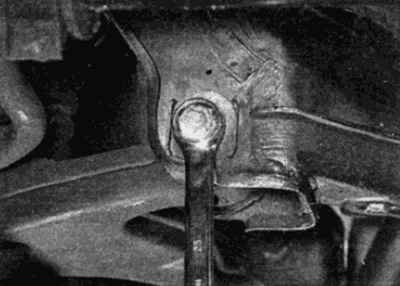
Fig. 7.8. Loosen the nuts of the lower arm axle bolt and remove the bolts; remember the orientation of the eccentric washers
Disassembly
9. Thoroughly clean the lower arm and the area around the arm bearings, removing all traces of dirt and mastic. Then check for cracks, deformation or other signs of wear or damage, paying particular attention to the bearing bushings and the ball joint. If a bushing or ball joint needs to be replaced, this should be done at a service station. To press out and press in the bushings or the ball joint, use a hydraulic press and suitable shims.
10. Check the lower arm ball joint boot. If it is worn or damaged, replace it (see fig. 7.10).
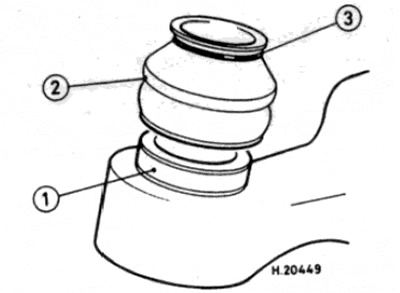
Fig. 7.10. Lower suspension arm ball joint cover
1 Ball joint
2 Case
3 Upper clamps
Installation
11. Position the lower arm and insert the front and rear axle bolts and eccentric washers. Insert the front bolt from the rear of the bushing and the rear bolt from the front of the bushing, making sure the eccentric washers are correctly positioned on the subframe. Install the new nuts, tightening them lightly at this stage, and align the marks made before removal.
12. Check that the lower arm spring cup is clean, then install the upper cup onto the spring and install the spring in place.
13. Position the lower end of the spring against the stop on the lower control arm cup. Align the upper spring cup with the support on the body and carefully lift the control arm, aligning the ball joint pin with the steering knuckle.
14. Make sure the spring is positioned correctly, then insert the lower control arm ball joint clamp bolt. Make sure the ball joint is positioned correctly, then install a new clamp bolt nut and tighten it to the specified torque. To prevent corrosion, fill the slit of the steering knuckle clamp with sealant.
15. Slide the rubber support onto the end of the anti-roll bar and install it into the clamp on the lower arm. Install the support clamp and tighten the new nuts to the required torque.
16. Remove the jack from under the lower arm, then carefully release the spring in the fixture, making sure that the lower and upper edges of the spring are correctly positioned in the spring cups.
17. Install the wheel, then lower the vehicle to the ground and tighten the wheel bolts to the required torque.
18. With the vehicle on the ground, rock it to position the lower arm correctly. Check that the eccentric washers of the lower arm axle bolt are correctly positioned according to the marks made before removal. Then tighten the nuts of both bolts to the required torque and install the engine shield.
Note: It is recommended to have the front wheel alignment checked at a service station as soon as possible.