



Note: A press is required for disassembly and assembly. If you don't have one, you can use a large bench vice and spacers (type of large socket heads). The inner races are pressed into the hub. If the inner race remains on the hub when it is pressed out of the steering knuckle, a bearing puller with sharp jaws will be required for removal.
1. Remove the rear hub holder as described paragraph 9.
2. Securely clamp the hub retainer and carefully press the hub flange out of the bearing center. If the inner bearing race remains on the flange, remove it using a bearing puller with sharp jaws.
3. Remove the bearing retaining ring from the hub holder.
4. Support the hub holder and press the hub bearing out of the socket using a pipe or bushing (see fig. 10.4).
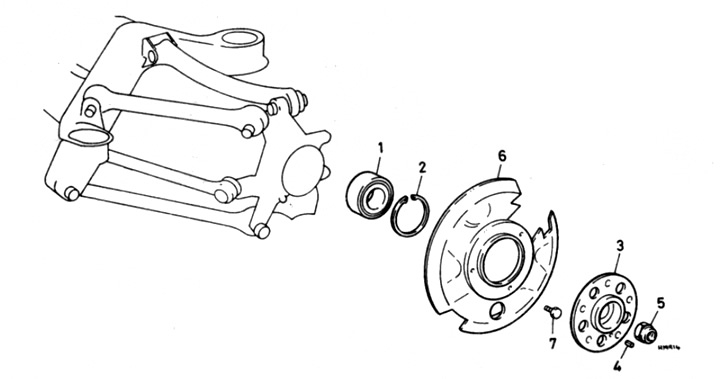
Fig. 10.4. Rear hub parts and bearing
1 Hub bearing
2 Retaining ring
3 Hub flange
4 Key
5 Hub nut
6 Brake shield
7 Bolt
5. Thoroughly clean the bearing seat in the hub carrier, removing all traces of dirt and grease and polishing off any burrs or metal build-up that may interfere with installation. Replace the retaining ring if there is any doubt about its condition.
6. When assembling, apply a thin layer of engine oil to the outer race of the bearing to facilitate its installation.
7. Position the bearing in the hub retainer and using a pipe or bushing that rests only on the outer race of the bearing, press it in until it stops, making sure it enters the hub perpendicularly.
8. Secure the bearing with the snap ring, making sure it is correctly positioned in the groove of the hub retainer.
9. Securely fasten the inner bearing race and press the hub flange until it rests on the bearing.
10. Check that the bearing rotates freely, then install the rear hub holder as described in paragraph 9.