
Checking the release pad
The release pad may be replaced in the following cases:
- after bearing overheating;
- in case of uneven rotation (by hand) or increased thruster noise.
Checking the push mechanism
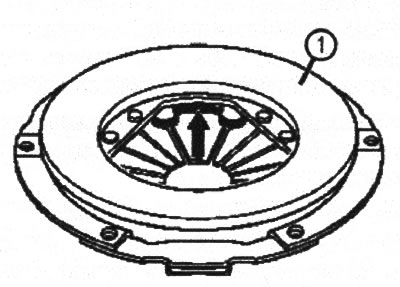
This check consists of a detailed inspection of the friction surface of the pressure plate (1) for cracks, chips, deep signs of wear. The spring is checked for cracks and chips on the petals (shown by arrow).
VN 3.010
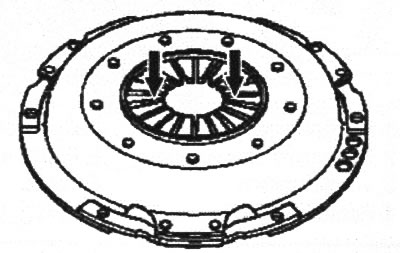
The outer part of the spring petals is checked for wear at the point of contact with the release pad (shown by arrows). You should also pay attention to the fact that all the petals of the spring have the same angle of rise.
VN 3.011
Drive Drive Check
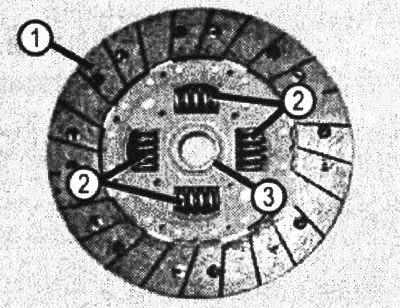
Checking the driven disk consists in checking the friction linings (1) for excessive wear and mechanical and thermal damage.
In addition, damper springs are checked (2) for wear and tear and breakage.
The next check of the driven disk is to check the condition of the splined hub (3) disk.
VN 3.012
Return to the initial position of the ring for automatic adjustment of the gap between the release pad and the petals of the membrane spring
Install the clutch pressure mechanism removed from the engine on the base (5).
With the help of a press (7) mandrel (6) gently press the petals of the membrane spring (1) so that the ring is released (2) automatic gap adjustment.
Use a screwdriver to turn the ring (2) counterclockwise until it is in position (A).
After final assembly, depress the clutch pedal at least 5 times to bring the adjusting ring into position.
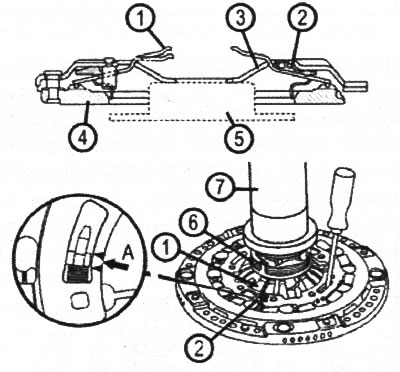
VN 3.013 1. Membrane spring; 2. Adjusting ring; 3. Body stops; 4. Pressure plate; 5. Foundation; 6. Mandrel; 7. Press