
Cars BMW Cars Volkswagen Cars Chevrolet Cars Land Rover Cars Lada Cars Honda Cars Peugeot
English Русский
Български
Беларускі
Український
Српски
Hrvatski
Română
Polski
Slovenský
Magyar
Bookmark News and articles Sitemap Feedback Site search
MercedesMan.ru


A-Class C-Class E-Class G-Class M-Class S-Class Others
Sprinter (1995-2000, diesel) Vito 1 (1996-2003) Vito 2 (2003-2014, diesel) Vario 814D (1996-2003, diesel)
  • Main
  • Mercedes-Benz
  • Vito 2 (2003-2014)
  • Electrical equipment
  • Equipment and devices
  • Brake Assist System (BAS): Functional Description

Brake Assist System (BAS): Functional Description (Mercedes-Benz Vito W639)

0
Contents: BAS Normal Mode: Functional…↡ Boosting Pressure Mode (BAS):…↡ Pressure relief mode (BAS functional…↡
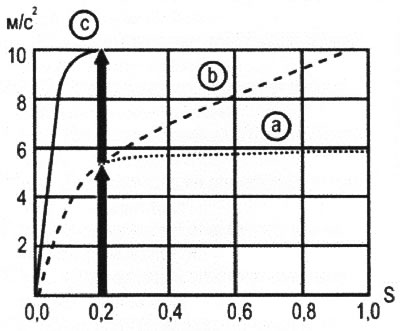
Simulator studies with regular drivers and on a test track have shown that most drivers, in the event of emergency braking, first of all, at the beginning of the braking process press the pedal quickly, but not hard enough.

It is necessary to distinguish:
  • slow braking - at the beginning of the braking process, the driver applies insufficient force to press the pedal and increases it slowly;
  • insufficient braking - throughout the entire braking process, the driver does not press the brake pedal hard enough.

To optimize the braking process, the Brake Assist system was developed (emergency braking system).

Purpose


Brake Assist System (BAS, Brake Assistance System) is an active safety system. It is activated when, in an emergency situation, the driver suddenly presses the brake pedal. Based on the speed at which the driver presses the pedal, the system determines whether an emergency braking situation exists. In this case, the electromagnetic valve in the brake booster opens - and the booster applies full force for braking.

When the driver releases the brake pedal, the system detects a decrease in the degree of pressure on the pedal and closes the electromagnetic valve again.
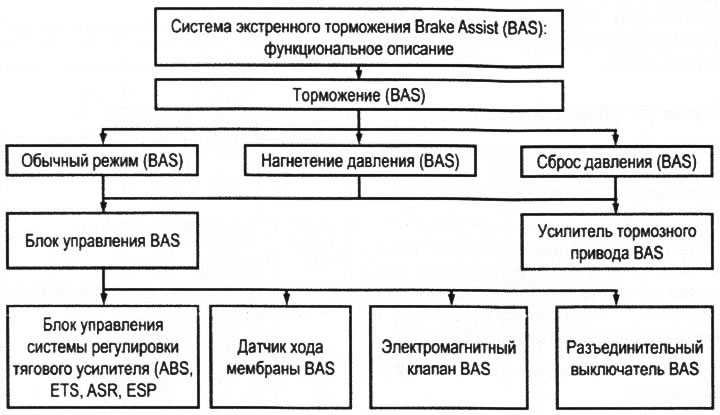
VN 9.063
VN 9.063


VN 9.064 a. Insufficient braking; b. Slow braking; c. Braking in BAS mode

VN 9.064 a. Insufficient braking; b. Slow braking; c. Braking in BAS mode


Advantages


- Thanks to optimal deceleration, it reduces the risk of accidents in emergency situations and thus provides significant support in driving.

- Supports the operation of the ABS system, providing the maximum possible braking force.

- When the BAS system is turned on, the ABS operation is not affected.

- Significantly reduces the braking distance during slow or insufficient braking.

BAS Normal Mode: Functional Description


The braking process in normal mode (without the participation of the BAS system)


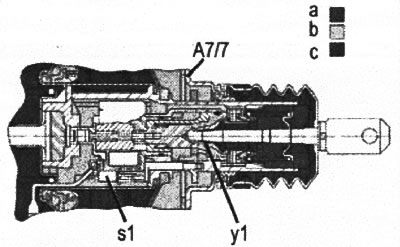
The brake booster BAS (A7/7) is constantly supplied with vacuum from the intake manifold via a vacuum line or (on a diesel engine) from the vacuum pump. When the brake pedal is not pressed, the same vacuum is created on both sides of the membranes. The pressure spring holds the membrane plate in its original position.

During braking, outside air is supplied through a channel to the rear side of the membranes. Between the front and rear chambers of the booster, a pressure difference arises that increases during braking, which acts in the direction of the main brake cylinder and thereby increases the pedal pressure.


VN 9.065 Illustration: slowdown; A7/7. Brake booster BAS; s1. BAS disconnecting switch; y1. BAS…

VN 9.065 Illustration: slowdown; A7/7. Brake booster BAS; s1. BAS disconnecting switch; y1. BAS electromagnetic valve (distribution valve); a. Atmospheric pressure; b. Reduced vacuum; s. Rarefaction


Boosting Pressure Mode (BAS): Functional Description


Pressure Boosting (BAS)


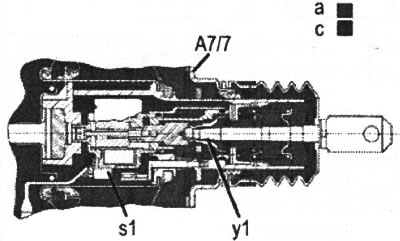
When the conditions for activating the BAS braking mode are met, the BAS electromagnetic valve (y1) is open. Atmospheric pressure is on the back side of the rod seal. As a result of the pressure difference between the front and rear walls of the membrane, the maximum increase in braking pressure occurs.
VN 9.066 Illustration: slowdown; A7/7. Brake booster BAS; s1. BAS disconnecting switch; y1. BAS…

VN 9.066 Illustration: slowdown; A7/7. Brake booster BAS; s1. BAS disconnecting switch; y1. BAS electromagnetic valve (distribution valve); a. Atmospheric pressure; s. Rarefaction


Pressure relief mode (BAS functional description)


The disconnecting switch BAS (s1) switches to the passive state. The solenoid valve (y1) is switched off and creates brake pressure corresponding to the position of the brake pedal.
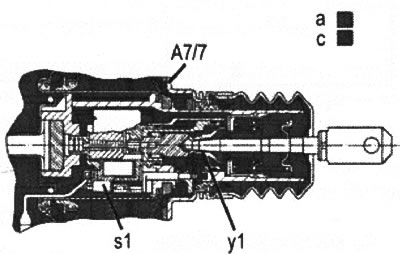
VN 9.067 Illustration: slowdown; A7/7. Brake booster BAS; s1. BAS disconnecting switch; y1. BAS…

VN 9.067 Illustration: slowdown; A7/7. Brake booster BAS; s1. BAS disconnecting switch; y1. BAS electromagnetic valve (distribution valve); a. Atmospheric pressure; s. Rarefaction
This article is available at: russian, bulgarian, belarusian, ukrainian, serbian, croatian, romanian, polish, slovak, hungarian
The article has been verified: Lukyanov Nikita Ilyich
Share with friends:
◀ Previous
Mercedes Vito 2 / Equipment and devices
Next ▶

Functioning of the ESP system
Hydraulic brake force control unit
Steering wheel angle sensor
Angular velocity (yaw)sensor
Lateral acceleration sensor
Vehicle Maintenance and Condition Monitoring System (ASSYST)
Tire pressure monitoring system
More similar articles for repairing other models

☛ Brake system specifications Mercedes W168 (1997-2004)
☛ Checking the brake system, adjusting the parking brake Mercedes W203 (2000-2007)
☛ BAS (Brake-Assist) system Mercedes W210 (1996-2002)
☛ Anti-lock brake system (ABS) Mercedes W463 (1999-2019)
☛ Anti-lock brake system (ABS) Mercedes W163 (1997-2005)
☛ Location of Brake Assist System (BAS) components Mercedes W140 (1991-1998)
Link in different formats to this article
Comments and feedback from visitors
No comments yet


How much will 39 + 20 ?


Vario 814D (1996-2003, diesel) 
  • General information
  • Maintenance
  • Power unit
  • Engines 602.984/985
  • Engines 904.908/914/923/936
  • Transmission
  • Clutch
  • Manual gearbox 711.613
  • Manual gearbox 710.64/66
  • Manual gearbox 715.051
  • Automatic gearbox 723.345
  • Power take-off box
  • Chassis
  • Front suspension
  • Rear suspension
  • Steering
  • Brake system
  • Body and electrical equipment
  • Interior (internal elements)
  • Exterior (external elements)
  • Heater and air conditioner
  • Electrical diagrams
Vito 2 (2003-2014, diesel) 
  • General information
  • User manual
  • Maintenance
  • Diesel engine OM646
  • Engine repair
  • Cooling and lubrication system
  • Power and exhaust system
  • Transmission
  • Clutch
  • Car gearbox
  • Chassis
  • Front suspension
  • Rear suspension
  • Steering
  • Brake system
  • Body
  • Body elements
  • Electrical equipment
  • Equipment and devices
  • Security systems
  • Electrical circuits
Vito 1 (1996-2003) 
  • General information
  • User manual
  • Maintenance
  • Petrol engines 2.0 l
  • Engine repair
  • Lubrication system
  • Cooling system
  • Power and control system
  • Petrol engines 2.8 l
  • Engine repair
  • Lubrication system
  • Cooling system
  • Power and control system
  • Diesel engines 2.3 l
  • Engine repair
  • Cooling system
  • Lubrication system
  • Turbocharging and recycling
  • Power and control system
  • Diesel engines 2.2 l
  • Engine repair
  • Cooling system
  • Lubrication system
  • Turbocharging and recycling
  • Power and control system
  • Transmission
  • Clutch
  • Mechanical gearbox
  • Automatic gearbox
  • Chassis
  • Front suspension and wheels
  • Rear suspension
  • Steering
  • Brake system
  • Body
  • Exterior (external elements)
  • Interior (internal elements)
  • Electrical equipment
  • Equipment and devices
  • Heater and air conditioner
  • Electrical circuits
Sprinter (1995-2000, diesel) 
  • General information
  • Introduction to the guide
  • Maintenance
  • Power unit
  • Engine repair
  • Lubrication system
  • Cooling system
  • Power and exhaust system
  • Transmission
  • Clutch
  • Mechanical gearbox
  • Automatic gearbox
  • Front axle
  • Rear axle and cardan
  • Chassis
  • Car suspension
  • Steering
  • Brake system
  • Tires and wheels
  • Electrical equipment
  • Equipment and devices
  • Headlights and lighting
  • Power devices
  • Electrical circuits
 
MercedesMan.ru © 2017–2026 · Mobile version · Read about Mercedes · Sitemap: EN BG BY UA RS HR RO PL SK HU · Feedback · Site search · Bookmark A-Class (W168) · C-Class (W201) · C-Class (W202) · C-Class (W203) · E-Class (W123) · E-Class (W124) · E-Class (W210) · G-Class (W463) · M-Class (W163) · S-Class (W116, petrol) · S-Class (W126, petrol) · S-Class (W140) · S-Class (W220) · Sprinter · Vito 1 · Vito 2 · Vario 814D ·
 
We only use cookies without which some of the site's features may not be available.