



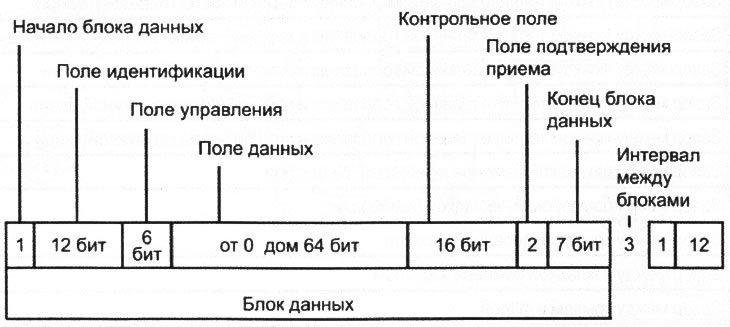
VN 9.002 Complex signal in the CAN data bus
In normal transmission mode, data packets have the following block configurations (frames) (see figure VN 9.002).
The message data block is used to transmit messages via the CAN data bus (for example, coolant temperature).
The request data block is used to request messages via the CAN data bus from another control unit.
The error data block serves to notify all connected control units that an error has occurred and the last message on the CAN data bus is invalid.
The CAN data bus protocol supports two different CAN data bus message frame formats, which differ only in the length of the identifier:
- standard format;
- extended format.
DaimlerChrysler currently uses only the standard format
The data packet for transmitting messages via the CAN data bus consists of seven consecutive fields.
- Start of data block: marks the start of a message (start bit) and synchronizes all modules.
- Identification field: This field consists of an identifier (address identifier) in 11 bits, 1 control bit and request) (Remote Transmission Request-Bit). This control bit marks the packet as a Data Frame (message data block) or as Remote Frame (request data block) without the actual message.
- Control field: (6 bits) contains IDE (control bits) bit (Identifier Extension Bit) to recognize the standard and extended format, a reserve bit for subsequent extensions and - in the last 4 bits - the number of data bytes contained in the data field.
- Data field: can contain from 0 to 8 bytes (from 0 to 64 bits) data. A 0-byte CAN data bus message is used to synchronize distributed processes.
- Control field: CRC (Cyclic-Redundancy-Check Field) contains 16 bits and is used for control recognition of errors during transmission.
- ASK confirmation field
- (Acknowledgement Field) contains a confirmation signal from the receiver units about the receipt of error-free messages via the CAN data bus
- End of Data Block: Marks the end of a data packet.
- Inter-data block interval: separates data blocks in time and must contain at least 3 bits. After this, any control unit can transmit the next data packet.
- Idle state: if no control unit transmits messages (rest mode), then the CAN data bus remains in idle mode until the next data packet is transmitted.
[Article borrowed from the web portal MercedesMan.ru]