



Operating principle of the CAN multiplex network
Previously used cable connection of individual electrical and electronic devices (standard cable connection) ensures a direct connection between each control unit and all sensors and actuators from which the given unit received measured values or which it controlled. Under certain circumstances this may result in excessive length or duplication of cable lines. Compared to standard cabling, the data bus provides the following advantages.
1. The wires from the sensors need to be run only to the nearest control unit, which converts the measured values into a data packet and transmits it to the CAN data bus.
In this case, the servo mechanism can be controlled by some other control unit, which receives the corresponding data packet via the CAN data bus and, based on it, calculates the value of the control action on the servo mechanism.
2. Signals from one sensor (for example, from the coolant temperature sensor) can be used by different systems.
3. Improving diagnostic capabilities. Since the signals from one sensor (eg speed signal) are used by different systems, then if a fault message is generated by all systems using this signal, the faulty one is usually the sensor or the control unit that processes its signals. If a fault message is received from only one system, although the signal is also used by other systems, then the cause of the fault is most often in the processing control unit or actuator.
4. High data transfer rate up to 1 Mbps with max line length of 40 m (currently not used on Mercedes Benz vehicles). The data transfer speed on Mercedes Benz vehicles ranges from 83 kbps to 500 kbps.
5. Several messages can be transmitted successively over the same line.
The figures below show a block diagram of a multiplex network and a diagram of the distribution of information in a complex signal of a multiplex network.
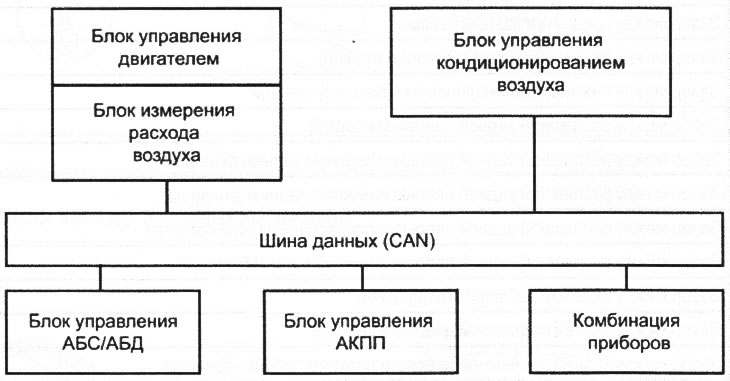
VN 9.001 Sample block diagram of a multiplex (CAN) network