



Contents: Instrument cluster ↡ Control and measuring instruments ↡ Control lamps and indicator lights ↡
Instrument cluster
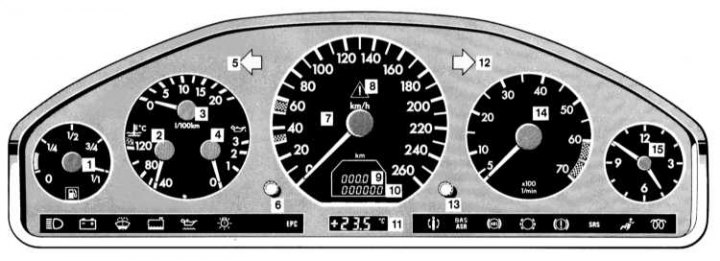
Instrument cluster design
1 - Fuel gauge with built-in reserve indicator lamp; 2 - Coolant temperature gauge; 3 - Current fuel consumption meter; 4 - Engine oil pressure gauge; 5 - Left turn signal indicator light; 6-Instrument illumination intensity control/Mileage meter reset button/instrument cluster activation/Active maintenance system (ASSYST)mode switching; 7 - Speedometer; 8 - ASR/ESP traction loss warning lamp; 9 - Current mileage meter display screen; 10 - Odometer/Active Maintenance System/Starter Interlock Indicator Display Screen; 11 - Screen displaying readings of the outside thermometer; 12 - Right turn signal activation indicator lamp; 13 - Switch for setting the clock/activating the instrument cluster; 14 - Tachometer; 15 - Hours
Control and measuring instruments
Activating the instrument cluster
The instrument cluster is activated by opening the door, by pressing one of the push-button switches mounted in the cluster to the right and left of the speedometer, and also by turning on the ignition.
Adjusting the intensity of instrument lighting
Adjusting the intensity of the instrument lighting (with the running lights on - see Section Access to the luggage compartment) is carried out using a rotary push handle mounted in the instrument panel on the left under the speedometer dial - using the same handle, the instrument cluster can be activated and the operating modes of the digital display built into the speedometer can be switched/the current mileage counter can be reset.
Fuel gauge
The gauge is located in the left corner of the instrument cluster and records the amount of fuel remaining in the tank.
The error of the meter readings is minimal when the car is in a strictly horizontal position. When the car is moving on winding or hilly roads, the error of the device increases. The operation of the meter does not depend on the position of the ignition key. The 1/1 mark corresponds to a full tank, 0 - an empty tank. A control lamp with an image of a gas pump built into the dial of the meter notifies the driver of the need to refuel the car at the first opportunity.
Combined coolant temperature/current fuel consumption/engine oil pressure gauge
The three-function combination meter is located to the right of the speedometer and serves to indicate the engine coolant temperature (lower left sector), readings of the current fuel consumption meter (upper sector) and oil pressure sensor readings (lower right sector).
Coolant temperature gauge
Under normal conditions, the boiling point of the coolant (antifreeze with anti-corrosion additives added to it), filled into the system tract designed to operate under excess pressure is approximately 130°C. Under severe operating conditions, for example, in very hot weather or during a long uphill climb, the pointer of the gauge may rise to the upper red mark on the scale. If the engine temperature has increased so much that the pointer of the gauge enters the red range of the meter scale, you should immediately stop driving, pull over to the side of the road, park and check the condition of the cooling system to determine the cause of engine overheating (see Chapter Routine maintenance, Troubleshooting).
Current fuel consumption meter
During movement, the meter constantly records the current fuel consumption in l/100 km. In idle and forced idle modes, the meter needle drops to 0.
Driving at very low outside temperatures, in a busy urban cycle (start-stop mode), as well as towing a trailer and driving in mountainous areas are associated with increased fuel consumption.
Engine oil pressure gauge
At operating temperature, the oil pressure decreases at idle speed. This does not negatively affect the operational reliability of the engine. Pressing the gas pedal should lead to an increase in engine oil pressure.
Speedometer
The speedometer is mounted in the central part of the instrument cluster and shows the speed of the vehicle. The unit of measurement is km/h.
Attention! The red-highlighted sectors of the 30 and 50 km/h ranges are used to track the moments when the manual transmission switches to the next gear.
Tachometer
The tachometer is located to the right of the speedometer and shows the engine speed in thousands of revolutions per minute (the arrow reading should be multiplied by 100)To avoid engine failure, do not exceed the maximum permissible crankshaft speed (the tachometer needle should never enter the red zone of the scale).
Attention! In order to protect the engine, when the crankshaft speed reaches the red marking range, the fuel supply is cut off.
Watch
The on-board clock dial is mounted in the right corner of the instrument cluster. The clock setting regulator is located on the left under the tachometer dial. Turning the regulator pulled out of the panel clockwise increases the readings, counterclockwise - decreases them.
Odometer/tripmeter/service due date display
The odometer display, current mileage counter and scheduled maintenance indicator are built into the speedometer dial. The current mileage counter is reset/the odometer display/scheduled maintenance indicator modes are switched using the push-button switch located on the left under the speedometer dial.
Current mileage meter
The counter records the current mileage of the vehicle since the last reset of its readings (in kilometers or miles, depending on the version). The counter readings are displayed in the upper field of the digital indicator built into the dial of the speedometer. To reset the counter readings, activate the instrument cluster, then press the reset button and hold it down for about 1 second.
Odometer
The odometer records the total mileage of the car in kilometers since the start of operation. The odometer readings are displayed in the lower field of the digital indicator built into the dial of the speedometer.
Scheduled maintenance due date indicator (active maintenance system - Assyst)
Attention! See also Section Vehicle Identification Numbers Chapters Routine maintenance
The scheduled maintenance indicator informs you about the OPTIMAL time for maintenance and its readings are not related to the engine oil level.
Attention! If the battery is disconnected, the time the vehicle is parked is not included in the calculation of the scheduled maintenance period - in order to maintain the frequency of routine maintenance procedures, this period of time must be taken into account.
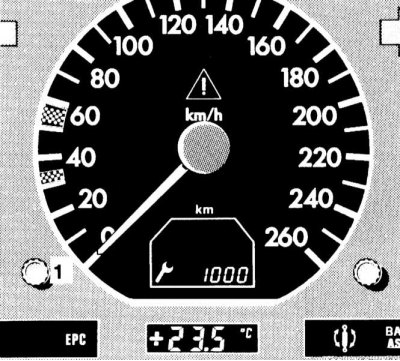
Information about the scheduled maintenance dates is displayed in the odometer reading field of the digital display built into the speedometer dial
1 — Button to switch the display to odometer mode
Approximately one month before the next scheduled maintenance, with the ignition on, the odometer reading field of the digital display of the speedometer displays the value of the remaining mileage, or the time (in days) until the next scheduled maintenance procedure is performed.
In this case, the indication
 1000 means that scheduled maintenance should be done after 1000 km, and
  10 - in 10 days. The data output format is determined by the vehicle operating conditions.
The display switches to odometer mode automatically after 10 seconds, or by pressing the button (1).
If the maintenance period is overdue, the indicator starts to flash, and a minus sign appears in front of the digital data.
It is also possible to display service readings manually, for which you should first activate the instrument cluster and then press the button (1) twice within 1 second. Switching the display to the odometer mode, as before, occurs automatically after 10 seconds, or by pressing the same button.
The indication of the scheduled maintenance date automatically switches off after 10 seconds or goes out when you press the button (1).
The indicator is reset at the Mercedes-Benz service station where the scheduled maintenance was performed.
If necessary, the indicator can be reset by the car owner himself:
- Turn the ignition key to position 2 and immediately press button (1) twice within 1 second.
- The last indication of the scheduled maintenance date is displayed in the total distance travelled counter.
- Turn the key in the steering wheel lock to position 0 for approximately 10 seconds.
- Press and hold the button (1).
- Turn the ignition key to position 2.
- Continue holding down button (1), the display screen will continue to show the old date of the previous service, then, approximately 10 seconds after the sound signal, the date of the next maintenance will be displayed - release button (1).
- If the scheduled maintenance due date indication is accidentally reset, the function can be reactivated at a Mercedes-Benz service station.
- The amount of mileage remaining before the next maintenance is determined by the driving style and ranges from 15,000 to 22,500 km (365÷730 days). An economical driving style at medium engine speeds and avoiding short-distance trips contribute to its increase.
Schedule of current maintenance the car is presented in Chapter Routine maintenance.
Control lamps and indicator lights
The vehicle's instrument cluster assembly has a whole set of control lamps and indicators built in, with the help of which the driver receives important information about the serviceability/malfunction of the vehicle's main units and systems. Below, the reader's attention is offered information about the operating principle of each of the provided light indicators separately.
List of control lamps and indicator lights included in the instrument cluster
 Warning light for ASR/ESP systems.
 High beam headlight activation indicator light.
 Battery charge indicator lamp.
 Windshield/Headlamp Washer Fluid Reservoir Level Indicator Lamp
 Coolant level indicator light.
 Engine oil pressure warning light.
 Indicator lamp for failure of incandescent lamps of external lighting devices.
EPC Control lamp for failures of the electronic injection control system of a diesel engine.
 Level Control System Malfunction Indicator Lamp (models with automatic damping system - ADS).
BAS
ASR BAS/ASR system failure indicator lamp.
BAS
ESP BAS/ESP system failure indicator lamp.
ABS ABS malfunction indicator light.
 Brake pad wear indicator light.
 Brake fluid level/parking brake engaged indicator light.
SRS Supplementary Restraint System (SRS) component failure indicator lamp.
 Fasten seat belt indicator light.
 Diesel engine pre-glow control lamp.
 Anti-Slip Regulation (ASR) and Electronic Stability Program (ESP) Warning Light
This indicator lamp is briefly activated when the ignition is switched on and should go out immediately after the engine has started. Activation of this indicator lamp is accompanied by forced disabling of the anti-slip regulation (ASR) and anti-skid regulation (ESP) systems (see sections Anti-Slip Regulation (ASR) and Electronic skid control system (ESP)). Activation of the lamp in flashing mode while the vehicle is moving warns the driver that the vehicle's wheels are at the limit of adhesion to the road surface and it is necessary to reduce speed to a safe level.
 High beam activation indicator light
This indicator light comes on simultaneously with the high beam headlights of the vehicle and has a characteristic blue glow.
 Battery charge indicator light
The charge indicator lamp should light when the ignition is turned on and go out immediately after the engine starts. When this indicator lamp lights up with the engine running, it warns the driver of a malfunction in the charging system, i.e., the battery is entering discharge mode. You should immediately switch off all electrical consumers whose operation does not affect road safety and try to prevent the engine from stopping, since an attempt to start it may result in the battery being completely discharged. Check the condition and tension of the alternator drive belt and make the appropriate adjustments if necessary. If the belt is in good condition, the car should be immediately taken to the nearest service station for diagnostics of the failure and the necessary repairs.
 Windshield/Headlamp Washer Fluid Reservoir Level Indicator Lamp
This indicator lamp is briefly activated when the ignition is switched on and should go out immediately after the engine has started. Activation of the indicator lamp while driving indicates that the washer fluid level has dropped to approximately 1/4 of the volume of the corresponding reservoir.
 Coolant level indicator light
This indicator lamp is briefly activated when the ignition is switched on and should go out immediately after the engine is started. Activation of the indicator lamp while driving indicates that the coolant level in the expansion tank has dropped to a dangerous level and it is necessary to make an urgent adjustment.
 Engine oil pressure warning light
The engine oil pressure indicator light (red) should light up when the ignition is turned on and go out immediately after the engine starts. Flashing of the light when the engine is running indicates a pulsating decrease in the working pressure of the engine oil in the engine. When the indicator switches to a constant glow mode, it means that the oil pressure has dropped to a dangerously low level, which is fraught with serious internal damage to the engine, up to its complete failure. In both cases, urgent measures should be taken to adjust the oil level, identify and eliminate the causes of the pressure drop.
 Indicator lamp for failure of incandescent lamps of external lighting devices
This indicator lamp is briefly activated in low-glow mode when the ignition is switched on and should go out immediately after the engine is started. Activation of the lamp in high-glow mode (both when turning the ignition key to position 2 and while driving) indicates that the incandescent lamp of one of the external lighting/signaling devices has failed.
Caution! If the brake light bulb fails, the warning light will only be activated during braking.
Attention! Any additional lighting devices must be connected via a fuse installed before the control unit of incandescent lamps. Neglect of this condition may result in failure of the control lamp, lighting devices and control unit.
EPC Diesel Engine Electronic Injection Control System Malfunction Indicator Lamp
Activation of this warning lamp when the engine is not running warns the driver of a malfunction in the fuel supply management system. The power developed by the engine in such a situation may be significantly reduced and the car should be driven to the nearest Mercedes-Benz service station.
 Level Control System Malfunction Indicator Lamp (models with automatic damping system - ADS)
The control lamp is briefly activated in a dim mode when the ignition is switched on and should go out immediately after the engine is started. The lamp's failure to switch off, as well as its activation while driving, indicates a malfunction of the automatic damping system, which controls the stiffness of the vehicle's suspension shock absorbers depending on the road conditions, load and driving style. The vehicle should be taken to a Mercedes-Benz service station at the earliest opportunity.
Attention! If the on-board power supply is disconnected due to disconnection or discharge of the battery, the indicator lamp will light when the engine is running. To turn off the lamp, turn the steering wheel from lock to lock.
BAS
ASR Brake Assist (BAS)/Traction Control System (ASR) Malfunction Indicator Lamp
The indicator lamp is briefly activated when the ignition is turned on and should go out immediately after the engine is started. Failure of the lamp to turn off, as well as its activation while driving, indicates a malfunction of the BAS or ASR system.
Attention! If the BAS system fails, the vehicle's braking system continues to function normally (unenhanced) mode.
A malfunction of the ASR system can lead to a noticeable reduction in engine power. The car should be taken to a Mercedes-Benz service station without delay for diagnostics and necessary repairs.
BAS
ESP Emergency Brake Booster (BAS)/ Anti-skid System (ESP)failure warning Light
The indicator lamp is briefly activated when the ignition is turned on and should go out immediately after the engine is started. Failure of the lamp to turn off, as well as its activation while driving, indicates a malfunction of the BAS or ESP system.
Attention! If the BAS system fails, the vehicle's braking system continues to function normally (unenhanced) mode. Note: A malfunction of the ESP system may result in a noticeable reduction in engine power. The vehicle should be taken immediately to a Mercedes-Benz service station for diagnostics and necessary repairs.
 ABS Malfunction Indicator Light
This indicator lamp serves to monitor the proper functioning of the ABS, lights up briefly when the ignition is turned on and should go out a few seconds after the engine is started.
 Brake pad wear indicator light
The indicator lamp is briefly activated when the ignition is switched on and should go out immediately after the engine is started. Activation of the lamp during braking indicates that the friction linings of the brake shoes have worn to the maximum permissible value and that they need to be replaced urgently.
 Brake fluid level/parking brake warning light
The indicator lamp (red) lights continuously when the parking brake is applied, reminding the driver to release it before driving. Driving with the parking brake applied leads to rapid overheating and failure of the rear wheel brakes, as well as premature wear of the rear tire treads, and may also cause the anti-lock braking system (ABS) to malfunction.
If the warning light remains on after the parking brake is released, or comes on while driving, this usually indicates that the brake fluid level has dropped excessively. One possible cause of a gradual decrease in the brake fluid level is normal wear of the brake pad friction linings. If the warning light comes on, the vehicle should be taken to the nearest service station to assess the condition of the pads and check the tightness of the hydraulic circuit of the brake system.
The control lamp also lights briefly when the ignition is turned on (even with the parking brake released).
SRS Supplemental Restraint System (SRS) Malfunction Indicator Lamp
This indicator lamp lights up for approximately 4 seconds when the ignition is switched on and should go out immediately after the engine is started. If the lamp remains lit when the engine is running (in constant or flashing mode), this indicates a malfunction of the SRS system components. If equipped, the activation of this indicator lamp may indicate a malfunction in the side and head airbag circuits or in the automatic emergency seat belt tensioners.
 "Fasten your seat belt" warning light
This indicator has an amber glow and briefly operates when the ignition is turned on. The indicator switches to flashing mode after the engine is started to remind the driver/passengers of the need to fasten their seat belts.
 Diesel Engine Pre-Glow Warning Light
The pre-glow indicator lamp lights up when the ignition is switched on and indicates that the pre-glow system is activated. The engine should not be started until the indicator lamp goes out.
Direction indicator lights
The arrow-shaped indicator lights glow green and serve to monitor the proper functioning of the corresponding turn signals. The direction of the indicator arrows coincides with the selected direction of the vehicle's course change. The indicators operate in a flashing mode with a frequency corresponding to the blinking frequency of the turn signals. Rapid blinking of one of the indicators usually indicates that the lamp of one of the indicators of the corresponding turn signal has burned out. The burned-out lamp should be replaced at the first opportunity in order to avoid creating emergency situations on the roads.
The simultaneous flashing of both direction indicator lights usually accompanies the activation of the hazard warning lights.