



Contents: General information ↡ Doors ↡ Front seats ↡ Headrests ↡ Seat belts ↡ Steering column ↡ Landing on the seat ↡
General information
The following instructions will provide the reader with ways to ensure maximum protection for all vehicle occupants.
Doors
After the driver and all passengers have taken their seats in the vehicle, make sure that all vehicle doors are tightly closed.
Some models are equipped with a special indicator lamp that lights up when one or more doors of the car are not closed tightly.
Front seats
A driver who sits too close to the instrument panel is at increased risk of injury, including serious injury or death, from being struck by the steering wheel or from an airbag deployment in the event of an accident.
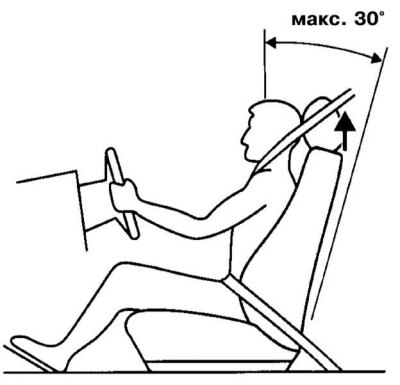
To avoid the risk of injury, properly fasten your seat belt, adjust the seatback to an upright position (no more than 30°) and press your back firmly against it, while moving the seat as far away from the steering wheel as possible.
Of course, the driver must ensure a good view and the ability to conveniently manipulate all the controls of the car. Make sure that the front passenger seat is also as far away from the dashboard as possible.
Warning! If the driver and front passenger seats are positioned too close to the steering wheel/instrument panel in the event of an accident, serious injury or even death may occur!
Always try to position the front seats as far away from the front airbag modules as possible.
The vast majority of drivers (even of short stature) can move the driver's seat as far away from the steering wheel as possible, while still being able to reach the pedals freely. However, if you are concerned about the driver's seat being too close to the steering wheel, the authors of this Guide recommend that you pay attention to the existence of certain types of auxiliary equipment - Mercedes-Benz service stations provide comprehensive information on this issue.
Once you have made sure that the seat is in the correct position, check that it is securely fastened.
Adjust the angle of the driver's seat back to the most comfortable position for your body type, as close to vertical as possible, while leaving sufficient space between your chest and the steering wheel hub with the airbag mounted in it. Remember that excessively close positioning of the driver/front passenger to the instrument panel significantly increases the risk of injury when the front airbags deploy.
If the seat back is tilted too far back, the shoulder section of the seat belt will not be pressed against the chest, which significantly reduces the effectiveness of its protective functions. The more the seat back is tilted back, the greater the likelihood of the occupant's body sliding under the lap section in a severe frontal impact, and the more severe the injuries may be. Instructions for adjusting the seat backs are provided in Section Seat adjustment.
Headrests
Before driving, make sure that the position of the head restraints on each seat meets the required requirements, providing adequate protection for the cervical spine and head of the occupant in the event of a rear impact.
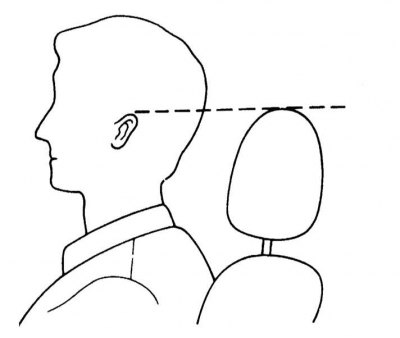
The headrest should be adjusted in height so that its central part is level with the back of the head. If this cannot be achieved, the headrest should be set to the highest position.
Warning! Incorrect positioning of the head restraints reduces the effectiveness of their protective functions and increases the risk of serious injury in a traffic accident! Instructions for adjusting the position of the head restraints are provided in Section Seat adjustment)
Seat belts
General information
All people in the vehicle must wear seat belts while the vehicle is moving.
The front and adjustable rear seat belts have a diagonal lap belt (three-anchor) design. A special adjustment device for comfortable fit of the three-anchor belts automatically reduces their tension force in positions 1 and 2 of the ignition key.
The central seating position of the rear seat is equipped with a two-anchor lap belt with a return device.
The front seat belts are equipped with automatic emergency tensioners. The procedure for using such belts is similar to the procedure for using belts of a conventional design. The operating principle of emergency tensioners is discussed in more detail in Section Supplemental Restraint System (SRS)).
It is not permitted to use one seat belt to secure more than one person.
The two-anchor belt and the waist section of the three-anchor belt should be positioned at hip level, covering the seated person's hip joint as the strongest element of the skeleton.
The shoulder section of the belt should not be placed under the arm or placed around the occupant's neck.
Make sure that the belt is not twisted.
Remember that the seat belt is most effective when the seat back is upright. If the seat back is too reclined, the occupant will be more likely to slide under the belt during an impact.
The diagonal-lap design seat belts have three anchor points, one of which is equipped with an inertial return device with automatic locking in case of jerks. Belts of this type do not require length adjustment.
When installing a special child seat, the seat belt must be set to the permanent locking position by pulling it completely out of the return device. Keeping it in the extended position, secure the child seat with it, acting in accordance with the instructions of the latter manufacturer. After the buckle is clicked, the excess length of the belt will be wound onto the drum of the return device and will be locked, ensuring reliable fixation of the child seat.
To return the belt to normal operation, remove the child restraint system and allow the retractor to rewind the belt onto its reel.
Rules for using seat belts
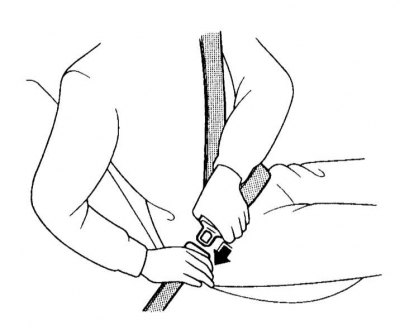
Slowly pull the belt out of the return device, place it over your shoulder and snap the belt buckle clip into the lock, then pull the shoulder section strap up, checking that the clip is securely locked into the lock. Make sure that the belt strap is not twisted - a twisted belt is dangerous in itself.
Lower the waist section of the belt as far as possible, placing it as low on your hips as possible.
Pull the shoulder section to take up the slack and try to get the belt to fit snugly against the body - tighten the belt as needed. The strap should be positioned diagonally across the occupant's chest so that the impact load is primarily on the strongest upper torso.
Warning! Failure to wear seat belts may result in serious injury in the event of a traffic accident!
The driver of a vehicle, having fastened his seat belt, must ensure that all passengers are also properly fastened.
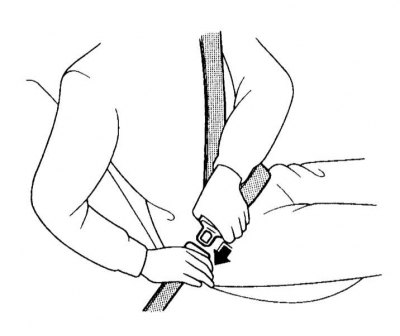
The correct position of the lap section of the belt will ensure the safest absorption of the body's inertia in the event of an accident, holding it by the strong bones of the hip joint.
Warning! Never pass the shoulder section of the belt under your arm or behind your back - this can have the most serious consequences in an accident!
An incorrectly functioning seat belt will not provide adequate protection for the driver/passenger in the event of a traffic accident. Improper use of the belts may result in serious injury, damage or even death. If you are not sure that the adjustments are correct, have your Mercedes-Benz service technician check the functionality of the seat belts.
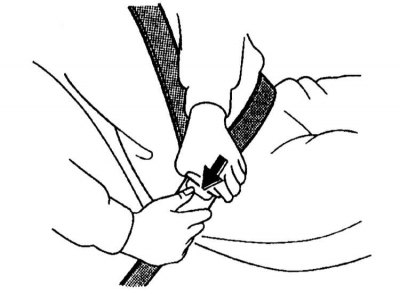
To unfasten the belt, press the red button with the inscription PRESS, which is located on the buckle lock body. When winding the belt with the drum of the return device, you should hold it by the buckle bracket. After leaving the car, make sure that the belt does not get into the door opening and is not jammed when the latter is slammed.
Additional information on vehicle seat belts is provided below.
Additional information on seat belts
Attention! Diagonal waist (three-anchor) seat belt
The diagonal-waist belts are equipped with an inertial-type return device, the drum of which automatically selects the slack of the straps and constantly maintains a slight preliminary tension of the belt pressed to the body. Inertial belts practically do not restrict the movements of the person fastened with them and allow him to easily change his position on the seat. In the event of a traffic accident or sudden braking of the car, the return device automatically locks the seat belt, ensuring the fixation of the body from dangerous movements.
The diagonal-lap seat belts of the rear seats used in the models under consideration are equipped with additional fasteners that ensure the possibility of securely fastening special child seats. More detailed information on this issue can be obtained at the official service stations of Mercedes-Benz.
When the shoulder section of the belt is pulled out sharply, the locking mechanism of the return device is activated. The drum locks the belt, eliminating the possibility of dangerous movement of the passenger.
A special adjustment device for comfortable fit of the three-anchor belts automatically reduces their tension in positions 1 and 2 of the ignition key.
Additional recommendations
Do not attach pads or other objects to the seat belt webbing. Adding additional devices or changing the position of the shoulder section attachment may reduce the effectiveness of the seat belts and increase the risk of injury in a crash.
Do not place hard or sharp objects between your body and the front airbag.
Carrying hard or sharp objects on your lap, or driving with a smoking pipe or other sharp object in your mouth during an accident can result in serious injury.
To prevent the risk of unauthorized deployment of the front airbags, try not to press your hands against the locations of their modules on the instrument panel and the steering wheel hub.
Automatic emergency seat belt tensioners
See Section Supplemental Restraint System (SRS).
Steering column
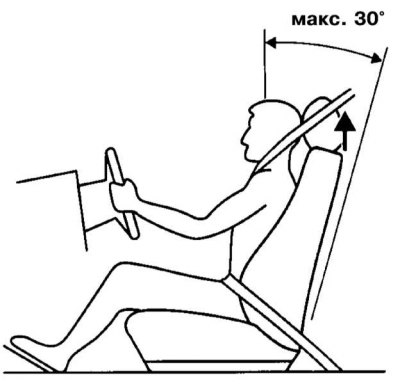
The steering column should be adjusted so that the steering wheel is positioned opposite the driver's chest.
The position in which the steering wheel hub is opposite the driver's face is incorrect, since it reduces the protective functions of the front airbag built into it. A description of the procedure for adjusting the steering wheel position is given in Section Adjusting the position of the steering wheel.
Landing on the seat
General recommendations
After the driver and all passengers have taken their seats in the car, adjusted their seats and put on their seat belts, they must position their bodies correctly, with their backs pressed firmly against the seat back and their feet firmly on the floor of the car. Their feet should not come off the floor until the car has come to a complete stop and the engine has been turned off.
Publication taken from an online resource: MERCEDESMAN.ru
Failure to sit correctly while driving increases the risk of injury in a traffic accident. For example, if passengers sit hunched over, lie down, turn to the sides, lean forward or to the side, climb onto the seat with their feet, the risk of them getting seriously injured in an accident increases significantly.
In addition, front passengers who are not seated properly may be seriously injured by interior trim breaking during a crash or by the deployment of the front airbag.
If the front passenger's head is tilted to the side while driving and is in the airbag deployment zone of a vehicle equipped with side/head airbags, the risk of serious injury or death in a crash is greatly increased.
Try to maintain proper seating position throughout the entire journey, keeping your back pressed firmly against the seatback and your feet flat on the floor. Remember that sitting upright and using seat belts correctly will improve the effectiveness of all safety features in your vehicle.
Recommendations for pregnant women
Ensuring the safety of a pregnant woman is the best way to preserve the fetus in the event of an accident, so when driving a car (as a driver or passenger) a pregnant woman must wear a seat belt, paying particular attention to the correct placement of its sections relative to her body.
When using diagonal-waist belts, remember that the waist section of the belt should be positioned as low as possible on the hips and should never be placed on the stomach.
A pregnant woman should also take an upright position on the seat. In this case, the front seat should be moved as far away from the dashboard as possible, which will reduce the risk of injury and mutilation not only for the mother but also for the fetus in the event of a traffic accident or deployment of the front airbag.
At each visit to your supervising physician, consult whether it is advisable for you to drive a car.
Transportation of children
To ensure the safety of transporting young and middle-aged children, special child seats and restraints should be used. Detailed instructions for placement and installation will be provided to you at the point of purchase. If necessary, contact Mercedes-Benz service stations for advice.
Always place your child in the REAR seat of the vehicle and secure him/her properly with a child restraint system or seat belt. A deploying air bag in a collision can cause serious injury or even death to a child, especially if the child is not restrained or is not properly restrained. Since children are smaller and weaker than adults, they are at greater risk of injury from deploying air bags. Always secure ALL child restraint systems in the REAR seat.
Attention! A rear-facing child seat must only be placed in the rear seat of the vehicle!
According to accident statistics, the back seat is safer for children than the front seat.