



Contents: Instrument cluster ↡ Control and measuring instruments ↡ Speedometer ↡ Display of odometer/current mileage…↡ Odometer and current mileage counter ↡ Engine oil level indicator ↡ Scheduled maintenance due date…↡ Tachometer ↡ Watch ↡ Control lamps and indicator lights ↡ List of control lamps and indicator…↡
Instrument cluster design
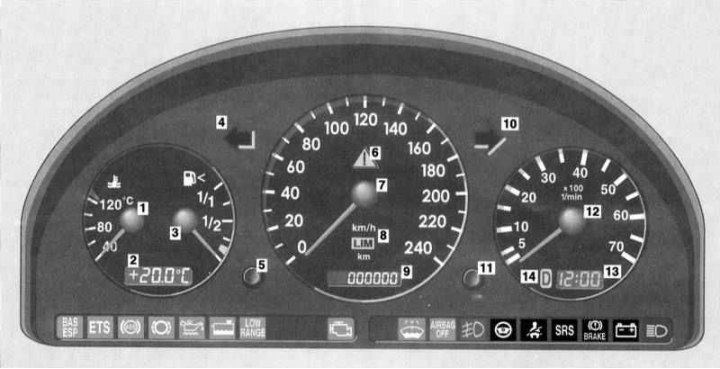
1 - Coolant temperature gauge; 2 - Outside air temperature indicator; 3 - Fuel gauge with minimum reserve indicator lamp; 4 - Left turn signal activation indicator lamp; 4 - Engine oil pressure gauge; 5 - Instrument illumination intensity regulator/knob for resetting the current mileage counter/activating the instrument cluster/switching the active maintenance system (ASSYST) modes; 6 - ETS/ESP system indicator light; 7 - Speedometer; 8 - Speedtronic system LIM indicator; 9 - Current mileage counter/engine oil level/maintenance indicator/variable speed limiter indicator; 10 - Right turn signal activation indicator lamp; 11 - Handle for setting the clock readings; 12 - Tachometer; 13 - Hours; 14 - Indicator of the selected AT range
Instrument cluster
The design of the instrument cluster is shown in the illustration.
Control and measuring instruments
Activating the instrument cluster
The instrument cluster is activated when the door is opened, by pressing one of the push-button switches mounted in the cluster to the right and left of the speedometer, and also when the ignition is turned on/the driver's door is opened. The board is switched off automatically.
Adjusting the intensity of instrument lighting
Adjusting the intensity of the instrument lighting (with the running lights on - see Section Interior controls and equipment) is carried out using a rotary push handle mounted in the instrument panel on the left under the speedometer dial - using the same handle, the instrument cluster can be activated (see above) and the operating modes of the digital display built into the speedometer can be switched/the current mileage counter can be reset (see below).
Combined fuel/coolant temperature gauge
The gauge is located in the left corner of the instrument cluster and is equipped with two indicators, one of which (the right one) registers the fuel supply remaining in the tank, the second (the left one) serves to indicate the engine coolant temperature. A display for displaying outside air temperature readings is mounted in the lower part of the gauge dial.
Fuel gauge
The error of the fuel gauge readings is minimal when the car is in a strictly horizontal position. When the car is moving on winding or hilly roads, the error of the device increases. The operation of the gauge does not depend on the position of the ignition key. The 1/1 mark corresponds to a full tank, 0 - an empty tank. A control lamp with an image of a gas pump built into the dial of the gauge notifies the driver of the need to refuel the car at the first opportunity.
Coolant temperature gauge
Under normal conditions, the boiling point of the coolant (antifreeze with anti-corrosion additives added to it), filled into the system tract designed to operate under excess pressure is approximately 130°C. Under severe operating conditions, for example, in very hot weather or during a long uphill climb, the pointer of the gauge may rise to the upper red mark on the scale. If the engine temperature has increased so much that the pointer of the gauge enters the red range of the meter scale, you should immediately stop driving, pull over to the side of the road, park and check the condition of the cooling system to determine the cause of engine overheating (see Chapter Cooling system).
Outside air temperature indicator
The display for the outside air temperature sensor is built into the dial of the left combination meter in the instrument cluster. The temperature is displayed in degrees Celsius (°C).
The display readings change after leaving the garage with a certain delay due to the sensor adaptation.
In addition, a forced delay in the increase of display readings is provided in accordance with the increase in ambient temperature when the engine coolant temperature exceeds 60°C, which helps prevent interference from a hot engine during stops and when the car is moving at low speeds.
Speedometer
The speedometer is mounted in the central part of the instrument cluster and shows the vehicle speed in km/h.
Display of odometer/current mileage meter / engine oil level indicator/due date for scheduled maintenance
The display of the odometer, current mileage counter and scheduled maintenance indicator is built into the speedometer dial. The current mileage counter is reset/display mode switching is performed using the push-button switch located on the left under the speedometer dial (see ibid).
Odometer and current mileage counter
The odometer records the total mileage of the vehicle since it was put into operation, the resettable counter allows you to track the current mileage of the car since the last reset of its readings (in kilometers). Switching between odometer/counter modes is done using the button located to the left of the speedometer.
To reset the meter, activate the instrument cluster (see above), then press the reset button and hold it down for about 1 second.
Engine oil level indicator
When checking the engine oil level, the vehicle must be in a horizontal position. Readings should be taken approximately 5 minutes after stopping the engine, which has warmed up to normal operating temperature.
Turn the key in the ignition switch to position 2 and wait until the display screen displays the following information:
 , then press the switch button (5) twice within 1 second. The following information should appear on the display:
 (oil level is normal),
 (add 1 liter of oil),
 (add 1.5 l of oil),
 (add 2 liters of oil),
or
 (drain excess oil to avoid engine damage or catalytic converter failure).
If correct level measurement is not possible, the indication
 will flash - repeat the check after a short time.
Note: If necessary, the oil level can be checked manually using the dipstick (see Chapter Maintenance).
Scheduled maintenance due date indicator (tO-Assyst system)
See Section Active Maintenance Warning System (ASSYST).
Tachometer
The tachometer is located to the right of the speedometer and shows the engine speed in thousands of revolutions per minute (the arrow reading should be multiplied by 100)To avoid engine failure, do not exceed the maximum permissible crankshaft speed (the tachometer needle should never enter the red zone of the scale).
Note: In order to protect the engine, when the crankshaft speed reaches the red marking range, the fuel supply is cut off.
Watch
The on-board clock dial is mounted into the tachometer dial. The clock setting regulator is located on the left under the tachometer dial (see ibid). Rotating the regulator pulled out from the panel clockwise leads to an increase in readings, counterclockwise to a decrease.
Control lamps and indicator lights
The vehicle's instrument cluster assembly has a whole set of control lamps and indicators built in, with the help of which the driver receives important information about the serviceability/malfunction of the vehicle's main units and systems. The layout of the control lamps on the instrument panel is shown in the illustration. Below is information on the operating principle of each of the provided light indicators separately.
List of control lamps and indicator lights included in the instrument cluster
 (Yellow) Anti-slip warning Light (4-ETS)/Anti-aircraft Protection (ESP)system; "Adapt your driving style to road conditions!"
(Information copied from the website: www.mercedesman.ru)
 (Yellow) Emergency Brake Booster (BAS)Failure Warning Light/anti-aircraft Protection System (ESP)
 (Yellow) Traction Control System (4-ETS) Warning Light
 (Yellow) Anti-lock Brake System (ABS) Malfunction Indicator Lamp
 (Yellow) Brake pad wear indicator light
 (Yellow) Engine Oil Level Warning Light
 (Yellow) Coolant Level/Temperature Warning Light
 (Yellow) Off-road mode indicator light (LOW RANGE)
 (Yellow) Failure warning light MIL/ "Check engine"
 (Yellow) Front passenger airbag deactivation indicator light when installing a child seat on the right front seat (AIRBAG OFF)
 (Green) Fog light activation indicator light
 (Red) Steering column adjustment mechanism lock indicator light
 (Red) Supplemental Restraint System (SRS) Warning Light
 (Red) Brake fluid level indicator/Electronic Brake Force Distribution (EBV) failure indicator/Parking brake cocking indicator
 (Red) Battery charge indicator light
 (Blue) High beam headlight activation indicator light
 (Yellow) Diesel Engine Glow Plug Indicator Light
 (Yellow) Electronic Power Control (EPC) Warning Light
 (Red) "Fasten your seat belt" indicator light
 (Yellow) Windscreen/Headlight Washer Fluid Reservoir Level/Freeze Resistance Indicator Lamp
Warning light for anti-slip (ETS) and anti-skid (ESP) systems

This indicator lamp is briefly activated when the ignition is switched on and should go out immediately after the engine has started. Activation of this indicator lamp is accompanied by forced disabling of the anti-skid (ESP) system (see Sections Traction Control System (4-ETS) and Electronic skid control system (ESP)). Activation of the lamp in flashing mode while the vehicle is moving warns the driver that the vehicle's wheels are at the limit of adhesion to the road surface and it is necessary to reduce speed to a safe level.
Attention! When towing a vehicle with the rear wheels off the ground, as well as when checking the proper functioning of the brake mechanisms on the stand, the engine must be turned off, because otherwise the active braking effect of the ESP system may lead to failure of the rear wheel brake mechanisms!
Emergency Brake Booster (BAS)Failure Warning Light/anti-aircraft Protection System (ESP)

The indicator lamp is briefly activated when the ignition is turned on and should go out immediately after the engine is started. Failure of the lamp to turn off, as well as its activation while driving, indicates a malfunction of the BAS or ESP system.
Note: If the BAS system fails, the vehicle's braking system continues to function normally (unenhanced) mode.
A malfunction of the ESP system can lead to a noticeable reduction in engine power. The car should be taken to a Mercedes-Benz service station without delay for diagnostics and necessary repairs.
To switch off the control lamp that is triggered when the engine is running, after switching off the on-board power supply, turn the steering wheel from lock to lock. When the voltage level drops below 10 V, the BAS system is automatically switched off. This is accompanied by the activation of this control lamp. The system is also automatically restored to working condition when the voltage level is restored - the lamp should go out.
Traction Control System (4-ETS) Warning Light

The indicator lamp is briefly activated when the ignition is switched on and should go out immediately after the engine is started. If the lamp fails to turn off, or if it is activated while driving, this indicates a malfunction of the 4-ETS system - the car should be taken to a Mercedes-Benz service station without delay for diagnostics and necessary repairs.
Note: When the brakes are under high load, the 4-ETS system is automatically switched off briefly to prevent the brakes from overheating. This switching off is accompanied by the activation of the indicator lamp.
The 4-ETS system is activated at speeds between 40 and 80 km/h when any of the wheels reaches the limit of tire adhesion to the road (for example, in case of one-sided ice). The corresponding wheel is braked in order to ensure reliable traction.
ABS Anti-lock Brake System Warning Light

This control lamp serves to monitor the proper functioning of the ABS, briefly lights up when the ignition is turned on and should go out a few seconds after the engine has started. If the lamp fails to turn off, or if it is activated while driving, this indicates a malfunction of the ABS - the car should be taken to a Mercedes-Benz service station without delay for diagnostics and the necessary repairs.
Note: At the same time as ABS, the 4-ETS, BAS and ESP systems are also switched off, which should be confirmed by the activation of the corresponding indicator lamps (see above).
Brake pad wear indicator light

The indicator lamp is briefly activated when the ignition is switched on and should go out immediately after the engine is started. Activation of the lamp during braking indicates that the friction linings of the brake shoes have worn to the maximum permissible value and that they need to be replaced urgently.
Engine oil level warning light

The engine oil level indicator lamp comes on briefly when the ignition is switched on and should go out after the engine has started. If the indicator lamp comes on while the engine is running, this indicates that the engine oil level has become dangerously low. Check the oil level as soon as possible and make the appropriate adjustments if necessary (see Chapter Maintenance), make sure there are no signs of developing leaks.
Coolant level/temperature warning light

This indicator lamp is briefly activated when the ignition is switched on and should go out immediately after the engine has started. Activation of the indicator lamp while driving indicates that the coolant level in the expansion tank has dropped to a dangerous limit and it is necessary to make an appropriate adjustment immediately, or the coolant temperature has reached the upper limit of the permissible range (129°C). Switch off the engine, let it cool down a little, check the coolant level in the expansion tank, and make an appropriate adjustment if necessary (see Chapter Checking the cooling system and frost resistance of the coolant, replacing the liquid).
Off-road mode indicator light

This indicator lamp serves to confirm that the switch to off-road driving mode is working properly (see Section Interior controls and equipment), - during the switching process, the lamp should blink three times, then switch to a constant glow mode. Frequent blinking of the lamp when the ignition is turned on indicates a malfunction in the LOW RANGE switching system and the car should be taken to a Mercedes-Benz service station for diagnostics and the necessary repairs.
Malfunction Indicator Lamp MIL (Check Engine)

This warning lamp briefly lights up when the ignition is switched on and should go out a few seconds after the engine has started. If the lamp fails to turn off, or if it becomes active while driving, this indicates a malfunction in the engine management/emission control systems - the vehicle should be taken to a Mercedes-Benz service station without delay for diagnostics and necessary repairs.
Note: To turn off the warning light that is activated after refilling a completely empty fuel tank, repeat the engine starting procedure three or four times.
Front passenger airbag deactivation indicator light when installing a child seat on the right front seat (AIRBAG OFF)

This indicator lamp should light when such a special child seat is secured to the front passenger seat, thus confirming that the passenger airbag has been deactivated. If the indicator lamp does not light, the airbag has not been deactivated and the child seat should be moved to the rear - contact a Mercedes-Benz service center for assistance.
Fog light activation indicator light

The activation of this light indicator confirms that the fog lights are activated properly (both front and rear – see Section Interior controls and equipment).
Steering column adjustment mechanism lock indicator light

When this indicator lamp is activated, it alerts the driver that the steering column height adjustment mechanism is not locked (see Section Interior controls and equipment) and it is dangerous to start moving.
Supplemental Restraint System (SRS) Warning Light

This indicator lamp lights up for approximately 4 seconds when the ignition is switched on and should go out immediately after the engine is started. If the lamp remains lit when the engine is running (in constant or flashing mode), this indicates a malfunction of the SRS system components. If equipped, the activation of this indicator lamp may indicate a malfunction in the side and head airbag circuits or in the automatic emergency seat belt tensioners.
Brake fluid level indicator light/Electronic Brake Force Distribution System (EBV) failures/Parking brake cocking indicator

The indicator light stays on continuously when the parking brake is applied, reminding the driver to release it before driving. Driving with the parking brake applied will cause the rear brakes to overheat and fail quickly, and will cause premature wear of the rear tire treads, and may also cause the anti-lock braking system (ABS) to malfunction.
If the warning light remains on after the parking brake is released, or comes on while driving, this usually indicates that the brake fluid level has dropped excessively - one possible cause of a gradual decrease in the brake fluid level is normal wear of the brake shoe friction linings.
Another reason for the activation of this warning lamp is a malfunction of the electronic brake force distribution (EBV) system - the car should be taken to the nearest service station to assess the condition of the pads and check the tightness of the hydraulic circuit of the brake system.
Note: The indicator lamp also lights briefly when the ignition is turned on (even with the parking brake released).
Battery charge indicator light

The charge indicator lamp should light when the ignition is turned on and go out immediately after the engine starts. Activation of the lamp with the engine running warns the driver of a malfunction in the charging system when the battery goes into discharge mode. You should immediately turn off all electrical consumers whose operation does not affect road safety and try to prevent the engine from stopping, since an attempt to start it may lead to a final discharge of the battery. Check the condition and tension of the alternator drive belt, and make the appropriate adjustments if necessary. If the belt is in order, the car should be immediately driven to the nearest service station for diagnostics of the failure and the necessary repairs.
High beam activation indicator light

This indicator serves to confirm that the high beam headlights are activated.
Diesel Engine Pre-Glow Warning Light

The pre-glow indicator lamp lights up when the ignition is switched on and indicates that the pre-glow system is activated. The engine should not be started until the indicator lamp goes out.
Diesel Electronic Power Control (EPC) Warning Light

This warning lamp should light when the ignition is turned on and go out immediately after the engine starts. If the lamp comes on while driving, this indicates a failure in the fuel injection control system of the diesel engine - the system goes into emergency operation mode, when driving in which you should not press the gas pedal all the way down and exceed crankshaft speed of 2500 rpm. The power developed by the engine in such a situation may significantly decrease and the car should be driven to the nearest Mercedes-Benz service station.
"Fasten your seat belt" indicator light

This indicator has an amber glow and briefly (for about 6 seconds) it is activated when the ignition is turned on, reminding the driver and passengers to fasten their seat belts.
Windshield/Headlight Washer Fluid Reservoir Level/Freeze Resistance Indicator Lamp

This indicator lamp is briefly activated when the ignition is switched on and should go out immediately after the engine has started. Activation of the indicator lamp while driving indicates that the washer fluid level has dropped to approximately 1/4 of the volume of the corresponding reservoir.
At temperatures below 0°C, this warning lamp can also warn the driver that the washer fluid is freezing and that the concentration of the frost-resistant ingredient in it needs to be increased.
Direction indicator lights
The arrow-shaped indicator lights glow green and serve to monitor the proper functioning of the corresponding turn signals. The direction of the indicator arrows coincides with the selected direction of the vehicle's course change. The indicators operate in a flashing mode with a frequency corresponding to the blinking frequency of the turn signals. Rapid blinking of one of the indicators usually indicates that the lamp of one of the indicators of the corresponding turn signal has burned out. The burned-out lamp should be replaced at the first opportunity in order to avoid creating emergency situations on the roads.
The simultaneous flashing of both direction indicator lights usually accompanies the activation of the hazard warning lights.