



Sequence of works


1. Unscrew the ends from the steering rods. When unscrewing them, count the turns so that when reinstalling them, screw them in by the same number of turns, otherwise the wheel alignment will be disrupted.
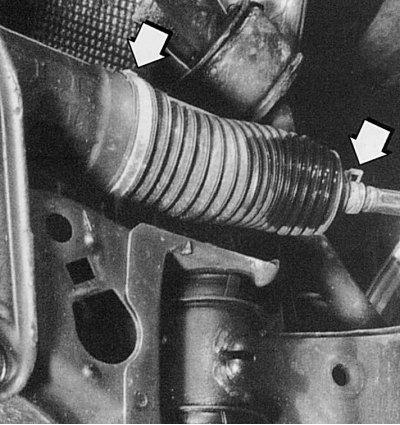
Fig. 7.18. To remove the mudguard clamps, use pliers to cut off the tabs (arrows). Use new clamps when reassembling
2. Remove both clamps holding the mudguard. To do this, use pliers to cut off the clamp tongues (fig. 7.18, arrows).
3. Pull the mudguard off the steering rod.
4. Before reinstalling, clean and lightly lubricate the steering rod.
5. Pull the mudguard onto the steering rod, making sure that it fits precisely into the grooves of the steering rod and the toothed rack housing and is not twisted. Otherwise, the protection will be incomplete.
6. Secure the mudguard with new clamps.
7. Install the tip and tighten the fastening nut to a torque of 60 N·m.
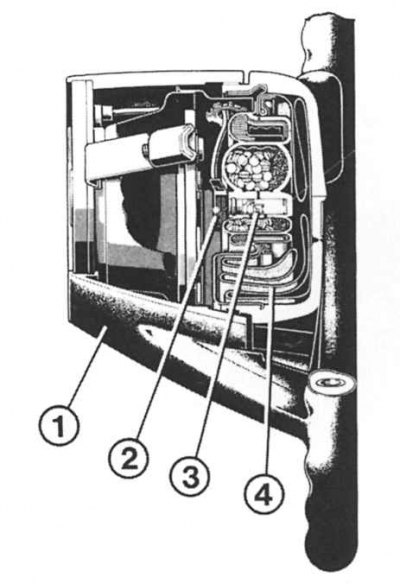
Fig. 7.19. Steering wheel with airbag in section: 1 – steering wheel; 2 – connection connector; 3 – pyropatron with solid explosive; 4 – folded airbag
8. Check the wheel and steering alignment. If necessary, adjust at a service station.
Warning! Steering wheel and airbag
Warning! There are strict regulations even for the transportation and storage of airbags, as well as for the workplace where they are removed and installed. The reason is the gas generator, which in the event of an accident detonates the solid explosive contained in it in a split second and fills the airbag (Fig. 7.19). Since the airbag is subject to the law on explosives in production, only specially trained personnel are involved in serial installation of the airbag, and at service stations, airbag repair mechanics have special qualifications. Given the above, we strongly recommend that you refrain from any independent repair of the driver's and passenger airbags. This also applies to tuning work, when, for example, the steering wheel is trimmed with wood or leather. Working with the airbag is in any case a task for a service station.
Car measurements
Optimal driving characteristics and minimal tire wear can only be achieved with perfect wheel alignment. The necessary measurements cannot be taken without special optical measuring equipment. Therefore, it is recommended to find a special service station to measure the vehicle parameters and suspension geometry. Such a check is necessary in the following cases:
1. After major bodywork.
2. After repair of front and rear suspension units.
3. In case of increased and uneven wear of tires.
4. If the vehicle is not stable enough.