



Contents: Running in ↡ Help Call System - TeleAid ↡ Emergency power supply battery ↡ Ignition switch ↡ Models with petrol engine ↡ Models with diesel engine ↡ Models with automatic transmission ↡ Sequentronic automated gearbox ↡ Locking the steering lock ↡ Unlocking the steering lock ↡ Starting and stopping a gasoline…↡ Before launch ↡ Launch ↡ Repeat launch ↡ Stopping the car engine ↡ Starting and stopping a diesel engine ↡ Before launch ↡ Launch ↡ Repeat launch ↡ Emergency engine shutdown ↡ Starting off and changing gears ↡ Parking ↡ Automatic transmission (Sequentronic) ↡ Gearbox shift position ↡ Indication on the universal display ↡ Gear shift conditions ↡ Starting the engine ↡ Manual mode ↡ Moving off ↡ Driving a car ↡ Automatic mode ↡ Moving off ↡ Driving a car ↡ Switching between manual and…↡ Switching to automatic mode ↡ Switching to manual mode ↡ Braking/stopping ↡ Maneuvering ↡ Parking ↡ Emergency mode ↡ Automatic transmission ↡ Moving off ↡ Shifting to a higher gear after…↡ Accelerator pedal position ↡ Stopping the car ↡ Maneuvering ↡ Parking ↡ AT selector lever positions ↡ Switching ranges for special…↡ Program switch ↡ Parking brake ↡ Driving Tips ↡ Control pedals ↡ Traffic and parking ↡ Warming up the engine to operating…↡ Moving off ↡ Steering ↡ Brakes ↡ Service brake ↡ Disabling fuel supply in forced idle…↡ Engine malfunctions ↡ Hydroplaning ↡ Tire grip ↡ Tires ↡ Travelling abroad ↡ Operation in winter ↡ Windscreen washer and headlight…↡ Battery control ↡ Tires ↡ Recommendations for driving in icy…↡ Anti-skid chains ↡ Towing a trailer ↡ Tempostat ↡ Precise setting in 1 km/h steps ↡ Recalling the entered speed from…↡ Notes for models with manual…↡ Notes for models with Sequentronic…↡ Speedtronic ↡ Permanent speed limiter (Only…↡ Brake Assist (BAS) (Brake Assist) ↡ Anti-lock brake system (ABS) ↡ Electronic skid control system (ESP) ↡ Switching off and on the ESP…↡ System "Parktronic" (PTS) ↡ Position of the AT selector lever ↡ Signaling devices ↡ Sensors ↡ Sensor range ↡ Shutting down the system "Parktronic" ↡ Towing a trailer ↡ System failure "Parktronic" ↡ Remote garage door opener ↡ Opening/closing the garage door ↡ Resetting the built-in remote…↡ Refueling ↡
Running in
The more carefully you treat the engine at the beginning of its use, the more satisfied you will be with its operation later. Avoid heavy loads for the first 1500 km (movements at full throttle) and high engine speed (no more than 2/3 of the maximum speed in the selected gear).
Shift gears in time!
When pressing the accelerator pedal, it is advisable not to exceed the resistance point ("kick-down").
Do not downshift using the selector lever for braking purposes.
Select shift ranges 3, 2 or 1 only at low speeds (on mountain passes).
After the first 1500 km, the speed and number of revolutions can be gradually increased to the maximum values.
Help Call System - TeleAid
(Telematic Alarm Identification on Demand - used in some European countries).
Main functions
Call for help - the call for help system allows you to transmit a call for help signal to the emergency services control center in certain European countries (see the following description).
Telediagnostics - will help you, for example, if technical problems occur with your car or in the event of an accident. When you call this service, the vehicle's parameters regarding location and identity are transmitted. You can request this service via your landline phone with the TeleAid system (separate "Telephone Operating Guide").
"MB" -Info - will help you with all questions concerning the car, such as additional accessories. You can request this service by your landline phone with the TeleAid system.
The emergency call system allows the transmission of an emergency call signal to one of the emergency call centres within some European countries.
The transmission of the call for help signal is carried out automatically after an accident. If a dangerous situation arises, you can activate the call for help system manually. In this case, all the information necessary for assessing the emergency situation is transmitted, such as data on the location of the vehicle (determined by the GPS satellite navigation system, as well as by the ABS system's path sensors) and concerning the severity of the accident.
Shortly after the call for help system is activated, voice communication is automatically established between the ambulance control center and the passengers of the damaged vehicle. If any of the passengers are able to speak, they can transmit more detailed information about the consequences of the accident to the ambulance control center staff. The phone is in speakerphone mode.
The call for help system is provided for:
- the presence of a valid agreement with the services offering the relevant services (telephone service and service for receiving emergency calls).
- have a valid personal identification number (PIN), a telephone card (SIM), and permission to use the TeleAid system.
- access to the appropriate radiotelephone network (access is only possible within Germany on the basis of the D1 and D2 networks), which provides the transmission of short messages via the SMS service (Short Message Service),
- operational readiness of the emergency call system.
When the ignition key is turned to position 1 or 2, the assistance call system is ready for operation.
The indicator LED on the emergency call button lights up for approximately 5 seconds.
When the ignition key is turned to position 0 or when the key is removed, the call system is no longer operational.
Call for help
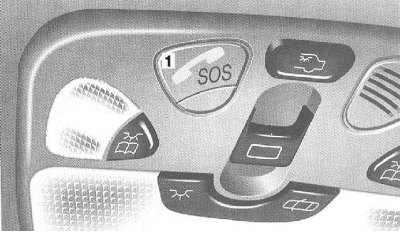
Manually: Press lightly on the cover "1" - the cover opens.
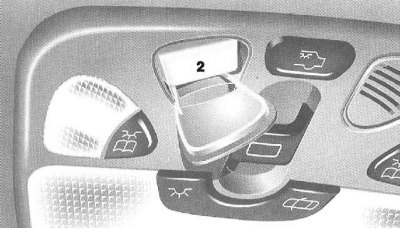
Press the emergency call system button "2" lightly.
The control LED on the emergency call button "2" flashes.
Receipt of a call for help signal for further transmission to the ambulance control center is confirmed by a message via a loudspeaker. Wait for voice communication with the ambulance control center.
After finishing the call for help, close the cover "1".
Automatically:
- when the airbag is deployed;
- in case of a strong impact on the car from behind;
- when the vehicle rolls over.
The control LED on the emergency call button "2" flashes.
Receipt of a call for help signal for further transmission to the ambulance control center is confirmed by a message through a loudspeaker. Wait for voice communication with the rescue service control center.
Note: The universal display first shows "EMERGENCY CALL" "CALL IN PROGRESS" (CALLING FOR HELP, ESTABLISHING CONTACT), and after the connection is established - indication "EMERGENCY CALL" "CALL ACTIVE" (CALL FOR HELP, COMMUNICATION ACTIVATED).
The control LED flashes until the help call is completed.
After transmitting the signal to call for help, the phone switches to speakerphone mode within a few seconds until the end of the exchange of information between the rescue service control center and the vehicle passenger.
It is not possible to have other conversations on the phone during this time.
Attention! At low voltage (for example, when the battery is discharged) it is not possible to transmit a call for help signal through the call for help system.
After transmitting the help call signal: If the control LED on the help call button is constantly lit and voice communication has not been established before, the help call signal has failed (for example, there is no radiotelephone network). The indication appears on the universal display "EMERGENCY CALL" "CALL FAILED".
In this case, rescue operations must be organized on your own.
Emergency power supply battery
The TeleAid system has an additional emergency power battery in case the vehicle's battery cannot be used, for example due to low voltage or a flat battery.
Warning! To avoid discharging the emergency power supply battery when disconnecting the vehicle battery, the phone should be set to maintenance mode ("Phone Operating Manual").
Ignition switch
There is a risk of accident!
Remove the key from the ignition switch even when leaving the vehicle for a short time.
Electrical adjustment of the seats and steering wheel is also possible with one door open. Therefore, do not leave children unattended in the car.
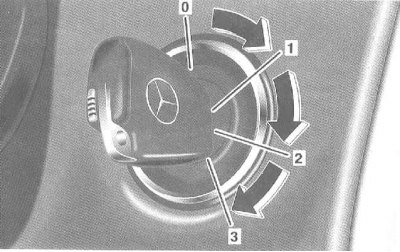
0 - When the key is removed, the steering is locked.
Models with manual transmission: Do not remove the key until the vehicle has stopped. The vehicle is uncontrollable when the key is removed.
Automatic transmission models: The key can only be removed when the AT selector lever is in the "P" position and the service brake pedal is not depressed.
1 - Steering is released.
Most electrical consumers can be switched on.
More detailed information is provided in separate technical descriptions.
2 - Movement.
Models with petrol engine
Driving position. All electrical consumers can be switched on.
Models with diesel engine
Pre-heating and movement position. All electrical consumers can be switched on.
Models with automatic transmission
The AT selector lever is released.
If the AT selector lever is in the "P" position, you must additionally press the brake pedal to move it.
Sequentronic automated gearbox
Gear shifting is possible.
3 - Launch
(Starting and stopping a petrol engine - see below).
(Starting and stopping a diesel engine - see below).
Locking the steering lock
After removing the key, turn the steering wheel until it locks.
Unlocking the steering lock
Insert the key into the ignition switch - the steering lock will unlock, while turning the steering wheel slightly.
Note: Do not cover the infrared window on the key tip or allow it to become dirty, otherwise the ignition switch cannot be guaranteed to function properly.
If the key has been left in the ignition switch in position 0 for a long time, it will no longer be possible to turn it. To ensure that it turns, remove it and reinsert it.
If the key in the ignition switch does not turn, the steering lock remains locked. This may be due to the vehicle's battery being significantly discharged. (See. Checking and charging the battery, or Starting the engine using an auxiliary battery).
When parking the vehicle for a long time, remove the key to avoid discharging the battery.
Starting and stopping a gasoline engine
Before launch
Set the parking brake.
Move the manual transmission shift lever to neutral position.
Move the Sequentronic automated transmission selector lever to position "N".
Move the automatic transmission shift lever to the "P" or "N" position.
Launch
Models with manual transmission
Turn the key in the ignition switch to position 3 and release it as soon as the engine starts.
Do not press the accelerator pedal.
Models with automatic transmission
Turn the ignition switch key to position 3 and release. The starting process is performed automatically until the engine starts or for a certain period of time - pulse start function.
Do not press the accelerator pedal.
Repeat launch
Before restarting, turn the ignition key back to position 0 and repeat the starting process, keeping the key in position 3 until the engine starts.
If the engine does not start after a long process, contact a service station "Mercedes-Benz".
Note: Too long attempts to start the vehicle will drain the battery. Emergency towing start is not possible for models with automatic transmission.
Stopping the car engine
After the vehicle has come to a complete stop, turn the ignition key to position 0. Apply the parking brake.
Models with automatic transmission
The key can only be removed when the ignition key is in position 0, if the AT selector lever is in position "P" and the service brake pedal is not pressed.
Starting and stopping a diesel engine
Before launch
Set the parking brake.
Move the manual transmission shift lever to neutral position.
Move the Sequentronic automated transmission selector lever to position "N".
Move the automatic transmission selector lever to the "P" or "N" position.
Launch
Preheat
Turn the key in the ignition switch to position 2. The pre-glow indicator lamp lights up.
Models with manual transmission
If the glow plug indicator lamp goes out, turn the ignition switch key to position 3 and release it as soon as the engine starts.
Do not press the accelerator pedal.
Models with automatic transmission
When the pre-glow indicator lamp goes out, turn the key in the ignition switch to position 3 and release. The starting process is carried out automatically until the engine starts or for a certain period of time - pulse start function.
Do not press the accelerator pedal.
Starting a warm engine: The engine can be started without preheating.
Repeat launch
Before restarting, turn the ignition switch key back to position 0 and repeat the starting process, keeping the key in position 3 until the engine starts.
If the engine does not start after a long starting process, contact a service station "Mercedes-Benz".
Note: If the pre-heating indicator lamp does not light, the pre-heating system is faulty. To fix the problem, contact a service station immediately "Mercedes-Benz".
Too long attempts to start the engine will drain the battery. Emergency starting of the engine by towing is not possible. (Starting the engine using an auxiliary battery is discussed in the Introduction).
Emergency engine starting by towing is only possible for models with manual transmission (Introduction).
Emergency engine shutdown
If the engine cannot be turned off with the key, it can be turned off by removing two fuses.
For this purpose, there are two fuses, designated in the fuse overview by the inscription "ENGINE EMERGENCY STOP" (EMERGENCY ENGINE SHUT-OFF), remove with a fuse removal tool.
The fuse overview and spare fuses are located in the passenger compartment fuse box (Specifications Chapter On-board electrical equipment).
The fuse removal tool is located in the additional trunk fuse box (Chapter On-board electrical equipment).
Starting off and changing gears
After starting off, quickly warm up the engine. Only then can you bring its load to full power.
Starting off on slippery ground: Avoid turning one of the drive wheels for a long time. This may damage the transmission.
Manual transmission (MT)
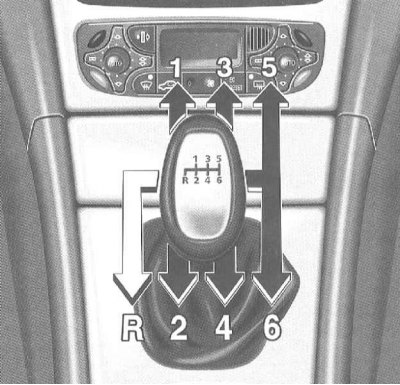
Do not exceed maximum speeds for individual gears.
Shifting to reverse gear is only permitted after the vehicle has stopped. To do this, lift the gearshift lever.
There is a risk of skidding!
Do not shift into a lower gear if the maximum speed for that gear is exceeded. The drive wheels may lock.
On slippery roads, do not shift to a lower gear for the purpose of braking.
Note: Shifting to a lower gear when the speed is too high (for the purpose of braking) may result in the engine exceeding its maximum permissible speed and thus causing engine damage.
Parking
Press the parking brake pedal.
Engage 1st gear or reverse gear.
On steep climbs or descents, turn the front wheels toward the curb.
Automatic transmission (Sequentronic)
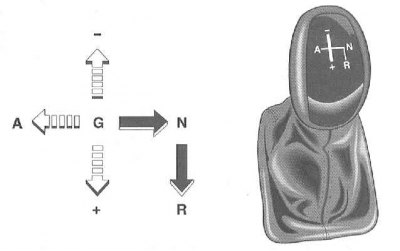
The gear shift pattern is shown on the gearbox linkage.
- "G" Movement position/basic position ("G")
- "- "Switching to a lower gear
- "+" Shift to a higher gear
- "N" Neutral position
- "R" Reverse gear
- "A" Automatic mode
The Sequentronic automated transmission provides manual and automatic gear shifting modes.
In manual mode, gear selection is performed by lightly pressing the gearshift lever in the "+" or "-" direction.
In automatic mode, gear shifting occurs automatically.
Unlike the manual transmission, in the manual mode of the Sequentronic automated transmission, the shifting process is performed only when the shifting conditions are met (for example, maximum revs, pressing the brake before shifting to the "R" position).
There is a risk of injury!
When working on a vehicle with the engine running, apply the parking brake and move the gearshift lever to the "N" position to prevent the vehicle from moving.
Gearbox shift position
- "G" Drive/base position. All six gears are used for forward movement.
- "+" Shift to a higher gear (manual mode). Shifting up in manual Sequentronic mode. By lightly pressing the gearshift lever in the "+" direction, the transmission shifts up to the next higher gear.
- "- "Switching to a lower gear (manual mode). By lightly pressing the gearshift lever in the "-" direction, the transmission switches to the next lower gear.
- "N" Neutral position. The engine can only be started if the gearshift lever is in the "N" position.
- "R" Reverse gear. Reverse gear can only be engaged when the vehicle is stopped and the brake pedal is depressed.
- "A" Automatic mode. All gears are used for forward movement. The optimal gear is automatically engaged.
Indication on the universal display
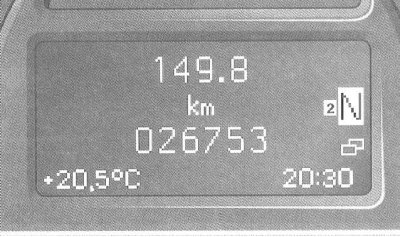
2 — Gearbox position indication
Gear shift conditions
The gear shifting process can be performed under the following conditions.
With the engine off and the key in the ignition switch in position 2:
To park the vehicle, it is possible to shift gears from the "N" position to the "G" drive position or to the "R" reverse gear without additional preliminary pressing of the brake pedal.
Shifting gears to neutral position "N" is only possible by pressing the brake pedal.
Note: The gearbox can only be shifted if the battery is sufficiently charged.
With the engine running:
When the vehicle is stopped, gear shifting from the "N" position to the "G" drive position is possible if the brake pedal has been pressed beforehand.
From a driving speed of approximately 5 km/h, gear shifting from the "N" position to the "G" driving position is possible without first depressing the brake pedal.
When the vehicle is stopped, gear shifting from position "N" to reverse gear "R" is possible if the brake pedal has been pressed beforehand.
Shifting gears to neutral position "N" is always possible without depressing the brake pedal.
Special case "Maneuvering" - see below.
In order to shift gears from the driving position "G" to a higher gear "+" or to a lower gear "-", specified conditions must be met, such as the permitted maximum speed for the specified gear. If these conditions are not met, the required shifting process is not performed.
Starting the engine
Turn the key in the ignition switch to position 2. The gear position indicator shows the gear position, or "0".
The engine can only be started if the gearshift lever and gearbox are in the "N" position, take into account the indication!
If the gear position indicator shows "0", the gearbox is in the "N" position, but the gear selector is in a different position. The universal display shows "ENGAGE N TO START" (TO START, PLACE GEAR "N"!)
Move the gearshift lever to the "N" position.
If the gear position indicator shows the set gear, and the gear selector is in the "N" position, then the universal display will show the following indication: "APPLY BRAKES!" (PUSH THE BRAKE!).
After pressing the brake, the gearbox switches to neutral position "N"; take into account the indication of the box position!
The engine can now be started.
Manual mode
In manual mode, the driver must manually select all downshifts on long climbs and descents, as well as before corners, especially under heavy loads (towing a trailer).
Moving off
Moving off is only possible in 1st gear or in reverse gear.
Press the brake pedal, then shift from the "N" position to the "G" drive position or to the "R" reverse gear. The gear position indicator shows the engaged gear.
Moving off is done by metered pressing of the accelerator pedal. On a level road, moving off at walking speed can be achieved by purposefully releasing the service brake.
If the switching process does not occur, the gear position indicator shows "0" and the universal display shows "APPLY BRAKES!" (PUSH THE BRAKE!).
To repeat the gear shifting process, press the brake pedal and slightly move the gear selector in the "+", "-" or "A" direction, or engage reverse gear "R".
Driving a car
By shifting the gearshift lever, the driver selects the required gear.
To shift to a higher gear, move the gearshift lever slightly in the "+" direction.
To shift to a lower gear, move the gearshift lever slightly in the "-" direction.
Shifting to a higher or lower gear is only performed if the engine speed is within the permissible range for the required gear.
Automatic mode
To select automatic mode, move the gearshift lever slightly in the direction "A". The gearshift position indicator shows "A".
In automatic mode, depending on the parameters:
- speed of movement
- accelerator pedal position
- the appropriate optimal gear is automatically engaged
The shift program automatically adapts to the individual driving style and current operating conditions by shifting the gear shift points.
The shift point adjustment is a continuous process that constantly takes into account the current operating and driving conditions as well as the driver's intentions.
Moving off
Moving off is done by metered pressing of the accelerator pedal. On a level road, moving off at walking speed can be achieved by purposefully releasing the service brake.
Driving a car
Light pressure on the accelerator pedal: early upshifts.
Pressing the accelerator pedal hard: late upshift.
Hard pressure on the accelerator pedal - quickly press the accelerator pedal (without going past the kickdown point):
Shifting to a lower permissible gear. Shifting to a lower gear depends on the driving speed.
"Kick-down" (press the accelerator pedal until it reaches the resistance point):
Shift to the lowest possible gear.
Shifting to a higher gear at nominal engine speed, maximum acceleration.
Switching between manual and automatic modes
After starting the engine and moving the gearshift lever to the "G" drive position, the manual mode is first activated and 1st gear is engaged. The gearshift position indicator shows "1".
Switching to automatic mode
Slightly move the gearshift lever in the direction "A". The gearshift position indicator shows "A". Automatic mode is activated and the appropriate optimal gear is automatically engaged.
Switching to manual mode
Slightly move the AT linkage in the direction "A", the automatic mode is deactivated. The gear is not changed. The gear position indicator shows the set gear.
Slightly move the AT selector in the "+" or "-" direction, the automatic mode is deactivated. While driving - if possible - the transmission shifts to one higher or lower gear, and the gear position indicator shows the set gear.
Braking/stopping
Manual mode
In order to use the braking effect of the engine in the forced idle mode and when pressing the brake pedal, shift to the optimal lower gear under the given conditions.
In the forced idle mode, shortly before reaching the idle speed of the engine, the automatic switching to a lower gear occurs. Shortly before the car stops, the clutch is disengaged. Use the service brake to prevent the car from moving forward, and on an incline, from rolling back. 1st gear remains engaged.
Automatic mode
When braking, the transmission automatically switches to the optimal lower gear under the given conditions. Shortly before the vehicle stops, the clutch is disengaged. Leave the gearshift lever in the "G" driving position and secure the vehicle with the service brake from moving forward, rolling back, or moving at walking speed. 1st gear remains engaged.
Note: When the engine is running and a gear is engaged, a warning signal sounds when the driver's door is opened if neither the brake nor the accelerator pedal is depressed. The message "ENGAGE N!" appears on the universal display. Press the brake pedal and shift the transmission to position "N". If the brake pedal or accelerator pedal is not depressed for approximately 1 second, the Sequentronic automated transmission automatically shifts to position "N".
The gear position indicator shows "0" and the universal display shows "APPLY BRAKES!" (PUSH THE BRAKE!).
To re-engage the gear, press the brake pedal and slightly move the gearshift lever in the "+", "-" or "A" direction, or engage reverse gear "R".
On uphill slopes, prevent the car from rolling back not by pressing the accelerator pedal, but by using the service or parking brake. This will prevent excessive wear on the clutch.
Maneuvering
When maneuvering in tight spaces, regulate your speed by pressing the accelerator pedal in measured steps. Press the accelerator pedal only lightly and do not play with it.
On a level road, moving off at walking speed can be achieved by deliberately releasing the service brake.
For quick maneuvering (leaving a parking space in tight parking conditions, for example, in snow or blizzard conditions) at low speeds, shifting between 1st gear (driving position "G") and reverse gear "R" can be done without pressing the brake. To disengage the gear lock, the gearshift lever must be shifted from position "G" to position "R" or vice versa within approximately 0.5 seconds. If the shifting of the gearshift lever is too slow or the speed is too high, the gearbox switches to neutral position "N".
Parking
Press the parking brake pedal.
Engage 1st gear or reverse gear "R".
The gear position indicator should show "1" or "R". Only then is it guaranteed that the selected gear is engaged.
On steep climbs or descents, turn the front wheels toward the curb, being careful not to damage the tires.
Turn the ignition switch key to position 0 and remove it. The last gear indicated on the gear position indicator remains engaged.
When parking, a warning signal sounds and an indicator appears on the universal display "APPLY PARKING BRAKE!" (LOCK THE PARKING BRAKE!), if the vehicle is left uninsured, that is, if:
- the car is stopped;
- the driver's door is open;
- the gearbox is shifted to position "N";
- the parking brake is not engaged.
As soon as the parking brake is applied or a door is closed, the warning signal is switched off and the display on the universal display goes out.
Emergency mode
If the universal display shows "TRANSMISSION" "VISIT WORKSHOP!" (GEARBOX, CONTACT THE SERVICE STORE!), then the gearbox is in emergency mode. Automatic mode is exited, it cannot be reactivated, and the extra slow motion function is deactivated.
To ensure the possibility of continuing the movement, you can engage 1st, 2nd or 3rd gear, position "N" and reverse gear. Contact the service station immediately "Mercedes-Benz" to check the gearbox.
If the gear position indicator additionally shows "F", the system has detected a serious malfunction. Contact a service station immediately "Mercedes-Benz" to check the gearbox.
Automatic transmission
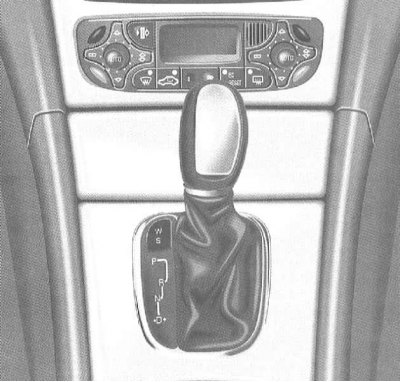
Individual gears are engaged automatically depending on:
- aT selector lever positions with shift ranges 4, 3, 2 and 1
- selected shift program (W/S)
- accelerator pedal position
- speed of movement
The gearshift mechanism automatically adapts to the driver's individual driving style by shifting the gearshift points.
The shifting of the gearshift points is a continuous process that constantly takes into account the current operating and driving conditions, as well as the driver's wishes.
The automatic transmission responds to changed operating conditions with an adapted gear shift program.
The AT selector lever can be switched in position 2 of the ignition switch. To move the AT selector lever from position "P", the service brake must be additionally pressed.
Moving off
Press the service brake to release the AT selector lever. Release the parking brake.
Shift the AT selector lever to one of the drive positions with the engine idling. Wait until the gear is fully engaged, especially when the engine is cold. This is confirmed by a slight jerk.
Release the service brake and press the accelerator pedal.
Shifting to a higher gear after starting a cold engine
After starting a cold engine, gear shifting occurs at a higher engine speed than shifting at operating temperature.
This allows the catalytic converter to reach its operating temperature sooner.
Accelerator pedal position
Lightly pressing the accelerator pedal causes early upshifts.
"Kickdown" - pressing the accelerator pedal beyond the point of resistance causes maximum acceleration and shifting to the lowest possible gear.
When you reach the desired speed, release the accelerator pedal - the transmission will shift to a higher gear again.
Stopping the car
Leave the selector lever in the "D" or "R" drive position and use the service or parking brake to prevent the vehicle from moving forward, or from rolling back on an incline.
Maneuvering
When maneuvering in a confined space, regulate the speed by gradually releasing the service brake. Press the accelerator pedal only slightly, do not play with it.
Parking
Press the parking brake pedal.
Move the AT selector lever to position "P".
On steep climbs or descents, turn the front wheels toward the curbstone, being careful not to damage the tires.
AT selector lever positions
The position of the automatic transmission selector lever is indicated on the instrument panel display.
P Parking lock. Additional protection for the vehicle when parked. Switch on only after the vehicle has come to a complete stop.
Note: The key can only be removed when the AT selector lever is in position "P".
When the key is removed, the AT selector lever is locked in the "P" position.
R Reverse gear. Engage only after the vehicle has come to a complete stop.
N Neutral position. No torque is transmitted from the engine to the drive wheels. With the brakes released, the car can move freely (pushing, towing).
Do not shift into "N" position while driving, as this may damage the transmission.
If the EPS function is disabled or faulty: Only if there is a risk of skidding is the vehicle allowed to shift to position "N" (for example, in winter on a slippery road).
D All 5 forward gears are used. The mode is designed for all normal forward driving conditions.
Switching ranges for special operating conditions
In the "D" position of the AT selector lever, shift ranges for special operating conditions are selected by lightly pressing or pressing the selector lever to the left or right.
The engaged switching range is indicated on the instrument panel.
Press the selector lever lightly in the "—" direction.
Switching is performed each time to one range in the sequence D, 4, 3, 2, 1.
Press the selector lever in the direction - and hold it pressed:
The shift range changes to the currently engaged AT gear. If the vehicle is already in the highest possible gear of the engaged shift range, the shift is only made to the next lower shift range.
Note. If you move the selector lever in the " — " direction at too high a speed, you will not switch to a lower gear. This prevents the engine speed limit from being exceeded.
Press the selector lever slightly in the "+" direction: The gear shift is made from the currently engaged shift range to the next higher shift range.
Press the selector lever in the "+" direction and hold it down: The shift range currently engaged is switched directly to the "D" position.
Note: If the transmission is in the "D" shift range, you can shift up one gear by lightly pressing the selector lever in the "+" direction.
Switching ranges:
- 4 Shifting only up to 4th gear.
- 3 Shifting only to 3rd gear. In this position, the engine braking effect can be used.
- 2 Shifting only to 2nd gear. The mode is intended for driving on steep passes, in the mountains, in difficult operating conditions, and also as a braking position on particularly steep descents.
- 1 1st gear. Braking position for driving on particularly steep descents and long passes.
Program switch
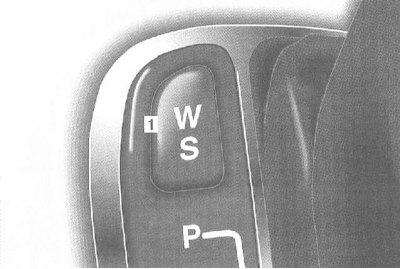
Pressing the "W/S" switch "1" switches between the "W" and "S" programs.
Press the "W/S" switch only when the selector lever is in the "P", "N" or "D" positions.
The selected program is displayed on the instrument panel.
"S" Standard mode
The mode is designed for all normal driving conditions.
"W" Winter mode
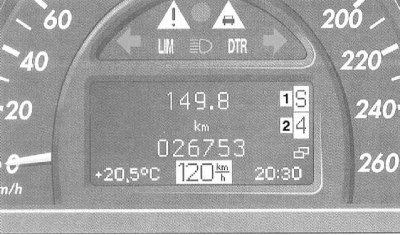
1 - Selected program
2 — The engaged position of the AT selector lever or the switching range
Upshifts and downshifts are performed by pressing the accelerator pedal firmly at lower driving speeds and lower engine speeds than in the "S" program.
In the kick-down position of the accelerator pedal, shifting to a higher and lower gear is carried out as in the "S" program.
Emergency mode
If the transmission can no longer be shifted while driving and retains the engaged gear even under changed operating conditions, the transmission is in emergency mode.
To enable further movement, 2nd gear or 2nd reverse gear can be engaged. The sequence of actions is as follows:
Stop the car.
Move the AT selector lever to position "P".
Turn the ignition key to position 0.
Wait at least 10 seconds.
Start the engine.
Move the AT selector lever to position "D": 2nd gear is engaged.
Original source of information: mercedesman.ru
Move the AT selector lever to the "R" position: Contact a service station immediately "Mercedes-Benz" to check the transmission.
Parking brake
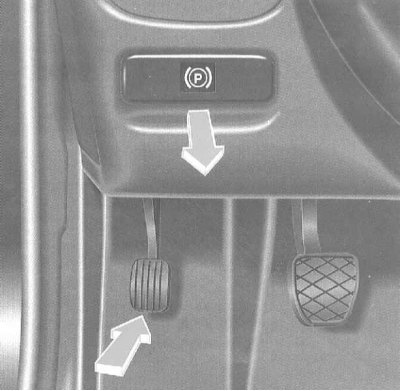
To set the parking brake: Press the parking brake pedal firmly. The parking brake is set.
When the parking brake is applied, the brake system indicator light comes on on the instrument panel.
Release: Pull the handle towards you. The parking brake is released instantly - the car can move immediately.
The brake system indicator light on the instrument panel goes out when the engine is running.
Note: When moving away with the parking brake applied, a warning signal sounds - release the parking brake.
If the brake system warning light remains on when the parking brake is released and the engine is running, refer to the "Brake System Warning Light" section.
Driving Tips
Control pedals
Never restrict the freedom of control of the pedals. There should be no objects in the driver's footwell. If using foot mats or carpets, ensure that there is sufficient free space and that they are securely fastened.
Traffic and parking
When driving or parking, ensure that exhaust system components do not come into contact with flammable material.
Warming up the engine to operating temperature
After starting off, quickly warm up the engine to operating temperature. Only then can you bring its load to full power.
Moving off
Starting off on slippery ground: Be sure to avoid prolonged spinning of one of the drive wheels. This may damage the transmission.
Steering
When the engine is not running, the power steering does not function. In this case, much more effort is required to steer.
Brakes
The hydraulic brake booster only works when the engine is running. It should be noted that when the engine is not running, braking requires significantly more force.
On long and steep descents, it is recommended to relieve the brakes by shifting the transmission to a lower gear - engage shift ranges 3, 2 or 1.
This prevents the brakes from overheating and reduces wear on the brake pads.
After an increased load on the brakes, it is recommended not to park the car immediately, but to first continue driving for a while in order to cool the brakes more quickly with the oncoming air flow.
If you have been driving for a long time without braking in heavy rain, there may be some delay when you first brake and you will have to press the brakes with greater force. Therefore, keep a greater distance than usual from the cars driving in front of you.
To prevent corrosion on the brake discs, before parking the car after driving on a wet road, especially if it has been sprayed with de-icing agent, press the brake hard to dry the brake discs by heating them.
Service brake
With relatively low operational loads on the brake system, its efficiency should be verified from time to time by short, strong braking at a higher speed. This will help the brake pads to become used to the brakes.
Make sure that braking does not endanger other road users!
Please note the operating principle of the Brake Assist (BAS) emergency brake assist system (see below).
If the brake system warning light comes on when the parking brake is released, refer to Section Warning and indicator lamps, as well as information display messages about registered faults.
Install the correct brake pads! Refer to the section Purchase of spare parts.
Disabling fuel supply in forced idle mode
In forced idle mode, fuel supply is interrupted if the accelerator pedal is fully released.
Engine malfunctions
If the engine is running unstable (for example, in case of misfires) unburned fuel can enter the catalytic converter and cause thermal damage.
In case of misfires, only short-term operation of the engine under light load is permitted (at low speeds).
The fault must be immediately corrected at a service station "Mercedes-Benz".
Hydroplaning
Depending on the water level on the road, aquaplaning may occur despite sufficient tire tread depth and low driving speed. In rain, brake carefully and avoid driving in ruts.
Tire grip
While on a dry road a vehicle is completely controllable at a certain speed, when driving on a wet or icy road the speed must be reduced accordingly to achieve the same degree of driving safety.
Even at temperatures close to freezing, the condition of the road surface should be monitored especially carefully.
If ice forms on the road (for example, due to fog), when braking on ice, a thin water film quickly forms, significantly reducing the coefficient of adhesion of the tires to the road. In such weather, exercise special caution.
In winter, it is recommended to use M + S type tires (with a tread for driving on dirty and snowy roads). On icy roads and slippery snow, they can reduce the braking distance compared to tires with a summer tread pattern.
Tires
Be sure to maintain the prescribed air pressure in your tires.
This is especially important for tyres that are used under extreme conditions, such as high speed, full load and high outside temperatures.
Avoid excessive wear of the tires. When the tread depth is less than 3 mm, the wet grip coefficient of the tires decreases sharply.
The coefficient of adhesion of tires to the road varies significantly depending on the weather or road surface conditions.
Travelling abroad
Network of service stations "Mercedes-Benz" also available abroad. The corresponding lists of service stations "Mercedes-Benz" can be requested at any service station "Mercedes-Benz".
In some countries, only low-octane fuel is sold.
In countries with traffic regulations that differ from the traffic regulations in the country where the vehicle is approved for use, it is necessary to switch the headlights to symmetrical low beam or partially cover them.
This reduces the glare from oncoming vehicles.
Operation in winter
Before winter arrives, prepare your vehicle for winter use.
Change the engine oil: if the oil is not approved for use in winter.
Check the concentration of antifreeze with anti-corrosion additives.
Windscreen washer and headlight cleaner
Add detergent concentrate to the water (refer to Specifications Chapter Routine maintenance).
Battery control
As the temperature drops, the battery capacity decreases. Only a well-charged battery ensures reliable engine starting even at low temperatures.
Tires
In winter, we recommend using M + S tires on all wheels (with a tread for driving on dirty and snowy roads). In this case, it is necessary to observe the maximum speed limit for M + S tires, as well as the maximum speed limit specified in the traffic rules!
Note: When driving the vehicle in winter, the maximum effect of the Electronic Skid Control (ESP) system is only achieved when using M+S tyres and, if necessary, snow chains.
When starting off with anti-skid chains, disabling the ESP anti-skid function can play a positive role (see below in this Section).
Recommendations for driving in icy conditions
The most important rule when driving on icy roads:
- Drive carefully, avoid sudden acceleration, braking and maneuvering when driving.
- If there is a risk of skidding or if the vehicle cannot be stopped at low speed, disengage the clutch or move the automatic transmission selector lever to the "N" position.
- Use the steering wheel to try to keep the car under control.
Anti-freeze agents used on roads may have a negative effect on braking performance. Therefore, greater force may be required to achieve the usual braking performance.
In this regard, it is recommended that when driving for a long time on roads covered with defrosting agents, you press the brake pedal repeatedly. This can normalize the braking effect reduced by defrosting agents.
Be careful not to endanger other road users when braking!
If the vehicle has been parked after driving on roads sprinkled with defrosting agents, the braking action should be checked immediately, if possible, with due caution before continuing the journey. If braking efficiency has noticeably decreased, it can be restored by repeatedly pressing the brake pedal.
Anti-skid chains
Use only MB tested and approved snow chains.
The installation of snow chains is only permitted on certain wheel and tyre combinations. (For more detailed instructions, see Specifications).
Apply snow chains to the rear wheels only (leading axle). Follow the manufacturer's installation instructions.
The maximum speed (50 km/h) is permitted only when driving on snow.
On roads without snow, snow chains should be removed immediately if possible.
(Recommendations for driving in icy conditions are given above).
When using snow chains, the ESP anti-skid function may be deactivated (see below).
Towing a trailer
Caution! Do not exceed the maximum support load, permissible towing load and permissible rear axle load of the vehicle.
It is necessary to strictly follow the installation instructions for the towing hitch with a removable ball head.
When operating with a trailer, it is necessary to take into account that the dynamic properties in this case differ significantly from the dynamic properties of a vehicle without a trailer.
A combination with a trailer is heavier, has limited acceleration and climbing ability, and a longer braking distance. It is more sensitive to crosswinds, etc., and requires more careful driving.
Fuel consumption when operating a vehicle with a trailer naturally increases.
When loading a trailer, make sure that the trailer's gross vehicle weight and the permissible towable weight of the vehicle together with the towing hitch are not exceeded (Specifications).
Permissible values are indicated in the vehicle registration documents and on the manufacturer's plates of the towing hitch and trailer.
The lowest value is valid.
In addition, the permissible load of the trailer drawbar on the ball head of the towing hitch must not be exceeded.
The maximum support load is specified in Specifications or on a glued-on plate. It must not exceed the value indicated on the manufacturer's plates of the towing hitch and trailer.
We recommend using the maximum support load on the trailer drawbar, and not less than 50 kg.
In accordance with the support load, it is necessary to reduce the weight of the load in the vehicle to avoid exceeding the permissible load on the rear axle.
It is recommended not to exceed the maximum speed of 80 km/h, including in countries where higher speeds are permitted.
If possible, avoid abrupt braking and first apply the brakes lightly to allow the trailer to roll onto the tractor. Then gradually increase the braking force.
If the trailer starts to sway, it is necessary to reduce the speed of movement, do not turn the steering wheel against the skid, and, if necessary, brake. In no case try to "pull out" the composition by increasing the speed of movement.
Given in Specifications the values for hill-climbing ability when starting off are based on sea level. When driving in the mountains, it is important to remember that as the altitude increases, the engine power decreases and, consequently, the hill-climbing ability decreases.
Note: Trailers with overrun braking systems must not be disconnected while rolling. The reverse motion of the overrun braking system may damage the bumper.
Tempostat
The cruise control automatically maintains the set speed.
The cruise control lever on the steering column can be used to select and activate the cruise control or the adjustable speed limiter.
The selected system, cruise control or adjustable speed limiter, is indicated by the LIM indicator on the cruise control switch lever:
- Cruise control: LIM indicator on cruise control lever does not light.
- Adjustable speed limiter: LIM indicator on cruise control lever illuminates - refer to Adjustable speed limiter subsection.
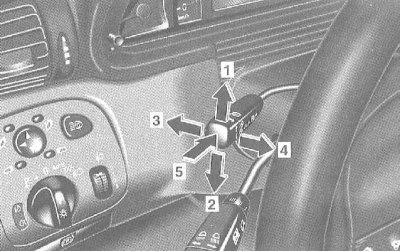
1 Saving the driving speed to memory - lightly press the cruise control lever.
Acceleration - keep the cruise control lever pressed.
Fine adjustment in 1 km/h steps – briefly press the cruise control lever.
2 Saving the driving speed to memory - lightly press the cruise control lever.
To reduce the speed of movement, hold the switch lever down.
Fine adjustment in 1 km/h steps – briefly press the switch lever.
3 Switching off - lightly press the switch lever.
The speed limit remains in memory.
4 To recall a stored speed, lightly press the cruise control lever.
5 Switching between adjustable speed limiter and cruise control – press the switch lever.
The cruise control is selected if the LIM indicator on the cruise control lever is off.
The adjustable speed limiter is selected if the LIM indicator on the cruise control lever is illuminated.
Please note! The cruise control function does not automatically adapt to road conditions, which means that the cruise control cannot be used, for example, on icy roads.
It is possible to record any speed above 32 km/h on petrol models and 40 km/h on diesel models.
Switching from adjustable speed limiter to cruise control. The LIM indicator on the cruise control lever must be off. If necessary, press the cruise control lever in the direction "5".
Accelerate to the desired speed by pressing the accelerator pedal.
Press the cruise control lever slightly in the direction "1" or "2". The speed is stored in the memory.
The speed entered into memory is displayed on the information display, and the segments from the speed entered into memory to the maximum speed of movement light up on the speedometer.
Release the accelerator pedal.
Note: When the vehicle speed is increased by pressing the cruise control lever in the "1" direction or decreased in the "2" direction after releasing the cruise control lever, the speed is recorded in the memory.
Precise setting in 1 km/h steps
To increase speed, press the cruise control lever slightly in direction "1".
To reduce speed, press the cruise control lever slightly in direction "2".
Recalling the entered speed from memory
Press the shift lever lightly in direction "4".
Select the memorized speed only if the driver remembers it well and intends to recall it again.
Note: When the ignition key is turned to position 1 or 0, the stored speed is reset.
Switching off: Briefly press the cruise control lever in the direction of "3" or "5", the speed remains in memory.
When pressing in the direction "5", the LIM indicator on the cruise control lever lights up - the adjustable speed limiter is selected.
The cruise control is also switched off when the brake or clutch pedal is pressed for more than 4 seconds, or when the AT selector lever is moved to the "N" position while driving.
Note: Note: When going uphill or downhill, the set speed may deviate. On models with automatic cruise control, the cruise control reduces the deviation from the driver's selected speed by shifting the transmission to a lower gear. Despite this, it is possible that the set speed may not be maintained.
After overcoming such a section, the stored speed is automatically set and the transmission returns to its previous position.
If the vehicle speed is reduced by pressing the cruise control lever in the "2" direction, then if the speed is not reduced sufficiently, the transmission shifts to 4th or 3rd gear.
To increase the speed of movement for a short time (eg for overtaking) - press the accelerator pedal. If the accelerator pedal is released again, the memorized speed is set again.
Use cruise control only when road conditions allow for a steady speed.
Notes for models with manual transmission and with automated Sequentronic transmission in manual mode
After changing gears, press the accelerator pedal slightly. This will improve the smoothness of the shift.
After releasing the accelerator pedal, the set speed is established again.
If the gearshift lever is in neutral after the clutch pedal is depressed, a short-term increase in engine speed is possible.
Always drive with sufficient but not exceeded engine speed - change gears in a timely manner. When changing gears, the cruise control does not switch off. Avoid downshifting by jumping through several gears. If the clutch pedal is depressed for more than 4 seconds when changing gears, the cruise control switches off.
Notes for models with Sequentronic automated transmission in automatic mode or with AT:
If the vehicle speed is reduced by pressing the cruise control lever in the "2" direction, then if the speed is not reduced sufficiently, the gearbox will shift to 4th or 3rd gear.
Speedtronic
Adjustable speed limiter
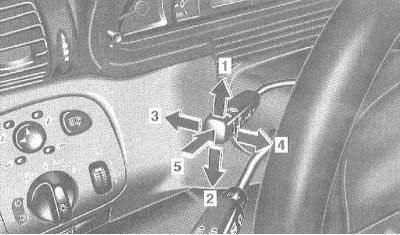
1 Activating the adjustable speed limiter - lightly press the cruise control lever.
To increase the speed limit, hold down the cruise control lever.
2 Activating the adjustable speed limiter - lightly press the cruise control lever.
To reduce the speed limit, hold down the cruise control lever.
3 To turn off the adjustable speed limiter, press the cruise control lever slightly.
The set speed limit remains in memory.
4 Recalling the speed limit from memory - lightly press the cruise control lever.
Fine adjustment, increasing the speed limit in 1 km/h steps – briefly press the cruise control lever.
5 Switching between cruise control and adjustable speed limiter - press the cruise control switch lever.
The adjustable speed limiter is selected if the LIM indicator on the cruise control lever is illuminated.
The cruise control is selected if the LIM indicator on the cruise control lever does not light. (Tempostat is discussed above in this Section).
Switching/activating
Start the engine.
When the engine is running, any speed above 30 km/h may be limited.
Switching from cruise control to adjustable speed limiter.
The LIM indicator on the cruise control lever should be lit. If necessary, press the cruise control lever in the direction "5".
Press the switch lever lightly in the direction (1, 2 or 4).
The adjustable speed limiter is activated.
The set speed limit is shown on the information display and the LIM indicator lights up on the speedometer.
Direction "1"
The driving speed is remembered as the new speed limit; rounding up to the next higher ten is performed. Further light pressing or holding of the lever increases the set speed limit.
Direction "2"
The driving speed is remembered as the new speed limit; this rounds off to the next lower ten. Further light pressing or holding of the lever reduces the set speed limit.
Direction "4"
The last stored speed limit is activated if the driving speed exceeds the limit by no more than 30 km/h.
By further lightly pressing or holding the lever, the set speed limit is increased in 1 km/h steps.
Deactivation
Lightly press the shift lever in direction "3" or press in direction "5".
All segments on the speedometer light up.
When you press in the direction "5", the LIM indicator on the cruise control lever goes out.
The speed limiter is also deactivated if, in the kick-down position of the accelerator pedal, the driving speed differs from the preset speed by no more than 20 km/h.
Note: Depending on the design, slight deviations in speedometer readings from the speed limiter setting are possible.
The unit of measurement for the speed indication can be selected in the menu "INSTRUMENT CLUSTER" (DASHBOARD) "Individual installation" systems, in the installation menu "DISPLAY VALUES IN" (VALUES ON THE DISPLAY IN) (Chapter Multifunctional steering wheel, universal display).
If in the menu "INSTRUMENT CLUSTER" (DASHBOARD) and "VEHICLE" (AUTOMOBILE) "Individual installation" systems call up the installation menu "DISPLAY VALUES IN" (VALUES ON THE DISPLAY IN) and "SPEED LIMIT" (WINTER TYRES), (SPEED LIMIT – WINTER TYRES), the adjustable speed limiter cannot be activated.
If the speed limiter cannot maintain the set speed (for example, on descents), a beep sounds and the universal display shows "LIMIT EXCEEDED" (SPEED LIMIT EXCEEDED). Additionally, the LIM indicator on the speedometer flashes.
If the adjustable speed limiter is faulty, refer to the subsection "Speedtronic", Section Warning and indicator lamps, as well as information display messages about registered faults).
Permanent speed limiter (Only Germany)
A permanent speed limiter can be set in the "VEHICLE" menu (AUTOMOBILE) "Individual installation" systems for specific values (for example, when operating a vehicle with winter tires) in the installation menu "SPEED LIMIT" (WINTER TYRES), (SPEED LIMIT - WINTER TYRES) (Chapter Multifunctional steering wheel, universal display).
Shortly before reaching the set speed limit, its value is displayed on the universal display. In addition, the LIM indicator lights up on the speedometer.
The set constant speed limit cannot be exceeded by depressing the accelerator pedal beyond the resistance point. On models with automatic transmission, this corresponds to the "kick-down" position of the accelerator pedal.
Note: Depending on the design, slight deviations in speedometer readings from the speed limiter setting are possible.
The unit of measurement for the speed indication can be selected in the menu "INSTRUMENT CLUSTER" (DASHBOARD) "Individual installation" systems, in the installation menu "DISPLAY VALUES IN" (VALUES ON THE DISPLAY IN) (Chapter Multifunctional steering wheel, universal display).
In case of malfunction of the permanent speed limiter - see "Warning and fault signaling system", system "Speedtronic" (Chapter Warning and indicator lamps, as well as information display messages about registered faults).
Brake Assist (BAS) (Brake Assist)
The Brake Assist emergency brake booster helps you reduce the braking distance when braking in dangerous road situations. It allows you to fully utilize the advantages of the anti-lock braking system (ABS).
When you press the brake pedal sharply, it provides maximum braking force. To achieve the shortest possible braking distance, do not reduce the force of your foot, but continue to press the brake pedal.
When the brake pedal is released, the booster turns off; service brakes are used.
Note: If the emergency brake assist system is faulty, see "Warning and fault signaling system" (Section Warning and indicator lamps, as well as information display messages about registered faults).
Anti-lock brake system (ABS)
When the ignition switch key is in position 2, the ABS indicator light comes on. It goes out when the engine is running.
If the ABS warning light on the instrument panel is constantly on when the engine is running, see Section Warning and indicator lamps, as well as information display messages about registered faults.
The ABS system prevents wheel locking regardless of road conditions, starting at speeds of approximately 8 km/h.
If the speed of one wheel deviates from the speed of the others during braking, ABS begins to control the brake pressure, and a vibration of the car and a slight pulsation of the brake pedal are felt. This way, the driver is notified of the ABS operation.
If further braking is required, do not reduce the force of your foot on the pedal. This takes advantage of the ABS system - braking while maintaining control of the car.
If full braking is required, press the brake pedal with full force, thereby ensuring the control mode using the ABS system.
On slippery roads, in icy conditions and snowfall, the system can be activated even at low braking force. The resulting pulsation of the brake pedal indicates that the driving style should be changed according to the difficult road conditions.
Note: If the anti-lock brake system is not functioning, refer to Section Warning and indicator lamps, as well as information display messages about registered faults.
Electronic skid control system (ESP)
The electronic ESP system improves the vehicle's driving stability and traction capability in all operating modes.
When the ignition switch key is in position 2, a warning light comes on in the speedometer. It goes out when the engine is running.
By braking the wheels and limiting the engine torque, skidding or poor control of the vehicle is counteracted. At the same time, the warning light on the speedometer flashes.
When the ignition key is in position 2, a warning light on the speedometer lights up. It goes out when the engine is running.
Switching off and on the ESP anti-skid function
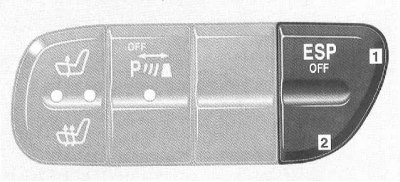
The switch is located on the center console.
Press the switch:
- 1 Turn off
- 2 Turning on
Shutdown
Press the ESP system switch at the top (1).
The warning light on the speedometer comes on.
When driving with anti-skid chains, in deep snow, sand or gravel, it can be beneficial to switch off the anti-skid function when starting off or while driving. In this case, the engine torque is not limited and the drive wheels can spin, creating a milling action.
The traction control function is also activated when one drive wheel reaches the limit of the tyre's adhesion to the road, for example on one-sided ice. To prevent the wheel in question from spinning, it is braked until sufficient traction has been achieved. This traction control function is activated at speeds up to approximately 40 km/h. It is deactivated at a driving speed of approximately 80 km/h at the latest.
The warning light on the speedometer will flash at any speed when the tires have reached the limit of adhesion to the road.
Turning on
To return to normal driving mode, press the ESP switch (2). The warning lamp on the speedometer goes out and the anti-skid function is again operational.
Caution! When towing with the front axle raised or checking the parking brake on a brake test stand, the engine must be switched off. Otherwise, the active braking effect via the ESP system may damage the rear axle brake system.
Note: When operating the vehicle in winter, the maximum effect of the electronic skid control system (ESP) is achieved only when using tires with a winter tread pattern (M+S) and, if necessary, anti-skid chains.
When using wheels with tyres of different sizes, the proper functioning of the ESP system is not ensured.
If the anti-lock brake system (ABS) is faulty, the electronic skid control system (ESP) and brake assist (BAS) are also switched off.
If the electronic anti-skid system malfunctions, see "Warning system and malfunction signaling" (Section Warning and indicator lamps, as well as information display messages about registered faults).
System "Parktronic" (PTS)
System "Parktronic" visually and acoustically warns of a dangerous distance between your car and an obstacle.
If the key in the ignition switch is turned to position 2, the system "Parktronic" automatically switches on and remains activated up to a speed of approximately 15 km/h.
At higher speeds the system "Parktronic" automatically turns off. At low speed it automatically turns on again.
The activation of the alarms with the corresponding control zone is carried out depending on the position of the automatic transmission selector lever.
Position of the AT selector lever
"D" Front zone alarms activated.
"R", "N" front and rear zone indicators are activated.
"P" alarms are deactivated.
Sequentronic automated gearbox lever positions:
- "G", "A", "N" forward zone alarms are activated.
- "R" front and rear zone indicators are activated.
Position of the manual transmission gear shift lever:
- Except for reverse: front zone warning lights activated;
- Reverse: Front and rear zone indicators are activated.
System "Parktronic" can be turned off using the switch on the center console.
Signaling devices
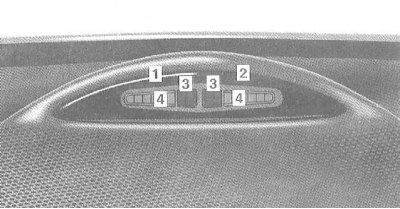
Shown are the alarms for the front zone.
- 1 Left side of the car
- 2 Right side of the car
- 3 Frames
- 4 Segments
The front zone indicators are located on the instrument panel above the center air vent.
The rear zone indicators are located on the roof headliner in the rear of the passenger compartment.
If the system "Parktronic" is on, the frames (3) on the indicators light up.
The distance between the sensor and the obstacle is indicated by the segments (4) of the alarms.
The indicators are divided into 6 yellow and 2 red segments.
If the vehicle approaches an obstacle registered by the sensors, one or more segments light up depending on the distance.
Starting from the seventh segment, an intermittent warning signal is additionally sounded, and starting from the eighth segment, a continuous warning signal is sounded for a maximum of 3 seconds.
Sensors
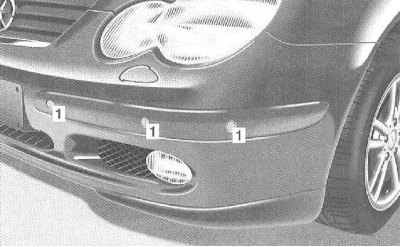
The nearest zone is monitored by 6 sensors "1" on the front bumper and 4 sensors on the rear bumper.
Sensor range
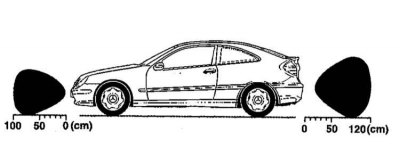 |
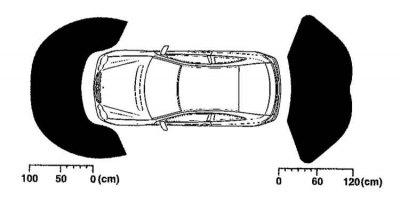 |
Front bumper: in the middle about 100 dark, about 60 cm.
Rear bumper: in the middle about 120 dark about 80 cm.
At these distances the first yellow segment lights up. As the distance decreases, other segments light up.
Minimum distance between sensor and obstacle:
- front corners about 15 cm
- in the middle about 20 cm
All yellow segments and one or both red segments light up. In addition, a warning signal sounds for approximately 3 seconds.
Further approach may result in the obstacle no longer being indicated (segments do not light up).
When parking, pay particular attention to objects located below or above the sensors, such as flower boxes or the trailer drawbar.
Similar objects in close proximity (about 30 cm), may not always be recognized by the system and may thus be damaged or cause damage to the vehicle.
Function of the system "Parktronic" may be impaired if the sensors are damaged or covered with dirt, snow, ice and especially slush.
Interference from other sources of ultrasound, such as air brakes on trucks or air hammers, also cannot be completely excluded.
It is possible that certain objects that may touch the front or rear of the vehicle will not be detected by the system's sensors.
Shutting down the system "Parktronic"
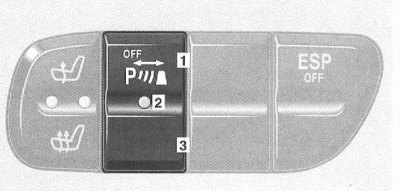
The switch is located on the center console.
Press the switch:
- 1 Turn off
- 2 Turning on
- 3 Control LED - lights up when the system is off "Parktronic"
Switching on occurs automatically when the key in the ignition switch is turned to position 2.
Towing a trailer
If the power cable is plugged into the socket when towing a trailer, the rear protection function is not activated.
If the power cable is disconnected, the rear protection function is reactivated.
Note: The trailer adapter with 7-pin plug must be removed from the socket after the trailer has been disconnected, otherwise the rear protection function remains inactive.
System failure "Parktronic"
In case of a malfunction, only the red segments of all alarms light up.
The cause may be an external ultrasound source or a dirty sensor.
(Cleaning the system sensors "Parktronic" on bumpers - refer to Chapter Suspension and steering).
After cleaning the sensors, turn the ignition key back to position 2.
In the event of a malfunction, a warning signal sounds for approximately 3 seconds and the control LED on the system switch lights up "Parktronic" on the center console lights up. The system turns off!
Contact a service station immediately "Mercedes-Benz" to check the system "Parktronic".
Remote garage door opener
There is a risk of accident!
Pressing one of the buttons on the transmitter of the integrated remote control in the interior rearview mirror is only permitted if there are no people or objects in the operating range of the garage door opener; otherwise, there is a risk of injury to people from the opening door.
The remote control integrated into the interior rear-view mirror can be used to open or close up to three different door systems.
Note: Some garage door openers cannot be controlled by the built-in remote control. For more information, please contact your service station "Mercedes-Benz".
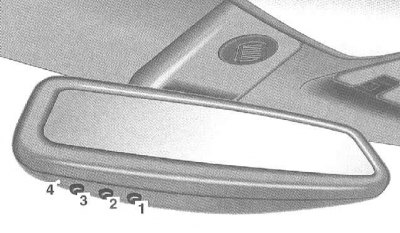
1 Transmitter button
2 Transmitter button
3 Transmitter button
4 Control LED
Programming the built-in remote control
Transmitter buttons "1", "2" and "3" can be programmed.
Programming using the example of transmitter button "1":
- Turn the ignition key to position 1 or 2.
- Press and hold transmitter button "1" until control LED "4" starts flashing at a frequency of approximately once per second.
- Continue to hold down the transmitter button "1".
Note: The control LED "4" will start flashing immediately if one of the transmitter buttons is being programmed for the first time, or if the contents of the built-in remote control memory have been reset beforehand.
- When reprogramming a programmed transmitter button, the control LED "4" starts flashing after approximately 20 seconds.
- Keep the portable remote control for the garage door opener pointed (transmitter output) on the left side of the interior rearview mirror. Press the transmitter button of the portable remote control until the control LED "4" starts to flash quickly.
- Programming was successful.
- Release the transmitter button "1".
Note: If your garage door opener operates with a rolling code (Rolling-Code), then you should synchronize the vehicle transmitter and the transmitter of the remote garage door opener system.
Opening/closing the garage door
The built-in remote control, once programmed, takes on the properties of a portable remote control for the garage door opener (refer to the appropriate "Operating Manual").
- Turn the ignition key to position 1 or 2.
- Press the desired transmitter button (1, 2 or 3) in accordance with programming.
- The garage door opens or closes.
Note: The transmitter operates as long as the transmitter button is pressed. After no more than 20 seconds, the transmission process is interrupted and the control LED "4" starts to flash. If necessary, press the transmitter button again.
Resetting the built-in remote control device
- Turn the ignition key to position 1 or 2.
- Press and hold buttons "1" and "3" for approximately 20 seconds until control LED "4" starts flashing rapidly.
- The contents of the memory have been reset.
Note: Before selling your vehicle, we recommend that you reset the contents of the built-in remote control device memory.
Refueling
Locking and unlocking the fuel filler flap is performed together with locking and unlocking the doors and trunk lid using the remote control device.
Information on fuel grades is provided in Specifications.
Remove the key from the ignition switch.
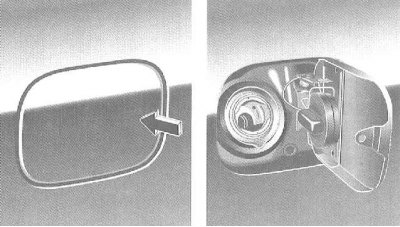
Open the fuel tank door: press in the direction of the arrow and open.
Open the fuel tank cap: turn to the left and hold to release excess pressure.
Remove the fuel tank cap and insert it into the holder located on the inside of the fuel tank door.
Fill the fuel tank only to the level at which the dispenser nozzle turns off - do not overfill the tank.
(Filling volumes are indicated in the Specifications to Chapter Routine maintenance).
Close the fuel tank cap: turn to the right until it locks.
Close the fuel filler cap.