



Attention! Incompetent use of the tempostat may cause a traffic accident!
Only use the speed control system when driving on freeways and in favorable weather conditions.
Attention! During the operation of the system, the gas pedal may move automatically, but do not hold it with your foot to avoid damage to the support and axle mechanisms!
The speed control system on the models in question can operate in one of two modes: as a standard design cruise control, and as a variable speed limiting system (Speedtronic), - the modes are switched using the steering column lever switch located on the left side of the steering column, above the combined steering column switch assembly. The same switch provides the ability to control the operation of the speed control system within the selected mode.
When using a cruise control on models equipped with a manual transmission, try to avoid excessive increases in engine speed by shifting gears in a timely manner and avoid downshifting by skipping intermediate gears.
Note: Shifting gears or holding the clutch pedal depressed for more than 4 seconds will cause the cruise control to be disengaged.
Tempostat Operation Management
Switching between the operating modes of the speed control system is done by pressing the end part, which activates the variable speed limit mode (Speedtronic) accompanied by the activation of the LIM indicator light lever built into the assembly.
The activation/mode switching/tempo control switch is located on the right side of the steering column (control principle in standard mode, - LIM indicator does not light)
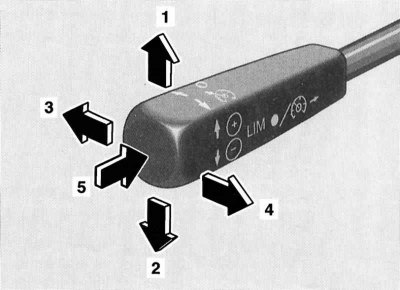
- 1 - Entering the current speed value into the system memory (briefly press the lever)/acceleration (keep the lever depressed)/fine adjustment of cruising speed setting in 1 km/h increments
- 2 - Entering the current speed value into the system memory (briefly press the lever)/reduce speed (keep the lever depressed)/fine adjustment of cruising speed setting in 1 km/h increments
- 3 - Turn off (the cruising speed value remains in the system memory)
- 4 - Retrieving the cruising speed value from the system memory
- 5 — Switching between "Tempostat/Speedtronic/Off" modes
Standard mode
The design of the cruise control switch allows any current vehicle speed to be entered into the system memory as cruising speed if it exceeds a value of 32 (petrol models)/40 (diesel models) km/h, - it is enough to briefly press the control lever up or down. After entering the cruising speed, release the gas pedal.
The cruising speed value is increased and decreased by pressing the lever up/down respectively and holding it in this position.
Note: By briefly pressing the lever up and down with the cruise control activated, the cruising speed can be adjusted in 1 km/h increments. When the lever is released after the cruising speed adjustment has been made, the newly selected value is automatically stored in the system memory.
Brief acceleration of the vehicle, for example when overtaking, can be achieved by pressing the gas pedal - after releasing the pedal, the speed will automatically decrease to the cruising value stored in the cruise speed setting.
After accelerating the car to a speed above 32 (petrol models)/40 (diesel models) km/h, the cruising speed stored in the memory of the speed controller can be recalled by briefly pulling the lever towards you.
Caution! Activate the recall of the cruising speed from the system memory only if you remember its value and are ready to move with it.
Note: When driving with cruise control on, deviations from the set cruising speed may occur downhill or uphill.
To turn off the cruise control, simply push the switch lever away from you or press its end handle. - the selected cruising speed value will remain in the system's memory.
When the ignition key is turned to position 1 or 0, the cruise value stored in the cruise control memory is reset.
The cruise control is also switched off by pressing the foot brake pedal or pressing the clutch pedal for more than 4 seconds (models with manual transmission), as well as moving the AT selector lever to the "N" position (models with AT).
Speedtronic mode
The Speedtronic system provides variable limitation of the vehicle speed according to the selected parameters.
A variable speed limiter allows you to limit engine speed without exceeding a certain set speed threshold, for example, when it is necessary to strictly comply with traffic rules.
Attention! Do not forget that the driver is always responsible for exceeding the speed limit!
The variable speed limit mode is activated by pressing the end of the cruise control switch lever handle and is accompanied by the activation of the yellow LIM indicator built into the switch handle - a similar indicator is also built into the speedometer assembly on the vehicle's instrument panel (see Section Instrument cluster, gauges and control lamps and indicator lights).
Note: The limiter is activated only if the current vehicle speed differs from the limit value stored in the system memory by no more than 30 km/h.
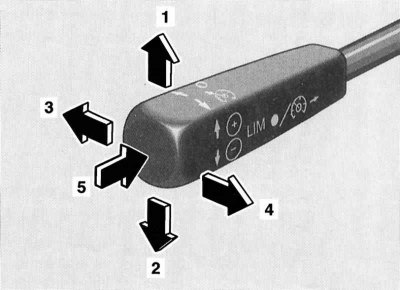
The activation/mode switching/tempo control switch is located on the right side of the steering column (control principle in standard mode, - LIM indicator is on)
[Publication taken from an online resource MercedesMan]
- 1 — Activate the system/increase the speed limit in 10 km/h increments
- 2 — Activate the system/reduce the speed limit in 10 km/h increments
- 3 - Turn off the system
- 4 — Recalling the stored speed limit value/fine adjustment of the speed limit setting in 1 km/h increments
- 5 — Switching between "Tempostat/Speedtronic" modes
Changing the speed limit value (in 10 km/h increments) is performed by pressing the switch lever up or down, the selected speed limit value will be displayed on the screen of the display built into the dial of the speedometer under the illuminated LIM indicator. With the engine running, it is possible to enter any speed limit, starting from 30 km/h.
On models with AT, the set speed limit can be exceeded by pressing the accelerator pedal all the way to the stop and passing the point of resistance (enable kickdown mode).
Unlike cruise control mode, pressing the foot brake pedal does not disable the speed limiter.
The limitation mode can be exited by briefly pushing the lever away from you, or by pressing the end of its handle - the LIM indicator should go out. The limiter is automatically disabled when the car accelerates in kickdown mode to a speed exceeding the set limit by more than 20 km/h.
If the limiter fails to cope with the task, for example when driving downhill, a warning buzzer is activated and a message is displayed on the instrument cluster display screen "LIMIT EXCEEDED".
Note: Due to design features, the speedometer readings may differ slightly from the speed limiter settings.