



Check the tyres regularly for damage such as cuts or bulges, especially on the side surfaces. Remove the wheels periodically and remove all dirt from the outer and inner surfaces. Inspect the wheel rims for corrosion and other damage. Light alloy wheels are easily damaged by hitting the curb when stopped: steel wheels can easily become dented. Very often, due to severe damage, there is no choice but to replace the wheel with a new one.
When installing new tires, they need to be balanced, but due to tire wear or loss of balancing weights attached to the wheel rim, a new balancing may be required. If the tires are unbalanced, they wear out faster, and the same applies to steering and suspension components. Wheel imbalance is usually accompanied by vibration, especially at a certain speed (usually around 50 mph). If such vibration is felt only through the steering, then it is likely that balancing is necessary only for the front wheels. If the entire car vibrates, then the rear wheels may be unbalanced. Wheel balancing should be done in a car repair shop.
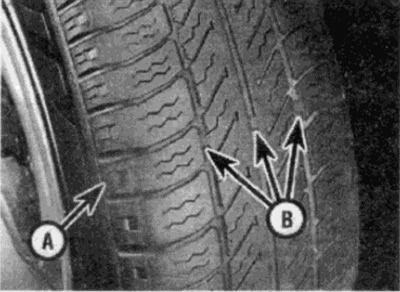
1. Tread depth - visual inspection
Tyres fitted at the vehicle manufacturer have wear indicator strips (B) which become visible when the tread groove depth is reduced to approximately 1.6 mm. The position of the strips is marked by a triangle (A) on the sidewall of the tyre.
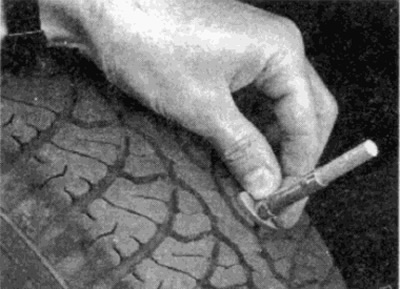
2. Tread depth - manual check
Another way to monitor tread wear is to use a simple and inexpensive device known as a tread depth indicator.
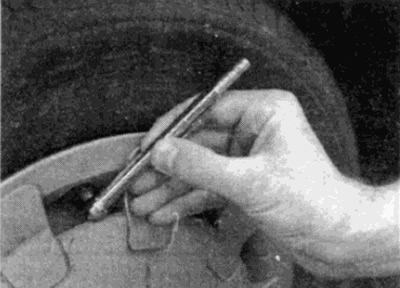
3. Checking tire pressure
Check the tire pressure regularly, when the tires are cold. Do not adjust the tire pressure immediately after driving, as this will lead to incorrect results. The tire pressure values are listed on the next page.