



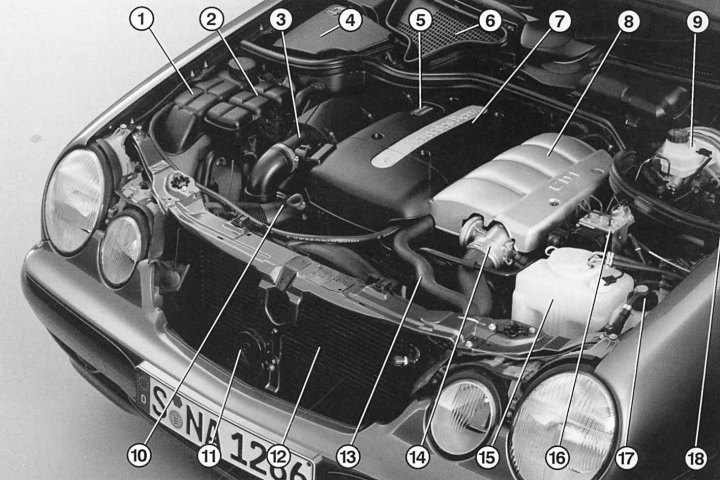
Fig. 4.1. Engine compartment of a 4-cylinder diesel engine of the CDI series: 1 – expansion tank of the cooling system; 2 – air intake of the intake system with air filter; 3 – turbocharger air intake duct; 4 – cooled plastic box for electronic control devices and relay blocks; 5 – oil filler cap; 6 – air intake grille for interior ventilation; 7 – engine casing; 8 – intake manifold casing; 9 – brake fluid reservoir with master cylinder and brake booster;10 – oil dipstick; 11 – signal; 12 – radiator; 13 – water cooling hose; 14 – throttle body with gas bleed valve; 15 – windshield washer reservoir; 16 – Brake system control module; 17 – reservoir for servo oil; 18 – relay and fuse box
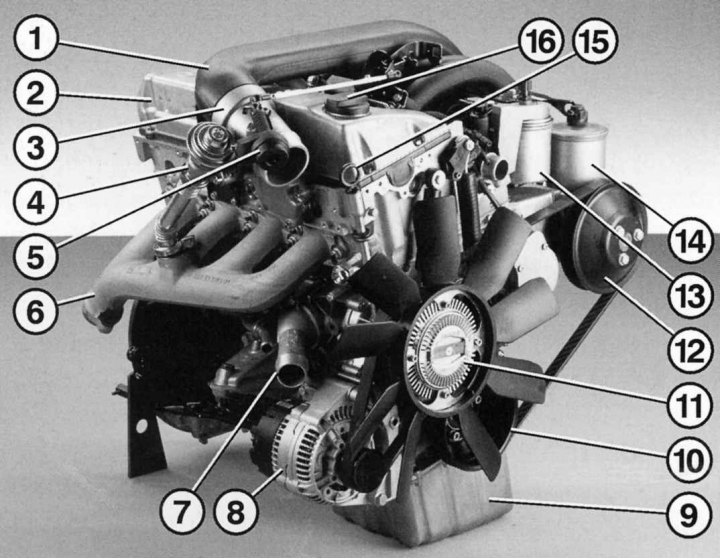
Fig. 4.2. Four-cylinder pre-chamber diesel engine: 1 – air intake; 2 – cylinder head cover; 3 – control valve casing; 4 – gas exhaust control valve; 5 – low pressure control valve; 6 – exhaust manifold; 7 – cooling system pipe; 8 – generator; 9 – crankcase; 10 – auxiliary drive belt; 11 – fan; 12 – Hydraulic servo control pump drive; 13 – fuel filter; 14 – oil filter; 15 – oil dipstick; 16 – oil filler neck
The new generation of Mercedes diesel engines began to be installed in the E-class in 1993 (Fig. 4.1). All engines, even the smallest one - OM 604 (2.2 l), were equipped with 4-valve prechamber cylinder heads, which were first mass-produced for Mercedes diesel engines. The valves were driven by two overhead camshafts (Fig. 4.2). The exhaust camshaft was driven by a chain from the crankshaft and, in turn, drove the intake valve shaft through a gear. High torque was provided by the intake system with long sector intake pipes.
Since June 1998, Mercedes E-Class models have been equipped with diesel engines with the Common Rail system. The first of this series was the E 200 CDI engine with a power of 85 kW/115 hp. The increase in power was achieved by using a new turbocharger with adjustable guide vanes.