
Cars BMW Cars Volkswagen Cars Chevrolet Cars Land Rover Cars Lada Cars Honda Cars Peugeot
English Русский
Български
Беларускі
Український
Српски
Hrvatski
Română
Polski
Slovenský
Magyar
Bookmark News and articles Sitemap Feedback Site search
MercedesMan.ru


A-Class C-Class E-Class G-Class M-Class S-Class Others
W123 (1976-1985) W124 (1984-1995) W210 (1996-2002)
  • Main
  • E-Class
  • W124 (1984-1995)
  • General information
  • Maintenance (gasoline)
  • Maintenance every 3 years

Maintenance every 3 years (Mercedes-Benz E-Class W124)

0
Contents: Draining the coolant ↡ Flushing the cooling system ↡ Radiator flushing ↡ Engine flush ↡ Filling the cooling system ↡ Antifreeze ↡

Draining the coolant


Caution! Replace the coolant on a cold engine. Avoid contact of coolant with painted surfaces of the body and clothing. Otherwise, wash the area where the coolant has come into contact with plenty of water.


Removal the cap from the expansion tank
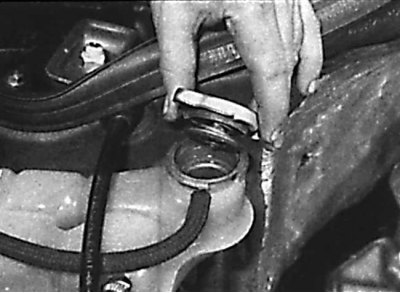


Removal the cap from the expansion tank


Location of coolant drain plug
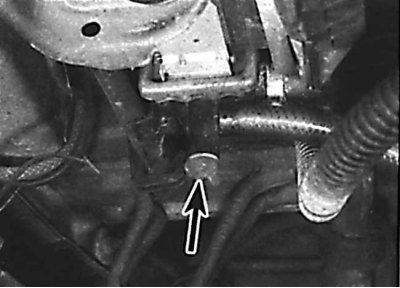


Location of coolant drain plug


Location of the coolant drain plug on the engine block
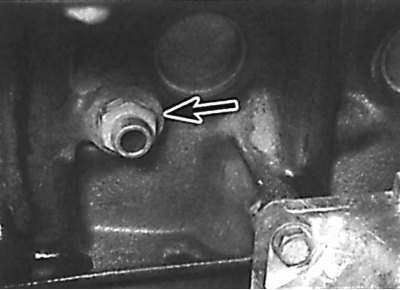


Location of the coolant drain plug on the engine block


1. Remove the cap from the expansion tank (see Fig. Removing the expansion tank cap).


2. Place a suitable container under the radiator and place a rubber hose on the drain end (see Fig. Location of drain tip for draining coolant). Using a large screwdriver, open the drain plug located under the tip and drain the coolant through the hose into a container.

3. Place a suitable container under the engine block drain plug, which is located on the right front side of the cylinder block (see Fig. Location of the coolant drain plug from the engine cylinder block). Open the drain plug by turning it with a wrench and drain the coolant from the engine block.

4. After draining the coolant, remove the drain hose and close the plugs on the radiator and cylinder block.

Flushing the cooling system


The coolant must be changed periodically and the cooling system flushed, as rust and dirt form in the system channels.

The radiator must be flushed independently of the engine.

Radiator flushing


1. Disconnect the hoses from the radiator.

2. Insert the hose into the inlet of the upper radiator tank, turn on the water and flush the radiator until clean water appears from the lower radiator tank.

3. If you cannot flush the radiator with clean water, use a detergent.

Engine flush


1. Remove the thermostat and temporarily install the thermostat cover.

2. Disconnect the hoses from the radiator and feed a stream of clean water through the hose into the engine block through the upper radiator hose and flush it until clean water appears from the lower hose leading to the radiator.

Article borrowed from the web portal [www.mercedesman.ru]


3. Install the thermostat and connect the cooling system hoses.

Filling the cooling system


Filling the expansion tank with water
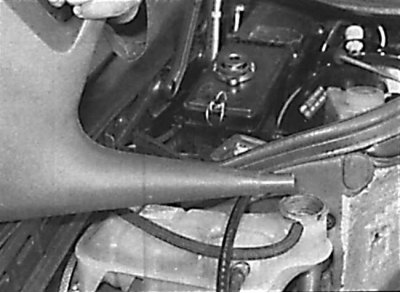


Filling the expansion tank with water


If the coolant was replaced, first pour 2 liters of water into the expansion tank.

Filling with antifreeze concentrate
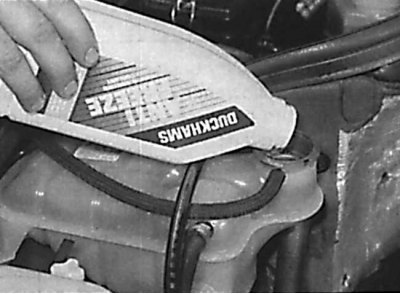


Filling with antifreeze concentrate


Next, pour in the required amount of antifreeze concentrate and clean water until the level reaches the max mark on the expansion tank

1. Before filling the cooling system, check that all hoses and clamps are in good condition. Note that the antifreeze mixture should be used year-round to prevent corrosion.

2. Remove the cap from the expansion tank.

3. Slowly add coolant until the level reaches the max mark on the expansion tank.

4. If the coolant was replaced, first pour 2 liters of clean water into the expansion tank, then pour in the required amount of antifreeze concentrate and the remaining water (see fig. Filling water into the expansion tank, Filling antifreeze concentrate).


5. To remove air from the cooling system, squeeze the upper and lower radiator hoses. After removing the air, add coolant to the max mark on the expansion tank and install the plug.

6. On 6-cylinder SOHC engines, remove the plug from the coolant sensor housing on top of the cylinder head. Once coolant appears from the hole, reinstall the plug.

7. Start the engine and warm it up to operating temperature.

8. Stop the engine and let it cool, then check the coolant level.

Antifreeze


Antifreeze is a mixture of distilled water and ethylene glycol concentrate. Antifreeze provides protection for the cooling system from corrosion and increases the boiling point of the coolant. The amount of ethylene glycol in antifreeze depends on the weather conditions of the car and ranges from 40 to 70%.
This article is available at: russian, bulgarian, belarusian, ukrainian, serbian, croatian, romanian, polish, slovak, hungarian
The article has been verified: Levin Kirill Glebovich
Share with friends:
◀ Previous
E-Class W124 / Maintenance (gasoline)
Next ▶

Maintenance every 12 months
Maintenance every 118,000 km or once every 4 years
Maintenance every 58,000 km
Maintenance every 18,000 km
Maintenance every 9,000 km
 
More similar articles for repairing other models

☛ Indication of maintenance period Mercedes W168 (1997-2004)
☛ Periodic care and maintenance Mercedes W202 (1993-2000)
☛ Routine care and maintenance — general information Mercedes W463 (1999-2019)
☛ Active Maintenance Warning System (ASSYST) Mercedes W163 (1997-2005)
☛ Routine Maintenance — General Information Mercedes W140 (1991-1998)
☛ Maintenance and care — general information Mercedes Sprinter (1995-2000, diesel)
Link in different formats to this article
Comments and feedback from visitors
No comments yet


How much will 10 + 26 ?


W210 (1996-2002) 
  • General information
  • Vehicle description
  • Working conditions and tools
  • Car care
  • Diesel engines
  • Engine repair
  • Lubrication system
  • Cooling system
  • Injection system
  • Supply system
  • Exhaust system
  • Gasoline engines
  • Engine repair
  • Lubrication system
  • Cooling system
  • Control system
  • Power and exhaust system
  • Transmission
  • Clutch
  • Mechanical gearbox
  • Automatic gearbox
  • Drive shafts
  • Chassis
  • Car suspension
  • Steering
  • Tires and wheels
  • Brake system
  • Body
  • Exterior (external elements)
  • Interior (internal elements)
  • Doors and windows
  • Heating and ventilation
  • Electrical equipment
  • Equipment and devices
  • Power devices
  • Lighting and signaling
  • Electrical circuits
W124 (1984-1995) 
  • General information
  • Governing bodies
  • Driving and operation
  • Weekly care
  • Maintenance (gasoline)
  • Maintenance (diesel)
  • Troubleshooting
  • Power unit
  • I4 petrol engine
  • V6 petrol engine (SOHC)
  • V6 petrol engine (DOHC)
  • Diesel engines
  • Engine overhaul
  • Cooling system
  • Heating and ventilation
  • Fuel system (carburetor)
  • Injection system «Bosch CIS-E»
  • Injection system «Bosch HFM»
  • Diesel fuel system
  • Supply system
  • Starting and charging system
  • Ignition system (I4)
  • Ignition system (V6)
  • Preheating
  • Transmission
  • Clutch
  • Mechanical gearbox
  • Automatic gearbox
  • Drive shafts
  • Chassis
  • Brake system
  • Car suspension
  • Steering
  • Body
  • Exterior (external elements)
  • Interior (internal elements)
  • Doors, locks and windows
  • Electrical equipment
  • Equipment and devices
  • Switches
  • Headlights and lighting
  • Electrical circuits
W123 (1976-1985) 
  • General information
  • Introduction to the guide
  • Power unit
  • Engine device
  • Repair M102 engines
  • Repair M110 and M123 engines
  • Cooling and lubrication (M102)
  • Cooling (M110 and M123)
  • Ignition system
  • Power system «Stromberg»
  • Power system «Solex 4A1»
  • Fuel injection «K-Jetronic»
  • Fuel injection «L-Jetronic»
  • Transmission
  • Clutch
  • Mechanical gearbox
  • Automatic gearbox
  • Cardan and rear axle
  • Chassis
  • Front suspension
  • Rear suspension
  • Steering
  • Brake system
  • Body
  • Exterior (external elements)
  • Interior (internal elements)
  • Doors, locks and windows
  • Electrical equipment
  • Equipment and devices
  • Power devices
  • Electrical circuits
 
MercedesMan.ru © 2017–2026 · Mobile version · Read about Mercedes · Sitemap: EN BG BY UA RS HR RO PL SK HU · Feedback · Site search · Bookmark A-Class (W168) · C-Class (W201) · C-Class (W202) · C-Class (W203) · E-Class (W123) · E-Class (W124) · E-Class (W210) · G-Class (W463) · M-Class (W163) · S-Class (W116, petrol) · S-Class (W126, petrol) · S-Class (W140) · S-Class (W220) · Sprinter · Vito 1 · Vito 2 · Vario 814D ·
 
We only use cookies without which some of the site's features may not be available.