



Contents: Checking the components of the…↡ Checking the oil level in an…↡ Checking the tightness of the hoses…↡ Checking and replacing the auxiliary…↡ Examination ↡ Replacement ↡ Checking the air conditioning system ↡ Checking and adjusting idle speed ↡ Examination ↡ Adjustment ↡ Checking the front suspension and…↡ Checking the shock absorber ↡ Checking the drive shaft protective…↡ Checking the front brake pads ↡ Checking the rear brake pads ↡ Checking the exhaust system ↡ Checking the oil level in a manual…↡ Checking the oil level in the main…↡
Periodic oil and oil filter changes are the most important preventative maintenance procedures. As engine oil ages, it becomes thin and contaminated, leading to premature engine wear.
Before starting this operation, gather all the necessary tools and materials together. It is necessary that the engine is warm so that the oil flows better together with the bulk of the contaminants.
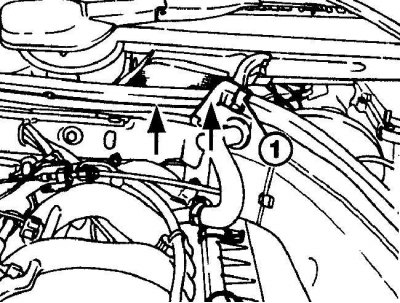
Location of the bracket (1) for fastening the seal to the engine compartment box
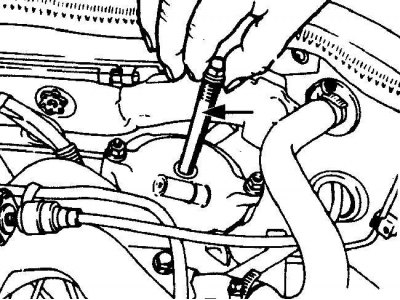
Location of oil return line
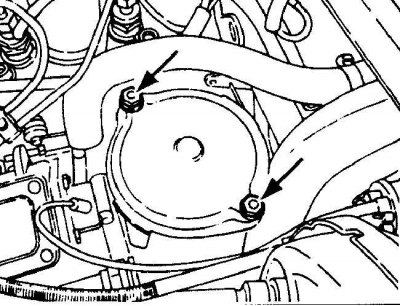
Location of oil filter cover mounting nuts
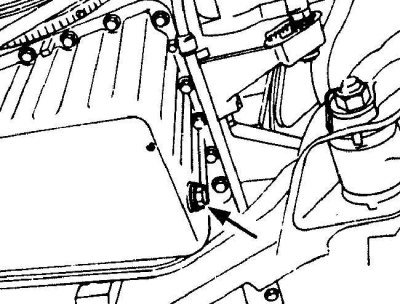
Location of the engine oil drain plug
Removal the filter element from the oil filter housing
Hole at the base of the oil return line
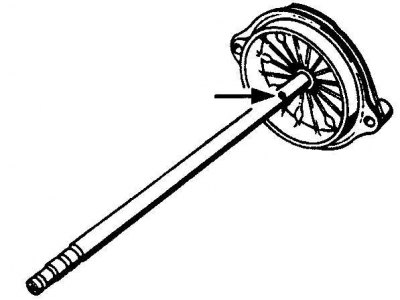
Clean out the small hole at the base of the oil return line.
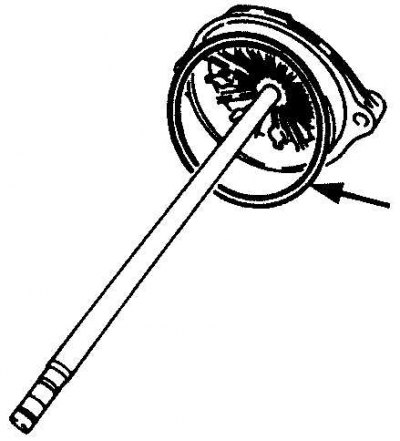
Installing a new O-ring on the oil filter cover
1. Raise the vehicle so that the engine oil drain plug is at its lowest point.
2. The oil filter housing is located in the left rear corner of the engine compartment behind the exhaust manifold.
3. If present, remove the mounting bracket or unscrew the screw and remove the rubber seal from the top of the engine compartment bulkhead to improve access to the oil filter housing (see Fig. Location of the bracket (1) securing the seal to the engine compartment box).
4. On models with an oil return line attached to the center of the oil filter housing cover, unscrew the oil return line and remove it from the cover (see Fig. Location of oil return line).
5. Unscrew the two nuts and remove the cover from the oil filter housing (see Fig. Location of oil filter cover mounting nuts).
6. Loosen the drain plug about half a turn. Place a container to collect the oil under the drain plug and unscrew the plug completely. If necessary, apply pressure to the plug while unscrewing to prevent the oil from leaking prematurely. Remove the O-ring from the oil drain plug (see Fig. Location of the engine oil drain plug).
7. Once the oil has drained completely, wipe off any debris around the drain hole with a rag and screw the plug back on securely.
8. Remove all tools from under the vehicle and lower the vehicle.
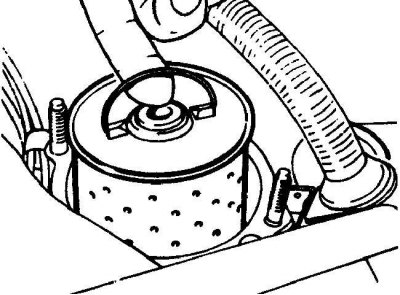
9. Remove the filter element from the oil filter housing (see Fig. Removing the filter element from the oil filter housing).
10. Wipe the oil filter housing and cover. Check the oil return line for patency. The line should be freely ventilated. If necessary, clean the small hole at the base of the line (see Fig. Hole at the base of the oil return line).
11. Install a new O-ring onto the oil filter cover (see Fig. Installing a new O-ring on the oil filter cover).
12. Install the new oil filter element into the housing and cover and secure with bolts, tightening them to the specified torque.
13. Install a new O-ring to the top of the oil return line, then install the oil return pipe.
14. Remove the dipstick and the oil filler cap. Fill the engine with oil using the correct grade of oil. Add half the required amount of oil and wait a few minutes for the oil to drain into the pan. Then continue adding oil in small amounts until the oil level reaches the minimum level on the dipstick. Adding about 1 more liter will raise the oil level to the maximum level on the dipstick. Insert the dipstick and close the oil filler cap.
15. Start the engine and let it run for a few minutes. Check for oil leaks around the filter and the drain plug on the oil pan. Note that the oil pressure warning light may stay on for a few seconds as the oil fills all the passages and oil reservoirs in the engine.
16. Turn off the engine and wait a few minutes for the oil to drain into the pan. Check the oil level and top up if necessary.
Checking the components of the self-leveling rear suspension system
Removal the dipstick from the reservoir of the self-leveling rear suspension system
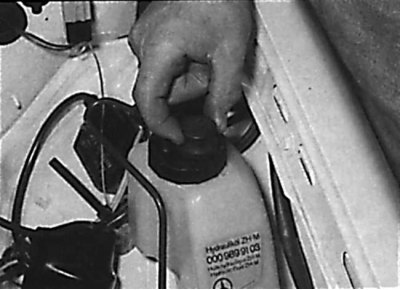
Rear self-leveling suspension fluid level
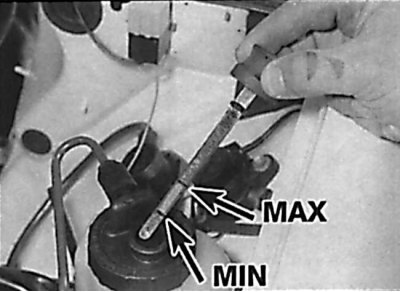
The fluid level in the self-leveling rear suspension system should be between the MIN and MAX marks on the dipstick.
Below is the procedure for performing work on models with a station wagon body.
1. Place the vehicle on a level surface and open the hood. Check the fluid level in the rear self-leveling suspension system on an unladen vehicle.
2. Remove the dipstick and wipe the fluid off the dipstick with a clean rag. Insert the clean dipstick into the reservoir and remove it again. Check the fluid level, which should be between the MAX and MIN marks on the dipstick (see fig. Removing the dipstick from the reservoir of the self-leveling rear suspension system, Fluid level in the self-leveling rear suspension system). If the fluid level is checked in a loaded vehicle, the fluid level may be below the MIN mark.
3. If necessary, add the required amount of the specified fluid through the dipstick hole.
Checking the oil level in an automatic transmission
Check the oil level in the automatic transmission with the transmission warmed up (oil temperature 80°C).
Removal the Automatic Transmission Oil Dipstick
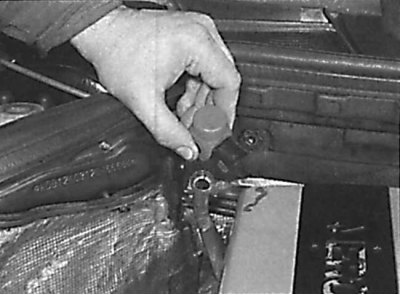
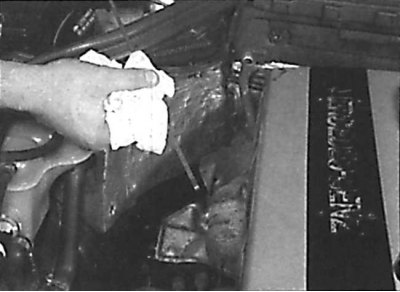
Using a rag to clean the automatic transmission oil dipstick
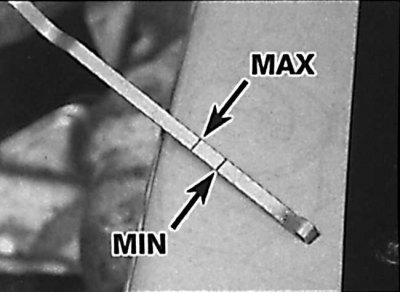
Location of marks on the dipstick for measuring the oil level in an automatic transmission
1. Place the vehicle on a level, horizontal surface.
2. Start the engine at idle speed and move the selector lever to position P and apply the handbrake.
3.Release the locking lever, remove the transmission oil dipstick, wipe it clean and reinstall it (see fig. Removing the automatic transmission oil dipstick, Using a rag to clean the automatic transmission oil dipstick).
4. Remove the oil dipstick and check that the oil level is between the MIN and MAX marks (see Fig. Location of marks on the dipstick for measuring the oil level in an automatic transmission).
5. If the oil level is below the MIN mark, add oil through the dipstick hole.
6. If there is a need to frequently top up the oil, then there is a leak that needs to be found and fixed before it leads to serious consequences.
Checking the tightness of the hoses and fluid leakage
1. Cooling system leaks are usually detected by a white or rust-colored coating in the area adjacent to the leak.
2. Carefully inspect the radiator and coolant hoses along their entire length. Replace any hoses that are cracked, torn, or showing signs of wear. Cracks are easier to spot if the hose is pinched. Pay particular attention to the clamps that attach the hoses to the cooling system components. Hose clamps that have been tightened too much can cause the hose to rupture or puncture, resulting in leaks in the cooling system. Inspect all hoses and hose connection surfaces for leaks. If any leaking problems of this nature are found, replace that component or gasket.
3. Fuel leaks are difficult to pinpoint until the leak is significant and therefore easily visible. Fuel tends to evaporate quickly once it comes into contact with air, especially in a hot engine bay. Small droplets may disappear before you can pinpoint the leak. If you suspect a fuel leak in the engine bay area, then cool the engine and run it while it is cold with the hood open. Metal objects tend to shrink when cold, and rubber hoses tend to loosen, so any leaks will be more obvious as the engine warms up from starting and being cold.
4. If there are signs that there is a leak of some kind of fluid, but you cannot identify the type of fluid or the exact source, then you should leave the car for a long time and put a large piece of paper or rag under the car. This will help to find the place of the leak and also help to identify the leaking fluid by color. But keep in mind that some leaks may only appear when the engine is running.
5. A leak in the vacuum hose means that air is being sucked into the hose (but it doesn't come out of the hose), and this makes the leak very difficult to detect. The detection method is to use an old vacuum hose as a kind of stethoscope. Hold one end of the hose close to your ear (but not in the ear), and use the other end to probe the area around the suspected leak. When the end of the hose is directly over the leak, a hissing sound will be clearly audible through the hose. Avoid contact with hot or moving parts, as the engine must be running when checking.
Checking and replacing the auxiliary drive belt
Examination
1. With the engine off, inspect the entire length of the accessory drive belt. Check the accessory belt pulleys for nicks, cracks, deformation, and corrosion.
Replacement
Installing the auxiliary drive belt on the idler pulley and crankshaft pulley
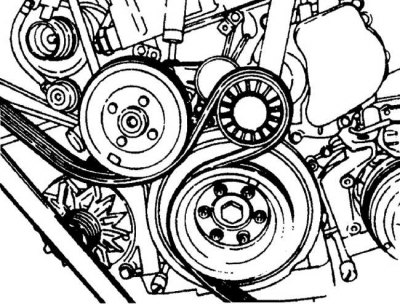
Elements of the auxiliary drive belt tensioning mechanism
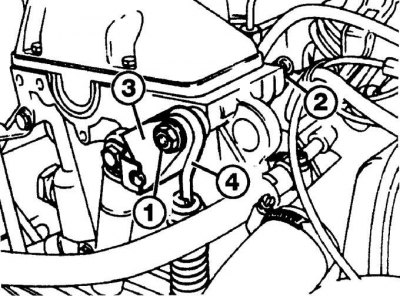
1 – tension mechanism lever mounting nut; 2 – tension mechanism lever mounting bolt; 3 – tension mechanism lever; 4 – tension mechanism lever spring
Moving the auxiliary drive belt between the water pump and crankshaft pulleys
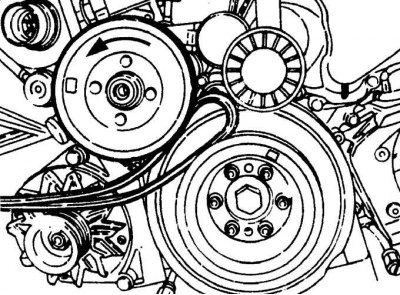
Installing the auxiliary drive belt into the pulley groove
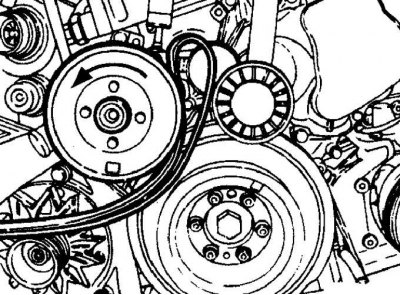
Auxiliary Drive Belt Location on Non-Air Conditioning Models
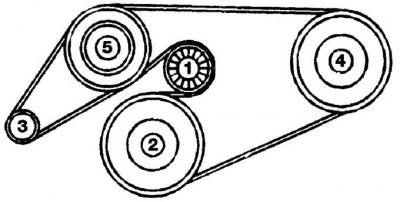
Sequence of installation of auxiliary drive belt on pulleys:
1 – tension mechanism pulley; 2 – crankshaft pulley; 3 – generator pulley; 4 – Power steering pump pulley; 5 – water pump pulley
Auxiliary Drive Belt Location on Models with Air Conditioning but Without Idler Pulley
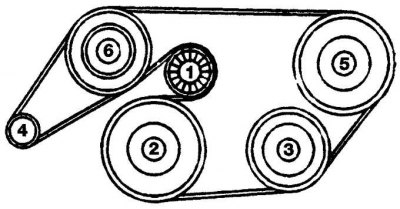
Sequence of installation of auxiliary drive belt on pulleys:
1 – tension mechanism pulley; 2 – crankshaft pulley; 3 – Air conditioning compressor pulley; 4 – generator pulley; 5 – Power steering pump pulley; 6 – water pump pulley
Auxiliary Drive Belt Location on Air Conditioning and Idler Pulley Models
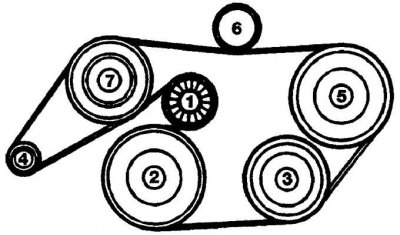
Sequence of installation of auxiliary drive belt on pulleys:
1 – tension mechanism pulley; 2 – crankshaft pulley; 3 – Air conditioning compressor pulley; 4 – generator pulley; 5 – Power steering pump pulley; 6 – idle pulley; 7 – water pump pulley
1. Remove the fan impeller and shroud.
2. Unscrew the nut securing the tension mechanism lever (see fig. Elements of the auxiliary drive belt tensioning mechanism).
3. Insert the lever (diameter 12 mm and length 300 mm) into the hole in the tensioner lever and press the lever counterclockwise until the lever bolt can be moved toward the intake manifold.
4. Turn the lever clockwise and remove the tension spring.
5. Move the idler pulley back and remove the accessory drive belt from the pulleys.
6. Install the new accessory drive belt as follows.
7. Raise the idler pulley slightly and hold it in this position during the following steps.
8. Compress the accessory drive belt into a loop and slide it between the water pump and crankshaft pulleys (see fig. Movement of auxiliary drive belt between water pump and crankshaft pulleys).
9. With your left hand, press the auxiliary drive belt into the groove of the water pump pulley and turn the water pump pulley counterclockwise and put the drive belt on the idler pulley (see Fig. Installing the auxiliary drive belt into the pulley groove).
10. Install the accessory drive belt onto the crankshaft pulley and then in the sequence shown in the illustrations Accessory Drive Belt Location on Non-Air Conditioning Models, Accessory Drive Belt Location on Air Conditioning Models but Without Idler Pulley, Accessory Drive Belt Location on Air Conditioning Models with Idler Pulley.
11. Release the idler pulley.
12. Press the tensioner lever and insert the lever mounting bolt.
13. Install the tension spring.
14. Secure the tensioner lever by screwing the nut onto the bolt and tightening it to the required torque.
15. Install the fan impeller and shroud.
Checking the air conditioning system
Location of the inspection window for checking the fluid level in the air conditioning system
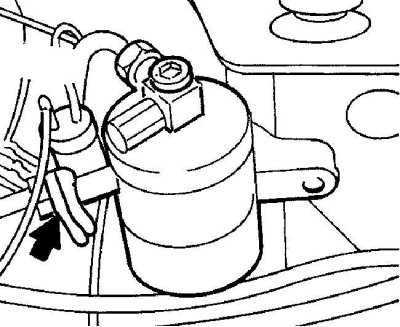
1. The air conditioning system pressure sensor is located on the side of the feed tank.
2. Turn off the ignition and disconnect the electrical connector from the top of the pressure sensor.
3. Start the engine at idle speed and turn on the air conditioning system on the instrument panel.
4. Wipe the viewing window located on the side of the feed tank (see picture).
5. Connect the electrical connector to the pressure sensor and observe the viewing window. This will activate the electromagnetic clutch and the refrigerant level in the viewing window should increase. The refrigerant visible in the viewing window should be free of air bubbles.
6. If the refrigerant level in the air conditioning system is too low or the pressure in the system is too low, the pressure sensor will prevent the air conditioning system from turning on. In this case, it is necessary to repair the air conditioning system in a specialized workshop.
Checking and adjusting idle speed
Examination
1. Check and, if necessary, adjust the accelerator cable (see subsection 9.8).
2. Start the engine and warm it up to normal operating temperature. Turn off all electrical consumers.
3. Using a diesel tachometer, check the idle speed.
Adjustment
Engines with pneumatic idle speed control
1. Loosen the lock nut on the top of the idle speed vacuum chamber, which is mounted to the rear of the fuel pump.
2. Turn the vacuum chamber with a wrench to set the desired idle speed. Tighten the lock nut.
Engines with ELR idle speed control
1. Disconnect the electrical connector from the solenoid actuator, which is attached to the back of the fuel pump.
2. The idle speed adjustment screw is located above the electromagnetic actuator housing. Loosen the lock nut and turn the adjusting screw to set the desired idle speed. Tighten the lock nut and connect the electrical connector.
Engines with EDS idle speed control
1. Disconnect the electrical connector from the solenoid actuator, which is attached to the back of the fuel pump.
2. The idle speed adjustment screw is located above the electromagnetic actuator housing. Loosen the lock nut and turn the adjusting screw to set the desired idle speed. Tighten the lock nut and connect the electrical connector.
3. The idle speed can also be changed by moving the jumper in a special socket.
4. The socket is located in the accessory compartment on the rear right side of the engine compartment.
5. To change the position of a jumper, remove it from the socket and install it in a new position, which is indicated by numbers 1 through 7 on the back of the socket.
6. Position No.1 corresponds to 600 rpm, and position No.7 corresponds to 700 rpm.
Checking the front suspension and steering
Checking the front wheel hub bearings for wear
1. Raise the front of the vehicle and support it securely on stands.
2. Visually inspect the ball joint dust boots and rack and pinion steering gear boots for cracks, wear, and aging. Any wear on these boots will result in loss of lubricant and entry of water and dirt, resulting in rapid wear of the ball joints or steering gear.
3. Check the power steering hoses for wear or deterioration, and the pipes and hose connections for leaks. Also check the steering gear boots for signs of pressure leakage, which indicates damage to the steering seal.
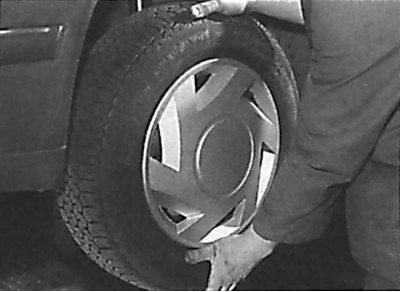
4. Raise the car with a jack, grab the wheel with your hands at the 6 and 12 o'clock positions and try to rock it in a vertical plane. A very small amount of play in the wheel is acceptable, but if the play is significant, further inspection is necessary to determine the source. Continue rocking the wheel while an assistant applies the foot brake. If the play is eliminated or significantly reduced, the hub bearings are likely damaged. If the play is still significant with the brake applied, there is wear in the suspension joint and mount (see picture).
5. Now take the wheel at the 9 and 3 o'clock positions and try to rock it horizontally. The presence of play in the horizontal plane can be caused by wear of the hub bearing or the ball joints of the steering rod. If the outer or inner ball joint is worn, the play will be obvious.
6. Using a large screwdriver as a lever, check for wear in the suspension mount bushings between the suspension component and the point of attachment. Some movement should be visible since the mount bushings are made of rubber, but excessive wear should be evident. Also check the condition of any visible portions of the rubber bushings for cracks, wear, and deformation.
Checking the shock absorber
Check the shock absorber for any signs of fluid leaks. If a leak is found, the shock absorber is damaged and needs to be replaced.
Attention! Shock absorbers must be replaced in pairs on one axle.
The effectiveness of the shock absorber is also checked by pressing on the corner of the body and releasing it sharply. The body should return to its original position after releasing it. If the body rises above the original position and continues to swing, then the shock absorber located on this side is probably out of order and must be replaced. Also check the shock absorber mount for wear.
Checking the drive shaft protective cover
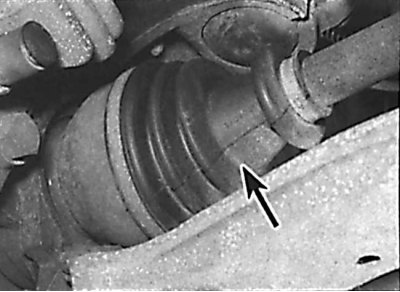
Checking the condition of the protective boot of the constant velocity joint of the drive shaft
1. Raise the rear of the vehicle and support it on stands.
2. While rotating the rear wheel, inspect the rubber boots of the constant velocity joints by squeezing them to open the folds. Check for cracks that could allow grease to leak out, or water and dirt to get in (see picture).
3. Also check the condition of the fastening clamps, inspect the inner hinge covers and the covers on the other side. If any damage is found, the protective cover must be replaced immediately.
4. At the same time, check the general condition of the constant velocity joints by holding the shaft and trying to turn the wheels. Try again by holding the inner constant velocity joint and turning the shaft. Any noticeable play indicates wear in the joint, wear in the shaft grooves, or looseness of the shaft lock nut.
Checking the front brake pads
1. Apply the handbrake, raise the front of the car and secure it on stands. Remove the front wheels.
2. Check the thickness of the brake pads through the inspection hole in the front of the caliper.
3. If the brake shoe lining is worn to the minimum thickness, all four brake shoes must be replaced as a set.
4. Install the wheels and lower the vehicle.
Checking the rear brake pads
1. Raise the rear of the car and secure it on stands. Remove the rear wheels.
2. Inspection of the brake pads can be done through the inspection hole in the top of the rear caliper. If the brake lining is worn to the minimum thickness, all brake pads must be replaced as a set.
3. Install the wheels and lower the vehicle.
Checking the exhaust system
1. With the engine cold, check the condition of the exhaust system along its entire length.
2. Check the pipes and their connections for leaks, corrosion and damage. Check that all brackets and suspension elements of the exhaust system are in good condition and evenly tensioned.
3. When moving the exhaust system of the car to the sides, make sure that it does not touch the car body. Otherwise, replace the rubber hangers of the exhaust system.
Checking the oil level in a manual transmission
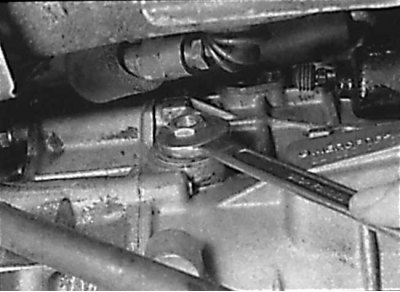
Unscrewing the oil level check plug in a manual transmission
1. Place the car horizontally over the inspection pit. Check the oil level no earlier than 5 minutes after stopping the engine.
2. Clean the area around the transmission oil level plug. The oil level plug is located on the front right side of the transmission. Unscrew the plug and clean it (see picture).
3. The oil level should reach the lower edge of the oil level plug hole.
4. If necessary, add oil to the gearbox through the oil level check plug hole.
5. Tighten the gearbox oil level check plug to the specified torque.
Checking the oil level in the main reverse gear
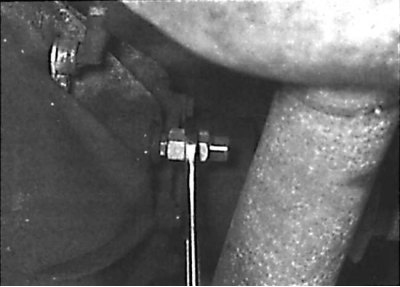
Unscrewing the plug for checking the oil level in the main reverse gear
1. Place the vehicle over an inspection pit or lift it on a lift.
2. Clean the area around the oil level check plug located on the left front side of the final drive. Remove the plug (see picture).
3. The oil level should reach the lower edge of the oil level check hole.
4. If necessary, add oil to the gearbox through the oil level check plug hole.
5. Screw the oil level check plug into the final drive and tighten it to the specified torque.
6. Lower the car.