Cars BMW Cars Volkswagen Cars Chevrolet Cars Land Rover Cars Lada Cars Honda Cars Peugeot
English Русский
Български
Беларускі
Український
Српски
Hrvatski
Română
Polski
Slovenský
Magyar
Bookmark News and articles Sitemap Feedback Site search
MercedesMan.ru


A-Class C-Class E-Class G-Class M-Class S-Class Others
W123 (1976-1985) W124 (1984-1995) W210 (1996-2002)
  • Main
  • E-Class
  • W123 (1976-1985)
  • Chassis
  • Rear suspension
  • Design and technical characteristics of the rear suspension

Design and technical characteristics of the rear suspension (Mercedes-Benz E-Class W123)

0
Contents: Suspension springs and upper support…↡ Shock absorbers ↡ Anti-roll bar ↡ Body height regulator ↡ Hydraulic pump ↡ Accumulation chambers ↡ Body position corrector ↡ Working fluid ↡ Rear wheel alignment angles ↡ Rear wheel hubs ↡ Tightening torques of main threaded…↡
The rear suspension is independent, with coil springs, diagonal arms, telescopic shock absorbers and an anti-roll bar.

Suspension springs and upper support cups


Depending on the model and configuration, cars are equipped with two types of springs in combination with three types of upper support cups of different thicknesses.

The spring is matched to the support cup at the factory and must be maintained throughout the entire service life to avoid deterioration of the vehicle's stability and controllability. When replacing a spring or support cup, be sure to install parts identical to the previous ones.

Suspension spring characteristics


Spring typeSpring numberWire diameter, mmDraft (P=100 kgf)Length (P=0 kgf)
1123.324.140415,9518,45355
2123.324.150414,9521,5337

Upper Spring Support Cup Characteristics


Letter indexCup numberThickness of the bottom of the support cup, mmNumber of protrusions around the circumference of the cup
a115.325.22449,51
b115.325.234414,02
c115.325.244419,03

Shock absorbers


The cars use gas-filled, oil-filled, single-tube, double-action shock absorbers. They are connected to the body and suspension arms.

Control parameters of rear shock absorbers


Shock absorber number

Color marking
Rod output, mm

Shock absorber type

new
acceptable

123.323.1700*

One white longitudinal stroke

0,0—2,0

32,0

Separating piston

123.323.6000

One white cross stroke

0,0

32,0

Without separating piston

123.323.0800

One white cross stroke

105,0—107,0

82,0


123.320.0413*

One white cross stroke

147,0—149,0

137,0


* Rarely encountered as a possible option.

Additional spring/shock absorber combination for various car models


Engine model

Spring No
Shock absorber no

Without level adjustment

"200"

—

—

"230"

123.324.1404

—

"250"

—

123.326.0600

"280", "280E"

—

123.326.0800

With level control

"200"

—

—

"230"

123.324.1504

—

"250"

—

123.320.04113

"280", "280E"

—

—


Anti-roll bar


Characteristic

Meaning

Stabilizer bar diameter, mm

  • cars with 4-cylinder petrol engine

13,0 (12,0)*

  • cars with 6-cylinder petrol engine

14,5 (13,0)*


* Data in brackets are for the coupe.

Body height regulator


The height adjustment device was installed on some models. It hydraulically adjusts the height of the rear suspension and consists of a hydraulic pump, a reservoir, two storage chambers and a body position corrector.

Hydraulic pump


The piston-type hydraulic pump is driven by a multi-groove auxiliary drive belt from the crankshaft.

Characteristic

Meaning

Working pressure at crankshaft speed of 900±100 min⁻¹, kgf/cm²

130

  • minimal

125

  • maximum

160

Feed at n=1500 min⁻¹, l/min

0,7

Broadcast (engine/pump)

0,667


Accumulation chambers


Each shock absorber receives working fluid from a separate storage chamber (pressure tank), in which the working fluid is under pressure, designed for its uniform and smooth supply to the shock absorbers.

Characteristic

Meaning

Valve opening pressure, kgf.cm²

  • nominal

21—25

  • minimal

15,0


Body position corrector


The body position corrector, installed between the hydraulic pump and the storage chambers on the transverse stabilizer, determines the amount of pressure of the working fluid entering the shock absorbers through the storage chambers in order to maintain a constant height of the rear of the body.


Characteristic

Meaning

Opening pressure of the discharge valve, kgf/cm²

30—36


Working fluid


Characteristic

Meaning

Filling capacity of the hydraulic system of the leveling system, l

3,5

Difference in fluid level between the "mini" and "maxi" marks on the dipstick, l

about 0.6

Liquid used

Aral Vitamol ZH-M or MB hydraulikol 000.989.9103

Frequency of checking oil with the engine running

every 20,000 km


Rear wheel alignment angles


Characteristic

Meaning

Collapse

from –0°20' to +0°20'

Toe-in 0.5 mm

0°20'—0°35'


Rear wheel hubs


The rear wheel hub is mounted on a sealed radial thrust ball bearing.

Characteristic

Meaning

Hub flange thickness, mm

10,00

Runout of the supporting surface of the brake disc, no more than, mm

0,02

  • in assembled condition

0,12


Tightening torques of main threaded connections, kgf·m


Connection type

Meaning

Lower shock absorber support

4,5

Fastening the anti-roll bar

  • with spring washers

1,9

  • without spring washers

3,0

Stabilizer connecting rod

  • metal

4,5

  • plastic

3,0

Body position control system struts

  • top mount

3,0

  • bottom mount

4,5

  • hose connection

1,9

  • ball joint

6,5

  • hollow screw of the accumulation chamber

4,2

Body position control system pump

1,2

Body position control system corrector

4,5

Front rear suspension mount

  • to the bottom of the body

3,0

  • to the rear axle

11,9

Wheel drive shaft bolt

3,0

Wheel mounting bolt

11,0


Rear axle


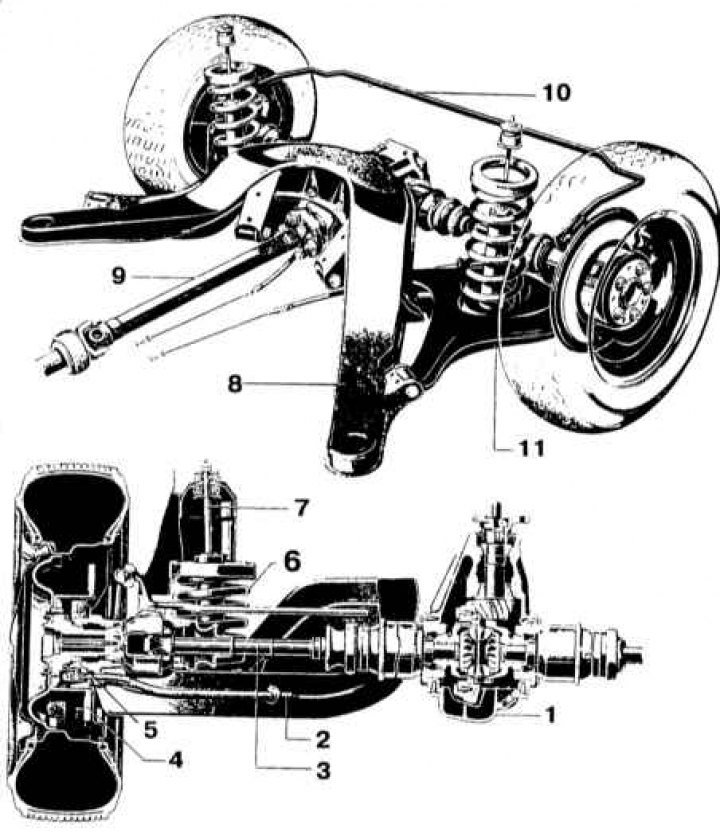
1 - main gear; 2 - parking brake cable; 3 - half shaft; 4 - brake disc; 5 - outer bearing; 6 -…

1 - main gear; 2 - parking brake cable; 3 - half shaft; 4 - brake disc; 5 - outer bearing; 6 - suspension spring; 7 - shock absorber; 8 - rear axle support beam; 9 - cardan shaft; 10 - stabilizer; 11 - diagonal lever
This article is available at: russian, bulgarian, belarusian, ukrainian, serbian, croatian, romanian, polish, slovak, hungarian
The article has been verified: Levin Kirill Glebovich
Share with friends:
◀ Previous
E-Class W123 / Rear suspension
Next ▶

 
Removal, inspection and installation of shock absorbers
Removal and installation the rear anti-roll bar
Removal and installation the rear suspension spring
Removal and installation the rear suspension assembly
Removal and installation the rear suspension diagonal arm
More similar articles for repairing other models

☛ Rear Suspension Trailing Arm Support Play — Check Mercedes W168 (1997-2004)
☛ Rear suspension design Mercedes W202 (1993-2000)
☛ General information about the rear suspension Mercedes W463 (1999-2019)
☛ Checking the condition of suspension and steering components Mercedes W163 (1997-2005)
☛ Rear suspension design of a car Mercedes W140 (1991-1998)
☛ Front and rear suspension — general information Mercedes Sprinter (1995-2000, diesel)
Link in different formats to this article
Comments and feedback from visitors
No comments yet


How much will 12 + 34 ?


W210 (1996-2002) 
  • General information
  • Vehicle description
  • Working conditions and tools
  • Car care
  • Diesel engines
  • Engine repair
  • Lubrication system
  • Cooling system
  • Injection system
  • Supply system
  • Exhaust system
  • Gasoline engines
  • Engine repair
  • Lubrication system
  • Cooling system
  • Control system
  • Power and exhaust system
  • Transmission
  • Clutch
  • Mechanical gearbox
  • Automatic gearbox
  • Drive shafts
  • Chassis
  • Car suspension
  • Steering
  • Tires and wheels
  • Brake system
  • Body
  • Exterior (external elements)
  • Interior (internal elements)
  • Doors and windows
  • Heating and ventilation
  • Electrical equipment
  • Equipment and devices
  • Power devices
  • Lighting and signaling
  • Electrical circuits
W124 (1984-1995) 
  • General information
  • Governing bodies
  • Driving and operation
  • Weekly care
  • Maintenance (gasoline)
  • Maintenance (diesel)
  • Troubleshooting
  • Power unit
  • I4 petrol engine
  • V6 petrol engine (SOHC)
  • V6 petrol engine (DOHC)
  • Diesel engines
  • Engine overhaul
  • Cooling system
  • Heating and ventilation
  • Fuel system (carburetor)
  • Injection system «Bosch CIS-E»
  • Injection system «Bosch HFM»
  • Diesel fuel system
  • Supply system
  • Starting and charging system
  • Ignition system (I4)
  • Ignition system (V6)
  • Preheating
  • Transmission
  • Clutch
  • Mechanical gearbox
  • Automatic gearbox
  • Drive shafts
  • Chassis
  • Brake system
  • Car suspension
  • Steering
  • Body
  • Exterior (external elements)
  • Interior (internal elements)
  • Doors, locks and windows
  • Electrical equipment
  • Equipment and devices
  • Switches
  • Headlights and lighting
  • Electrical circuits
W123 (1976-1985) 
  • General information
  • Introduction to the guide
  • Power unit
  • Engine device
  • Repair M102 engines
  • Repair M110 and M123 engines
  • Cooling and lubrication (M102)
  • Cooling (M110 and M123)
  • Ignition system
  • Power system «Stromberg»
  • Power system «Solex 4A1»
  • Fuel injection «K-Jetronic»
  • Fuel injection «L-Jetronic»
  • Transmission
  • Clutch
  • Mechanical gearbox
  • Automatic gearbox
  • Cardan and rear axle
  • Chassis
  • Front suspension
  • Rear suspension
  • Steering
  • Brake system
  • Body
  • Exterior (external elements)
  • Interior (internal elements)
  • Doors, locks and windows
  • Electrical equipment
  • Equipment and devices
  • Power devices
  • Electrical circuits
 
MercedesMan.ru © 2017–2026 · Mobile version · Read about Mercedes · Sitemap: EN BG BY UA RS HR RO PL SK HU · Feedback · Site search · Bookmark A-Class (W168) · C-Class (W201) · C-Class (W202) · C-Class (W203) · E-Class (W123) · E-Class (W124) · E-Class (W210) · G-Class (W463) · M-Class (W163) · S-Class (W116, petrol) · S-Class (W126, petrol) · S-Class (W140) · S-Class (W220) · Sprinter · Vito 1 · Vito 2 · Vario 814D ·
 
We only use cookies without which some of the site's features may not be available.