
Cars BMW Cars Volkswagen Cars Chevrolet Cars Land Rover Cars Lada Cars Honda Cars Peugeot
English Русский
Български
Беларускі
Український
Српски
Hrvatski
Română
Polski
Slovenský
Magyar
Bookmark News and articles Sitemap Feedback Site search
MercedesMan.ru


A-Class C-Class E-Class G-Class M-Class S-Class Others
190 (W201) (1982-1993) W202 (1993-2000) W203 (2000-2007)
  • Main
  • C-Class
  • W202 (1993-2000)
  • Power unit
  • Cooling system
  • Coolant (petrol engines)

Coolant (petrol engines) (Mercedes-Benz C-Class W202)

0
Contents: Drain ↡ Refueling ↡
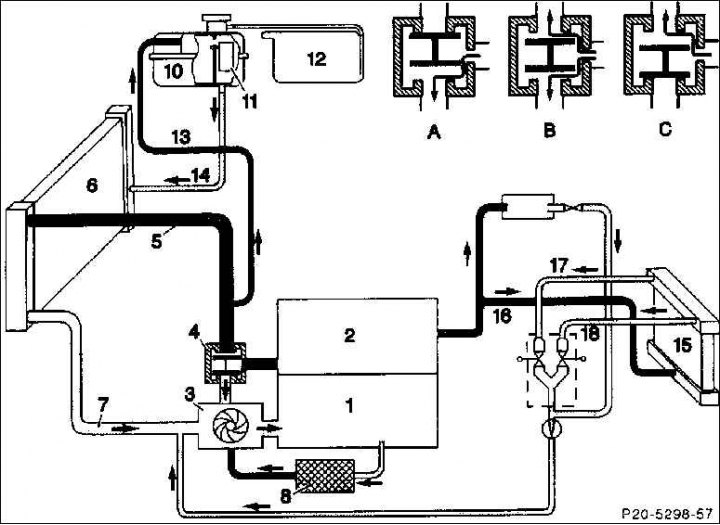
1. Engine cylinder block; 2. Cylinder head; 3. Liquid cooling system pump; 4. Coolant regulator…

1. Engine cylinder block; 2. Cylinder head; 3. Liquid cooling system pump; 4. Coolant regulator (thermostat); 5. Upper coolant pipe; 6. Radiator with horizontal coolant flow; 7. Lower coolant line; 8. Oil radiator; 10. Expansion tank; 11. Silicate stock for preventing corrosion of aluminum alloys; 12. Drain tank; 13. Air removal line; 14. Refueling line; 15. Heat exchanger of the heating system; 16. Heating supply; 17. Heating outlet on the right; 18. Heating outlet on the left; A – coolant circulation mode in a small circuit. The coolant circulates only in the engine when its temperature is below 87°C; B – mixed mode. When the coolant temperature is within 87–102°C, the coolant regulator is partially open. The coolant also flows through the radiator; C – cooling mode. When the coolant temperature is above 102°C, its regulator is fully open. All the coolant flows through the radiator


As part of maintenance, the coolant should be replaced every 3 years. If the cylinder head gasket, radiator, heat exchanger or engine were replaced during a cylinder head overhaul, the coolant should be replaced in each case. This is necessary because anti-corrosion decomposition products are deposited on new light alloy parts during the running-in period and form a durable anti-corrosion layer. Used coolant usually does not contain enough of these anti-corrosion decomposition products to form the necessary protective layer on new parts.


If coolant is drained as part of other repairs, reuse it.

Warning! The coolant is poisonous and should not be simply poured out or mixed with household waste, but must be drained into special places.


1. Disconnect the battery ground (–) cable.

Attention! This will erase the radio's anti-theft code.


2. Turn the cap on the expansion tank to the left until it locks in place and the excess pressure is released from the cooling system. Then turn the cap further and remove it completely.

Caution! If the engine is hot, place a thick cloth around the cap before removing it to avoid burns from hot coolant or its vapors. Remove the cap only when the coolant temperature is below 90°C.


3. Remove the lower engine compartment cover.
3. Remove the lower engine compartment cover.


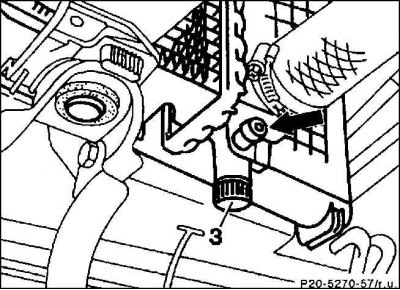
4. Attach a hose with an internal diameter of 12 mm to the radiator drain nipple (arrow).

5. Place a clean collecting vessel under the radiator. Insert the hose into the collecting vessel and open the drain plug (3).

Drain


Drain


[Article borrowed from the web portal: MercedesMAN.ru]


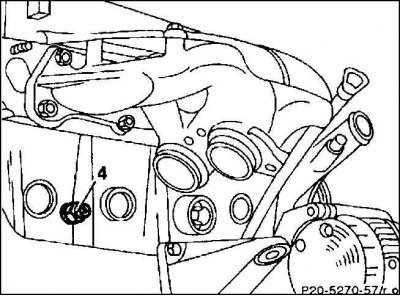
1. Attach a hose with an internal diameter of 12 mm to the drain plug (4) on the engine cylinder block.

2. Place a clean collecting vessel under the engine, insert the hose into it and only loosen the drain plug without unscrewing it completely.

3. Drain the coolant completely.

4. Tighten the drain plug on the engine block to 30 Nm.

5. Screw in the radiator drain plug with a torque of 1.5 to 2 Nm (by hand).

6. If fitted, remove the drain hose.

7. Install the lower engine compartment cover.

Refueling


1. Check the antifreeze content in the coolant.
1. Check the antifreeze content in the coolant.


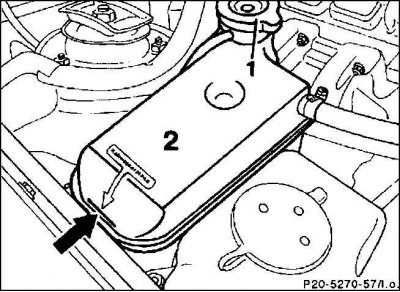
2. Fill the coolant up to the mark (arrow) through the filler pipe of the expansion tank (2). For cars without a separate expansion tank - up to the mark in the filler pipe, in the case of a black upper part of the tank - up to the beginning of the black part.

3. Connect the ground wire to the battery.

4. Let the engine warm up at idle speed until the coolant thermostat opens (coolant temperature is about 100°C). At the same time, set the heating to full power and press the accelerator pedal jerkily.

Caution! When the coolant temperature is between 60 and 70°C, close the expansion tank.


5. Check the tightness of the cooling system hose connections, as well as the threaded drain plugs and the liquid cooling system pump.

6. Set the time on the clock.

7. Enter the radio anti-theft code.
This article is available at: russian, bulgarian, belarusian, ukrainian, serbian, croatian, romanian, polish, slovak, hungarian
The article has been verified: Khromov Roman Mikhailovich
Share with friends:
◀ Previous
C-Class W202 / Cooling system
Next ▶

Coolant circulation circuit
Coolant (diesel engines)
Coolant (cars with air conditioning)
Antifreeze for radiator
Coolant thermostat (thermostat)
Checking the cooling system
More similar articles for repairing other models

☛ Coolant — Checking the Level Mercedes W168 (1997-2004)
☛ Petrol engines — general information Mercedes W210 (1996-2002)
☛ ME-SFI control system for petrol engines 112.945 and 113.962 Mercedes W463 (1999-2019)
☛ Removal and installation knock sensors (KS) — petrol engines Mercedes W163 (1997-2005)
☛ Checking the functioning of the cooling system and frost resistance… Mercedes W140 (1991-1998)
☛ Technical characteristics of petrol engines 111.948 and 111.978 Mercedes Vito 1 (1996-2003)
Link in different formats to this article
Comments and feedback from visitors
No comments yet


How much will 22 + 18 ?


W203 (2000-2007) 
  • General information
  • Introduction to guide
  • User manual
  • Maintenance
  • Power unit
  • Gasoline engines
  • Diesel engines
  • Cooling system
  • Ventilation and heating
  • Supply system
  • Injection system (gasoline)
  • Injection system (diesel)
  • Exhaust system
  • Ignition and control system
  • Charge and launch systems
  • Transmission
  • Mechanical gearbox
  • Automatic gearbox
  • Clutch and drive shafts
  • Differential
  • Chassis
  • Brake system
  • Car suspension
  • Steering
  • Body
  • Exterior (external elements)
  • Interior (internal elements)
  • Electrical equipment
  • Equipment and devices
  • Lighting system
  • Electrical diagrams (2000)
  • Electrical diagrams (since 2001)
W202 (1993-2000) 
  • General information
  • User manual
  • Driving a car
  • Car care
  • Maintenance
  • Power unit
  • Gasoline engines
  • Diesel engines
  • Lubrication system
  • Cooling system
  • Heating and ventilation
  • Ignition system
  • Fuel system
  • Injection system (gasoline)
  • Injection system (diesel)
  • Exhaust system
  • Transmission
  • Clutch
  • Car gearbox
  • Chassis
  • Suspension, wheels and tires
  • Steering
  • Brake system
  • Body
  • Exterior (external elements)
  • Interior (internal elements)
  • Doors and windows
  • Electrical equipment
  • Equipment and devices
  • Power devices
  • Lighting system
  • Electrical circuits
190 (W201) (1982-1993) 
  • General information
  • Introduction to the guide
  • Operation and care
  • Maintenance (gasoline)
  • Maintenance (diesel)
  • Troubleshooting
  • Power unit
  • Petrol engine I4
  • Petrol engine V6
  • Diesel engines
  • Engine overhaul
  • Cooling and heating
  • Power system (carburetor)
  • Injection system (gasoline)
  • Injection system (diesel)
  • Exhaust system
  • Charge and start system
  • Ignition system (I4)
  • Ignition system (V6)
  • Diesel heating system
  • Transmission
  • Clutch
  • Mechanical gearbox
  • Automatic gearbox
  • Cardan shaft and axle shafts
  • Chassis
  • Brake system
  • Car suspension
  • Steering
  • Body
  • Exterior (external elements)
  • Interior (internal elements)
  • Doors, locks and windows
  • Electrical equipment
  • Equipment and devices
  • Electrical circuits
 
MercedesMan.ru © 2017–2026 · Mobile version · Read about Mercedes · Sitemap: EN BG BY UA RS HR RO PL SK HU · Feedback · Site search · Bookmark A-Class (W168) · C-Class (W201) · C-Class (W202) · C-Class (W203) · E-Class (W123) · E-Class (W124) · E-Class (W210) · G-Class (W463) · M-Class (W163) · S-Class (W116, petrol) · S-Class (W126, petrol) · S-Class (W140) · S-Class (W220) · Sprinter · Vito 1 · Vito 2 · Vario 814D ·
 
We only use cookies without which some of the site's features may not be available.