



- prolonged vibrations of the body caused by unevenness of the road;
- body rocking on two successive bumps in the road;
- wheel bounce on normal road;
- car jerk when braking (may be caused by other reasons);
- lack of road holding on turns, skidding;
- loud knocks;
- increased tire wear with bald spots on the tread.
The shock absorber can be checked by hand. However, an accurate determination of the degree of wear is only possible with the help of devices: a rod tester (the shock absorber cannot be removed) or shock absorber testing machine.
Checking the shock absorber by hand
1. Remove the shock absorber.
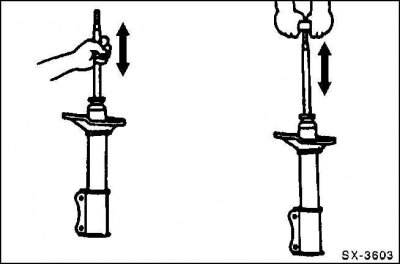
2. When assembled, stretch and compress the shock absorber 3 times. During the entire stroke, the shock absorber should move evenly, heavily, without jerks, and also without unwanted noise.
3. Push the shock absorber piston rod all the way in, then release it. The piston rod should move outward at a uniform speed.
4. If the shock absorber is working properly, minor traces of oil are not a reason to replace it.
5. Replace the shock absorber if there is a large amount of oil loss.
6. Install the shock absorber.
Disposal of shock absorbers
Attention! The shock absorber contains mineral oil, and, for example, in Germany, according to the waste law, its contents are handed in together with the engine oil.
[Publication taken from an online resource: MercedesMAN]
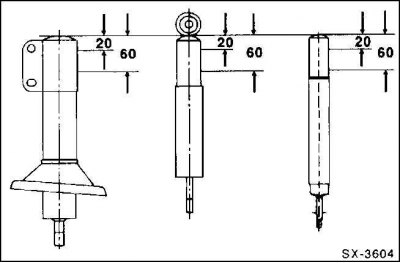
1. To drain the oil from the shock absorber, you should first release a non-toxic, colorless, odorless gas from it by drilling a hole with a diameter of 3 mm at a distance of 20 mm from the base.
2. To drain the oil, drill a 5mm diameter hole 60mm from the base.